Is Direct Admission Possible in Private BAMS Colleges in Delhi?
Home / BAMS / Is Direct Admission Possible in Private BAMS Colleges in Delhi?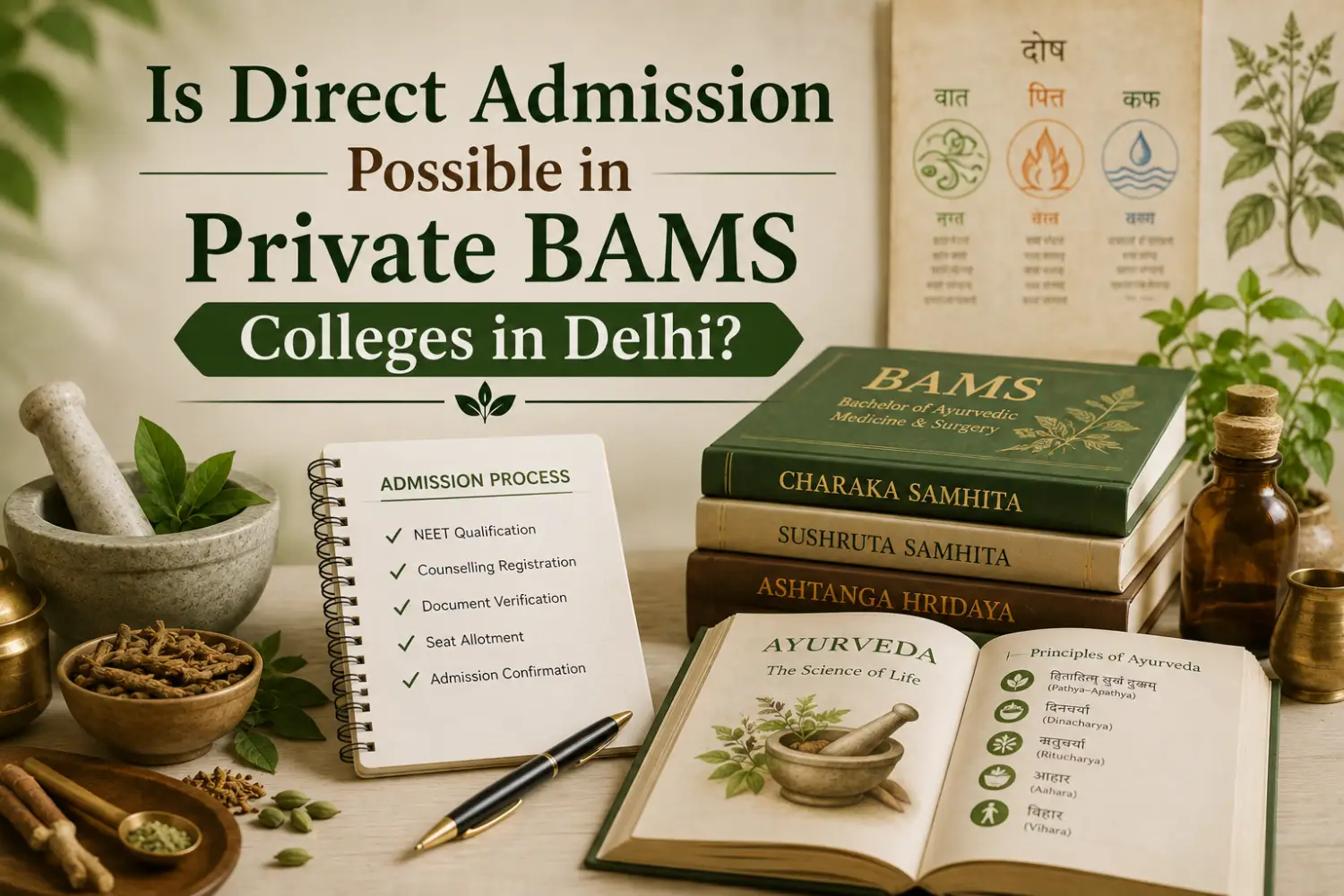
No. Direct admission is not possible, and there are two separate reasons for that. There are no private BAMS colleges in Delhi at all. The city has only two government Ayurveda colleges. On top of that, NEET UG has been compulsory for every BAMS seat in India since 2017, so no college anywhere can admit a student outside counselling. Students searching for Delhi options should look at the wider Delhi NCR belt in Uttar Pradesh.
Why This Question Comes Up Every Admission Season
Every year, once NEET results are out, the same phone calls start. A student has qualified but the score is low. A neighbour mentions an agent. The agent promises a seat in an Ayurveda college in Delhi, no counselling needed, just pay and join.
Many parents and students still believe that money can buy a medical seat. The situation has changed considerably over the last few years. NEET closed that door in 2017, and the rules have only tightened since. Families who hand over lakhs to an agent often find out much later that the admission was never valid.
This blog gives the plain facts about private BAMS colleges in Delhi, about what direct admission really means, and about the legal route that does work. It also covers eligibility, documents and fees, so a Class 12 student can plan the year properly instead of chasing a promise that does not exist.
Are There Any Private BAMS Colleges in Delhi at All?
No. According to the National Commission for Indian System of Medicine, Delhi has zero private BAMS colleges. The National Capital Territory has only two government Ayurveda colleges offering the BAMS programme, and both are run under the Government of NCT of Delhi.
Not everyone is aware of this. Search results are full of pages listing Delhi Ayurveda colleges, but a closer look shows most of those lists quietly mix in colleges from Ghaziabad, Noida, Gurugram, Sonipat and Rohtak. Those are Delhi NCR, not Delhi.
Table 1: Ayurveda Colleges Offering BAMS in Delhi
| Institution | Ownership | Counselling authority for state quota |
|---|---|---|
| Ayurvedic and Unani Tibbia College and Hospital, Karol Bagh | Government of NCT of Delhi | Faculty of Ayurvedic and Unani Medicine, University of Delhi |
| Chaudhary Brahm Prakash Ayurved Charak Sansthan, Khera Dabar, Najafgarh | Government of NCT of Delhi | Guru Gobind Singh Indraprastha University |
| Any private BAMS college | None on record | Not applicable |
Source: NCISM college listings, the Delhi Directorate of AYUSH and Delhi AYUSH counselling notifications. Between them the two colleges carry roughly 140 to 200 BAMS seats, depending on the listing consulted. The 15 per cent All India Quota in both is handled by AACCC.
Is Direct Admission Possible in Private BAMS Colleges in Delhi Without NEET?
No. NEET UG is compulsory for every BAMS seat in India. That has been the position since 2017 under the rules of NCISM, formerly the CCIM, and the Supreme Court has upheld NEET as the single entrance test for all undergraduate medical admissions.
This applies to government seats, private seats, deemed university seats, management quota seats and NRI quota seats alike. There is no exception hidden anywhere. It is quite common to hear otherwise, so the table below sets the claims against the actual rule.
Table 2: What Students Are Told Against What the Rule Says
| What agents and forums claim | What the rule actually says |
|---|---|
| A student can join BAMS without NEET | NEET UG has been compulsory for every BAMS seat since 2017 under NCISM rules |
| Management quota means no entrance test | Management seats still need a qualified NEET score. Only the closing cut-off is lower, and the fee is higher |
| NRI quota lets a student skip NEET | NRI seats also need NEET qualification and are allotted through counselling |
| Pay the college directly and join the class | Every seat must be allotted through official counselling. Offline admissions can be cancelled later, even mid-course |
| A Delhi private Ayurveda college still has vacant seats | Delhi has no private BAMS college, so there is no such seat to fill |
Source: NCISM regulations, Supreme Court rulings upholding NEET as the single entrance test, and the NTA NEET UG 2026 Information Bulletin.
What Does Direct Admission Actually Mean Then?
In practice the phrase is used loosely for management quota and NRI quota seats. Those seats are real. They carry lower closing scores and much higher fees. What they do not carry is freedom from NEET or from counselling.
One question that often comes up is whether an admission taken outside counselling can be regularised later. It cannot. A seat filled outside the official process can be cancelled at any stage, the fee is rarely recovered, and the college itself risks losing its NCISM permission.
How Can a Family Spot an Admission Scam?
- Any promise of a seat without a NEET scorecard is false, whatever the quota is called.
- Any request to pay the college or an agent in cash, outside the counselling portal, is a warning sign.
- Any offer that skips choice filling, seat allotment and document verification is not a real admission.
- Any college named in Delhi as a private Ayurveda college does not exist on the NCISM list.
- Any agent who discourages a family from checking the college on ncismindia.org is hiding something.
Eligibility Criteria To Study BAMS In India 2026-27
The eligibility rules are the same across the country, whether a student applies in Delhi, Uttar Pradesh or anywhere else. They are set by NCISM and by the NTA NEET UG bulletin.
Table 3: BAMS Eligibility for the 2026-27 Session
| Requirement | Detail |
|---|---|
| Academic qualification | Pass in 10+2 with Physics, Chemistry, Biology and English from a recognised board |
| Minimum marks | 50 per cent aggregate in PCB for General and EWS, 40 per cent for OBC, SC and ST, 45 per cent for General-PwD |
| Entrance examination | NEET UG, compulsory for every seat including management and NRI quota |
| Qualifying percentile | 50th for General and EWS, 40th for OBC, SC and ST, 45th for General-PwD |
| NEET UG 2026 qualifying marks | 75 to 213 for General and EWS, 212 to 177 for OBC, SC and ST |
| Minimum age | 17 years as on 31 December of the admission year |
| Upper age limit | None for NEET UG |
| Nationality | Indian nationals, NRI, OCI, PIO and foreign nationals, subject to counselling rules |
| Course length | 5.5 years, being 4.5 years of study and one year of compulsory rotating internship |
Source: NTA NEET UG 2026 Information Bulletin and NCISM undergraduate Ayurveda eligibility norms.
Documents Required To Get Admission In Top BAMS Colleges In India 2026-27
Counselling moves fast, and most seats are lost to missing paperwork rather than to low scores. Families should keep the full set ready before registration opens, along with five or six self-attested photocopies of each document.
- Academic records: Class 10 marksheet and passing certificate, plus the Class 12 marksheet and certificate showing Physics, Chemistry and Biology.
- Entrance records: NEET UG 2026 admit card and the NEET UG 2026 scorecard.
- Identity and residence: Aadhaar card or another valid photo identity, and the domicile or residence certificate needed for state quota seats. For the Delhi state quota there is no traditional domicile certificate. A student has to show that Class 11 and Class 12 were completed in a school inside Delhi.
- Category papers, where they apply: caste certificate for SC, ST or OBC, an OBC non-creamy-layer certificate valid for the current year, an EWS certificate, or a PwD certificate from an authorised medical board.
- Counselling papers: registration and fee payment receipts, and the seat allotment letter issued after each round.
- Other papers: recent passport-size photographs, a character certificate from the last institution attended, a migration or transfer certificate, and a medical fitness certificate.
Why Is India the Best Country to Study the BAMS Course?
Because Ayurveda is Indian by origin, and because India is the only country that regulates it as a full medical system with its own commission, its own hospitals and its own government service posts.
A closer look at the sector shows how far it has come. A BAMS graduate in India registers with a state board and practises as a doctor. No other country offers that combination of a recognised clinical degree, a patient base and a public health system built around the subject.
Table 4: What Backs a BAMS Degree in India
| Indicator | Figure |
|---|---|
| AYUSH market size in 2014 | USD 2.85 billion |
| AYUSH market size in 2023 | USD 43.4 billion |
| Registered AYUSH practitioners in India | Over 7,55,780 |
AYUSH undergraduate colleges |
886 |
| AYUSH hospitals and dispensaries | 3,859 hospitals and 37,385 dispensaries |
| AYUSH Health and Wellness Centres | 8,168 |
| Countries that recognise Ayurveda as a system of medicine | Above 30 |
| WHO Global Traditional Medicine Centre | Set up at Jamnagar, Gujarat, the first anywhere in the world |
Source: Ministry of Ayush figures released through the Press Information Bureau and the Invest India AYUSH sector page.
What Do Private BAMS Colleges in Delhi Fees Look Like Across the NCR Belt?
There is no such figure to quote, because the colleges do not exist. The useful comparison is the fee band across the colleges a Delhi student can actually reach. Government seats are cheap and very hard to get. Private seats cost far more but are open to a much wider score range.
Table 5: Indicative BAMS Fee Bands Around Delhi and Delhi NCR
| Type of seat | Where it exists | Indicative tuition per year |
|---|---|---|
| Government Ayurveda college | Delhi NCT, two colleges only | About Rs 2,385 to Rs 69,000 |
| Government Ayurveda college | Uttar Pradesh | About Rs 20,000 to Rs 75,000 |
| Private Ayurveda college, general merit seat | Uttar Pradesh and the wider NCR belt | About Rs 1.5 lakh to Rs 3 lakh |
| Private Ayurveda college, management quota seat | Across India | About Rs 2 lakh to Rs 8 lakh |
| Counselling charges in Uttar Pradesh | UP AYUSH counselling portal |
Rs 2,000 registration plus Rs 50,000 refundable security for private colleges |
Source: Delhi and Uttar Pradesh AYUSH counselling notifications, Collegedunia fee listings and AYUSH admission portals. Private fees are re-approved every year by the state fee authority, so families should confirm the current approved notification for the specific college before paying anything.
Which Are the Top BAMS Colleges in Uttar Pradesh?
This is where a Delhi student should be looking. Uttar Pradesh runs one of the biggest Ayurveda seat pools in the country, with 82 BAMS colleges holding 6,213 seats. Around nine are government colleges, so private colleges carry the large majority of the seats. Several of them sit inside the Delhi NCR belt, within a short drive of the capital.
There is no official ranked list of these colleges. NCISM permits colleges but does not rank them, and NIRF has no Ayurveda category. So a family has to judge on facts it can verify: current NCISM permission, the affiliating university, the size of the attached hospital, daily OPD numbers, the number of departments and the strength of the teaching staff.
Why Choose DJ Ayurvedic Medical College and Hospital?
Divya Jyoti Ayurvedic Medical College and Hospital is on the DJ Group campus at Niwari Road, Modinagar, in Ghaziabad district. Modinagar sits on the Delhi NCR corridor, which puts the campus within reach of families in Delhi, Ghaziabad, Noida and Meerut. For a Delhi applicant, this is the closest a Delhi applicant will get to a private Ayurveda college with a hospital of its own.
The college is approved by NCISM and affiliated to Mahayogi Guru Gorakhnath AYUSH University. Its NCISM intake disclosure lists 100 sanctioned BAMS seats. The hospital opened in 2012 and the college followed in 2017, so teaching was built around a hospital that was already running.
- Ranked first in UP AYUSH counselling for two years running, in 2023 and 2024, as stated by the college.
- One hundred sanctioned BAMS seats, listed in the published intake capacity disclosure.
- A teaching hospital with over 100 beds, running full OPD and IPD services on the same campus.
- Around 200 patients in the OPD daily, which gives students real cases from the early years.
- Fourteen specialised departments and over 10 specialised clinics, covering skin, joint and paediatric care.
- A Panchakarma centre with over 10 therapy rooms and eight certified therapists.
- Over 110 teaching faculty members handling academic and clinical mentoring.
- Over 500 graduates working in hospitals, wellness centres and research bodies, including Yashoda Hospital, Felix Hospital, Patanjali, Sri Sri Tattva and IMS BHU.
- Research published in peer-reviewed journals such as Annals of Ayurvedic Medicine and Aryavaidyan, backed by a dedicated research and entrepreneurship development cell.
- Study visits to the All India Institute of Ayurveda, New Delhi and to PCIM and H.
- A herbal garden, working laboratories, a digital library and a learning management system.
- Over 10 free medical camps a year, serving above 5,000 people in nearby communities.
Conclusion
The honest answer to the question in the title is short. Direct admission is not possible in private BAMS colleges in Delhi, because no such college exists and because no BAMS seat anywhere in India can be filled without NEET and counselling.
That is not bad news. It means the process is the same for everybody, and it can be planned. A student who qualifies NEET, registers on the correct portal, keeps the documents ready and fills choices sensibly has a real path into an Ayurveda college. The families who lose money are the ones who look for a shortcut instead.
It would not be wrong to say that the best thing a Delhi family can do this season is stop searching for a college that is not there, and start comparing the colleges that are, just across the border in the NCR belt.
Frequently Asked Questions
No, on two counts. Delhi has no private BAMS colleges at all, only two government Ayurveda colleges. And NEET UG plus official counselling is compulsory for every BAMS seat in India, so direct admission is not legally possible anywhere, in any quota.
None. As per NCISM records, Delhi has zero private BAMS colleges. The city has two government Ayurveda colleges, the Ayurvedic and Unani Tibbia College in Karol Bagh and Chaudhary Brahm Prakash Ayurved Charak Sansthan in Najafgarh, carrying roughly 140 to 200 seats between them.
No. NEET UG has been compulsory for all BAMS admissions since 2017 under NCISM rules, and the Supreme Court has upheld NEET as the single entrance test for undergraduate medical courses. Any agent promising a seat without NEET is making a false claim.
Management quota seats are legal and exist in private colleges. They carry lower closing scores and higher fees. They do not remove the NEET requirement or the counselling requirement. A student must still hold a qualifying NEET score and must still be allotted the seat through counselling.
Two bodies handle the state quota. The Faculty of Ayurvedic and Unani Medicine at the University of Delhi counsels for Tibbia College, while Guru Gobind Singh Indraprastha University counsels for CBPACS. The 15 per cent All India Quota in both is handled by AACCC at aaccc.gov.in.
There is no such fee, because Delhi has no private BAMS college. Delhi government Ayurveda colleges charge roughly Rs 2,385 to Rs 69,000 a year. Private colleges in the surrounding NCR belt in Uttar Pradesh charge about Rs 1.5 lakh to Rs 3 lakh a year on general merit seats.
In the Delhi NCR belt outside the city limits. Uttar Pradesh holds 82 BAMS colleges with 6,213 seats, and several sit in Ghaziabad and the districts near Delhi. Haryana districts such as Sonipat and Rohtak also have Ayurveda colleges within commuting distance.
Class 10 and Class 12 marksheets and certificates, the NEET UG admit card and scorecard, a photo identity, a domicile or residence proof for state quota, category certificates where they apply, counselling receipts, the allotment letter, photographs, a character certificate and a medical fitness certificate.
The admission is invalid. It can be cancelled at any stage of the course, the money paid is rarely recovered, and the student loses the academic year. The college itself risks action from NCISM. This is why every seat must be traced back to an official allotment letter.
General and EWS candidates need 50 per cent aggregate in Physics, Chemistry and Biology. OBC, SC and ST candidates need 40 per cent, and General-PwD candidates need 45 per cent. English must have been studied as a subject. A qualifying NEET UG score is required in every case.
Related Blogs
NEET UG 2026 and Your Path to a Bachelor Degree in Ayurvedic Medicine: Everything You Need to Know
So, you’ve decided to heal people the way your ancestors did — using nature, science,…
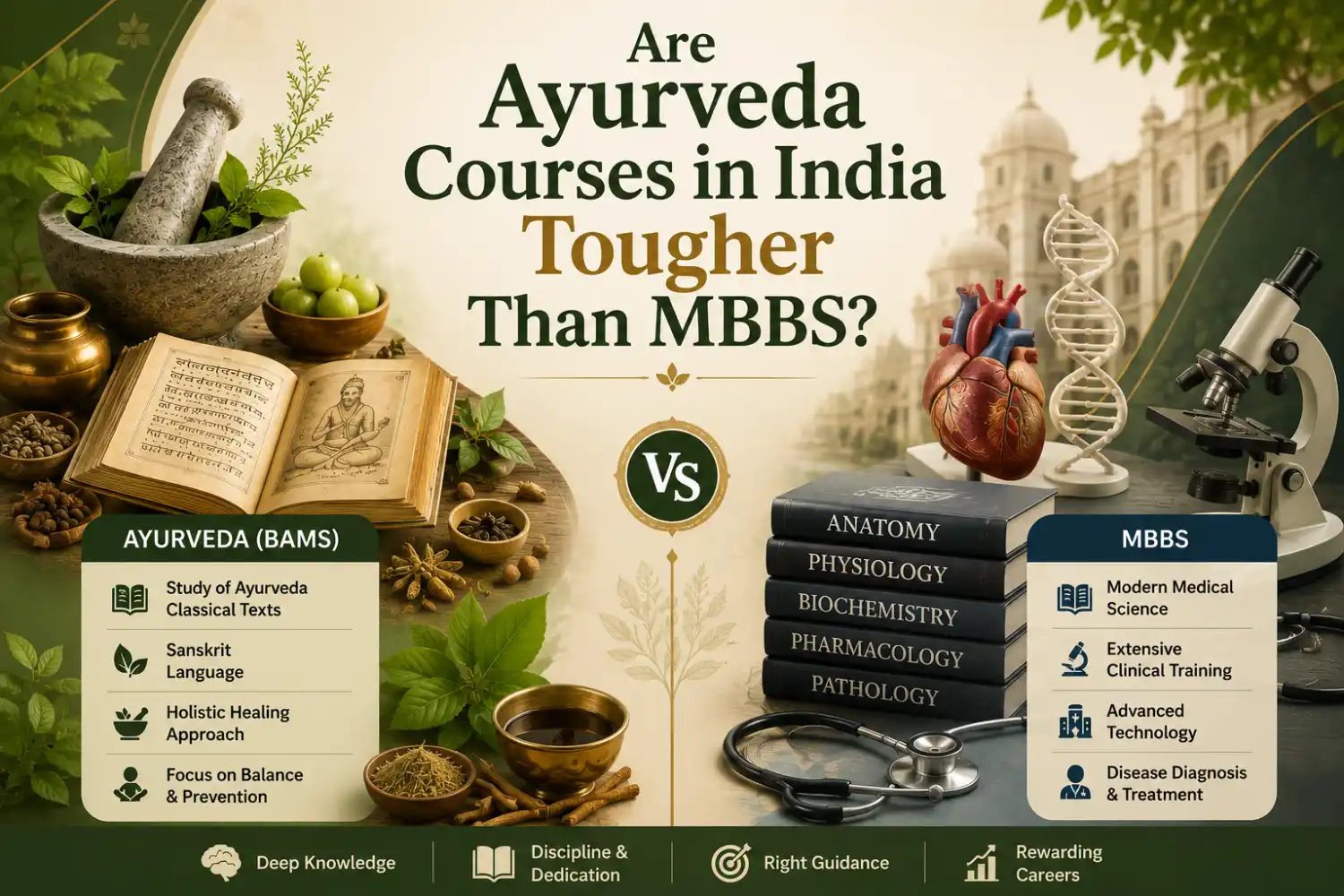
Are Ayurveda Courses in India Tougher Than MBBS?
Ayurveda courses in India are not easier than MBBS. They are difficult in a different…
Panchakarma for Weight Loss: Does It Really Work?
INTRODUCTION Current health statistics indicate that obesity affects nearly 5% of India’s population, a figure…
Can You Put ‘Dr’ After Studying at an Ayurveda Institute in Delhi?
Yes, but only if the course is a full BAMS degree. A graduate of an…
Sinusitis Cure in Ayurveda: Shalakya Tantra Guide
INTRODUCTION Current healthcare data suggests that chronic sinusitis impacts over 30 million individuals annually, creating…
The Tridosha Theory: How Vata, Pitta and Kapha Govern the Body
The Tridosha theory is the foundation of Ayurvedic physiology. It holds that three functional energies,…