Are Ayurveda Courses in India Tougher Than MBBS?
Home / BAMS / Are Ayurveda Courses in India Tougher Than MBBS?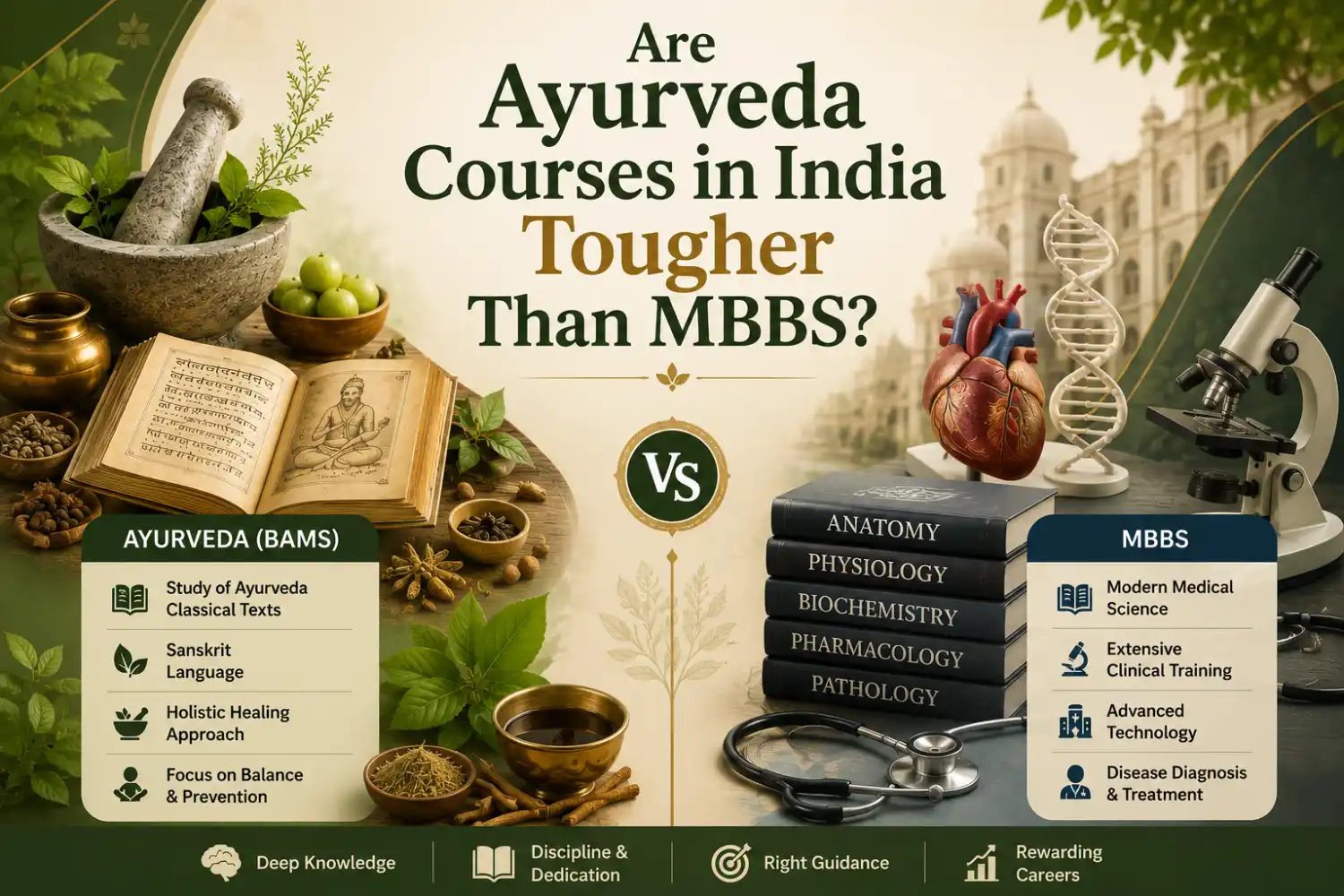
Ayurveda courses in India are not easier than MBBS. They are difficult in a different way. BAMS and MBBS both run for 5.5 years and both need a NEET UG score. MBBS is harder to enter, because seats close at far higher marks. BAMS carries the heavier reading load, because students learn modern medical science and classical Sanskrit texts together.
Introduction
One question comes up in almost every counselling season. Is Ayurveda the softer route for a student who misses an MBBS seat? Parents ask it openly. Students ask it quietly.
The answer surprises most families. Ayurveda courses in India are not a light option. A BAMS student stands in a dissection hall, learns physiology and pathology, then sits down with Sanskrit verses written thousands of years ago. An MBBS student never carries that second load.
The numbers explain why the question keeps returning. Close to 20 lakh candidates appeared for NEET UG 2026 and 11.21 lakh qualified. India has 1,36,939 MBBS seats for the 2026-27 session. Lakhs of qualified students therefore look towards Ayurveda, Homoeopathy and Unani every year. Many walk in expecting an easy course. Very few say the same thing after the first professional examination.
This article compares both courses on the points that actually decide difficulty: entry, length, subjects, language, hospital training and life after the degree.
What Do Ayurveda Courses in India Cover?
In short, ayurveda courses in India teach two medical systems at the same time. BAMS, or Bachelor of Ayurvedic Medicine and Surgery, is the main Ayurveda degree at undergraduate level. The National Commission for Indian System of Medicine (NCISM) sets its syllabus. The course runs 5.5 years, made up of 4.5 years of teaching and one year of compulsory rotating internship. MBBS follows the same pattern under the National Medical Commission (NMC).
| Point of comparison |
BAMS (Ayurveda) | MBBS (Modern medicine) |
|---|---|---|
| Regulator | NCISM |
NMC |
| Total duration | 5.5 years (4.5 + 1 year internship) | 5.5 years (4.5 + 1 year internship) |
| Academic stages | Three professional sessions of about 18 months each | Phase I, Phase II and Phase III Part I of 12 months each, plus Phase III Part II of 18 months |
| Core subjects | About 20 subjects, plus a minimum of nine electives | 19 subjects |
| Language of study | English and Sanskrit | English |
| Entrance test | NEET UG | NEET UG |
| Maximum time allowed | Ten years from the date of admission | Ten years from the date of admission |
Table 1. Sources: NCISM BAMS curriculum documents; NMC Competency Based Medical Education (CBME) Curriculum 2024.
The two degrees look almost identical on paper. The difference sits inside the syllabus.
Read More: Panchamahabhuta: The Five Elements Behind Ayurvedic Medicine
Is the Study Load Heavier in BAMS or MBBS?
In pure reading volume, BAMS is heavier. Students who ask whether ayurveda courses in India are lighter usually mean fewer hours of study. The syllabus says otherwise. An MBBS student covers 19 subjects across three phases, as listed in the NMC CBME Curriculum 2024. A BAMS student covers around 20 core subjects across three professional sessions and must also clear at least nine elective subjects.
| Stage | BAMS subjects (NCISM) | MBBS subjects (NMC) |
|---|---|---|
| First stage | Sanskrit and History of Ayurveda, Padartha Vijnana, Rachana Sharira (anatomy), Kriya Sharira (physiology), Samhita Adhyayan 1 | Anatomy, Physiology, Biochemistry, Introduction to Community Medicine, Humanities, AETCOM module |
| Second stage | Dravyaguna Vigyan, Rasashastra evam Bhaishajya Kalpana, Roga Nidan evam Vikriti Vigyan, Agadtantra evam Vidhi Vaidyaka, Swasthavritta evam Yoga, Samhita Adhyayan 2 | Pathology, Pharmacology, Microbiology, Forensic Medicine, Community Medicine, first clinical postings |
| Third stage | Kayachikitsa, Panchakarma, Shalya Tantra, Shalakya Tantra, Prasuti Tantra evam Stri Roga, Kaumarbhritya, Research Methodology, Emergency Medicine, Samhita Adhyayan 3 |
General Medicine, General Surgery, Obstetrics and Gynaecology, Paediatrics, Orthopaedics, ENT, Ophthalmology, Dermatology, Psychiatry, Anaesthesiology, Radiodiagnosis |
Table 2. Sources: NCISM subject codes for First, Second and Third Professional BAMS; NMC CBME Curriculum 2024.
Why Sanskrit Makes the First Year Harder
Sanskrit is a compulsory subject in the first professional year of BAMS. Students read the Charaka Samhita and the Ashtanga Hridaya in the original language. A student from a Class 12 science background has usually never studied a Sanskrit verse before. Learning the grammar and the medical terms together, inside one year, is where many BAMS students struggle. MBBS has no such subject.
There is a second layer. Rachana Sharira and Kriya Sharira are taught next to modern anatomy and physiology. The student has to hold two descriptions of the same human body in mind, and know when each one applies. That double thinking is the real difficulty of Ayurveda training.
Which Course Is Harder to Get Into?
MBBS, clearly. Both courses accept the same entrance test, so the difference shows up in the cut-offs and the seat count.
| Data point | Figure | Year |
|---|---|---|
| Candidates who appeared for NEET UG | Close to 20 lakh | 2026 |
| Candidates who qualified | 11.21 lakh | 2026 |
| MBBS seats approved (excluding AIIMS and JIPMER) | 1,36,939 across 823 colleges | 2026-27 |
| AYUSH undergraduate seats (Ayurveda, Siddha, Unani, Homoeopathy) | 64,812 | Reported 2024 |
| Closing mark, general category government MBBS seat under All India Quota | About 525 marks (All India Rank 26,178) | 2025 |
| Usual mark band for a government BAMS seat, general category | About 480 marks and above | 2025 |
Table 3. Sources: National Testing Agency NEET (UG) 2026 result notice; NMC Medical Assessment and Rating Board seat matrix, 14 July 2026; Ministry of Ayush reply in Lok Sabha; Careers360 NEET 2025 cut-off analysis.
Private BAMS colleges accept lower NEET scores, which is why families sometimes assume the course itself is easy. Entry and difficulty are two separate things. Students comparing the best ayurveda colleges in India should check NCISM permission, hospital bed strength and daily OPD numbers rather than brochures.
Where Does Each Course Feel Tougher?
A single winner does not exist here. The honest answer changes with the stage a student is at.
| Area of difficulty | Harder in | Reason |
|---|---|---|
| Getting a seat | MBBS | Government MBBS seats close at much higher NEET marks than government BAMS seats |
| Volume of reading | BAMS | Modern medical subjects sit alongside classical texts and elective subjects |
| Language | BAMS | Sanskrit is compulsory and is new to most science students |
| Hospital training | MBBS | Teaching hospitals attached to medical colleges usually carry a larger case load |
| Postgraduate competition | BAMS | AYUSH postgraduate seats are far fewer in proportion to graduates |
| Rules of practice | BAMS | What an Ayurvedic doctor may prescribe varies from state to state |
Table 4. Based on published data from NCISM, NMC, the National Testing Agency and the Ministry of Ayush, as listed in the sources below.
Read More: Ayurveda in the Age of Biohacking
What Happens After an Ayurveda Degree in India?
An ayurveda degree in India allows a graduate to register with the state AYUSH council and to practise as an Ayurvedic doctor. Graduates work in hospitals, run clinics, join Panchakarma and wellness centres, enter the Ayurvedic pharmaceutical industry, teach, or sit for government AYUSH posts.
Postgraduation is where Ayurveda becomes tight. The figures below explain the squeeze.
| Point | Ayurveda and other AYUSH streams | Modern medicine |
|---|---|---|
| Postgraduate entrance test | AIAPGET, conducted by the National Testing Agency | NEET PG |
| Undergraduate seats | 64,812 (AYUSH, reported 2024) | About 1,28,976 MBBS seats (2025-26) |
| Postgraduate seats | 7,799 (AYUSH, reported 2024) | 68,175 (2025-26) |
| Rough postgraduate to undergraduate ratio | About one PG seat for every eight UG seats | About one PG seat for every two UG seats |
| Title and registration | Dr, registered with the state AYUSH council under NCISM | Dr, registered with the state medical council under NMC |
Table 5. Sources: Ministry of Ayush reply in Lok Sabha (PIB); Ministry of Health and Family Welfare reply in Lok Sabha on MBBS and PG medical seats.
The ratio tells the real story here, not the raw numbers. A BAMS graduate who wants an MD or MS in Ayurveda faces sharper competition at that stage than an MBBS graduate faces at NEET PG. It also has to be said plainly that a BAMS graduate is not an MBBS doctor, and clinical rights differ by state.
Why Choose DJ Ayurvedic Medical College & Hospital?
Divya Jyoti Ayurvedic Medical College and Hospital stands on Niwari Road, Modinagar, in Ghaziabad district of Uttar Pradesh, inside the Delhi NCR belt. The college started in 2017 and its hospital has been running since 2012. It is approved by NCISM and affiliated to Mahayogi Guru Gorakhnath AYUSH University, Gorakhpur.
The BAMS programme runs the full 5.5 years across 14 departments, from Rachana Sharira and Kriya Sharira to Panchakarma, Shalya Tantra and Kayachikitsa. Students train in a 100 bedded teaching hospital that sees around 200 patients in the outpatient department each day, so patient contact begins early. The campus has a Panchakarma centre with over 10 therapy rooms and eight certified therapists, a herbal garden, laboratories, a digital library and a learning management system. Over 110 teachers handle academic and clinical mentoring, and the college reports over 500 graduates working across hospitals, wellness centres and research bodies. It also states that it stood first in Uttar Pradesh AYUSH counselling in 2023 and 2024.
Conclusion
So, are ayurveda courses in India tougher than MBBS? On entry, no. MBBS remains the harder door to walk through. On workload, yes, in one clear sense, because no MBBS student is asked to master a classical language while learning anatomy and pathology. On career, the two paths run in separate lanes under separate rules.
The better question is not which course is tougher. It is which course a student is willing to work at for 5.5 years. A student who finds Ayurveda interesting will find the reading rewarding. A student who picks it only as a fallback will find the same reading heavy.
Frequently Asked Questions
Both are hard, in different ways. MBBS is tougher to enter, because government seats close at much higher NEET marks. BAMS is tougher to read, because students study modern medical subjects and classical Sanskrit texts side by side. Neither course can fairly be called an easy option.
BAMS runs 5.5 years. This covers 4.5 years of teaching across three professional sessions and one year of compulsory rotating internship. MBBS follows the same 5.5 year pattern. Students who fail a professional examination take longer, and NCISM allows a maximum of ten years from admission.
Yes. NEET UG is compulsory for every BAMS seat in India, including management and NRI seats in private colleges. No legal route skips NEET or counselling. Any offer of direct admission without a NEET score should be checked with the state AYUSH counselling authority before any payment.
For 2026-27, NMC approved 1,36,939 MBBS seats across 823 colleges, not counting institutes of national importance. The Ministry of Ayush has reported 64,812 undergraduate seats across Ayurveda, Siddha, Unani and Homoeopathy. Seat numbers change every year, so they should be checked before counselling.
Yes. The NCISM syllabus includes modern anatomy, physiology, pathology, pharmacology, toxicology, forensic medicine and surgery, taught next to Ayurvedic subjects. Students also complete clinical postings in the attached teaching hospital. Classical and modern portions are examined together in each professional examination.
Yes. Sanskrit and the history of Ayurveda form a subject in the first professional year. Students need Sanskrit to read the Samhitas in the original. Most students arrive from an English medium science background, so this subject usually takes the most effort in the first year.
In 2025, general category students generally needed around 480 marks and above for a government BAMS seat, and leading institutes closed much higher. Cut-offs shift each year with paper difficulty, seat count and candidate numbers, so the AACCC and state counselling portals remain the only reliable check.
Yes. A BAMS graduate registers with the state AYUSH council and uses the title Dr. A BAMS graduate is not an MBBS doctor. The medicines an Ayurvedic doctor may prescribe depend on the rules of the state in which the practice is registered.
Ayurveda is proportionally harder. Official figures show about 7,799 AYUSH postgraduate seats against 64,812 undergraduate seats, roughly one in eight. Modern medicine had 68,175 postgraduate seats against about 1,28,976 MBBS seats in 2025-26, which is closer to one in two.
Delhi itself has only government Ayurveda colleges. The private BAMS colleges sit in the wider Delhi NCR belt, in districts such as Ghaziabad, Gautam Buddh Nagar and Gurugram. Divya Jyoti Ayurvedic Medical College and Hospital in Modinagar, Ghaziabad, is one such NCISM approved option.
Related Blogs
Is Direct Admission Possible in Private BAMS Colleges in Delhi?
No. Direct admission is not possible, and there are two separate reasons for that. There…
What Is the Starting Salary From Private BAMS Colleges in India?
The starting salary from private BAMS colleges in India usually falls between ₹2.5 lakh and…
Ayurveda in the Age of AI – How Technology is Changing BAMS Careers
When you think of courses after BAMS, what comes to mind, traditional specializations, or something…
BAMS vs MBBS: Which Medical Career Is Better for You?
Neither degree is better in the abstract. MBBS trains a doctor in modern medicine and…
Ashwagandha in Ayurveda: Benefits, Classical Use, and How Private BAMS Colleges in UP Teach It
Ashwagandha is one of the most important rejuvenating herbs in Ayurveda. Classical texts classify it…
What Is Sapta Dhatu in Ayurveda? The Best BAMS Colleges in India Explain
Sapta Dhatu refers to the seven foundational tissues that build the human body: Rasa (plasma),…