Can You Put ‘Dr’ After Studying at an Ayurveda Institute in Delhi?
Home / BAMS / Can You Put ‘Dr’ After Studying at an Ayurveda Institute in Delhi?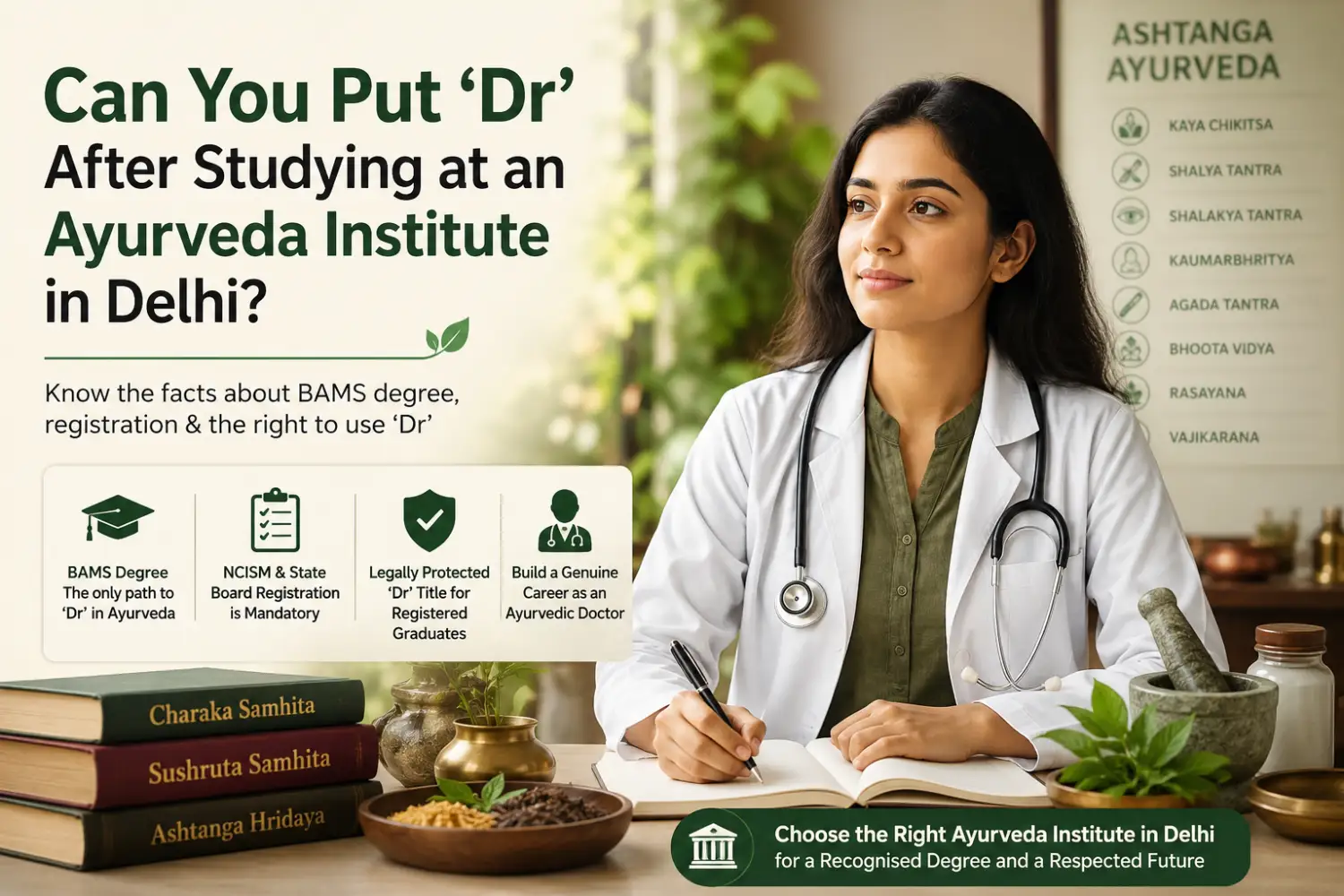
Yes, but only if the course is a full BAMS degree. A graduate of an ayurveda institute in Delhi can use the ‘Dr’ title once they complete the 5.5 year BAMS programme and register with the state Ayurveda board and NCISM. A short diploma or certificate course in Ayurveda does not give this right, since the title ‘Dr’ is reserved for holders of a recognised medical degree who complete formal registration.
Introduction
Every year thousands of class 12 students look up at an ayurveda institute in Delhi hoping to wear a white coat and add ‘Dr’ to their name. Many of them also see short online courses and weekend workshops in Ayurveda advertised with the same promise. This raises one honest doubt in a student’s mind. Does any Ayurveda course let a person call themselves a doctor, or does it depend on which course a student picks?
Parents ask this question too, mostly before paying a course fee. Some students hear that a certificate course is faster and cheaper, and wonder if it leads to the same result as a full degree. Others simply want to know what happens after they finish studying at a best ayurveda institute in Delhi, and whether the ‘Dr’ title comes automatically with the certificate.
This blog answers that question directly. It explains which Ayurveda courses actually lead to the ‘Dr’ title, what BAMS gives you that a diploma cannot, the registration steps a graduate must complete, and how to choose the right ayurveda institute in Delhi for a genuine career as an Ayurvedic doctor.
Can You Use the ‘Dr’ Title After Studying Ayurveda?
The short answer is yes, but only under specific conditions. In 2021, the Ministry of Health told Parliament that holders of BAMS, along with BHMS, BUMS, BSMS, BNYS and MBBS, can add ‘Dr’ to their name once they hold a recognised degree. This applies equally to a graduate from any NCISM-approved ayurveda institute in Delhi or elsewhere in India.
What this rule does not cover is a short certificate or weekend workshop. The title ‘Dr’ is protected under the Indian Medicine Degrees Act, 1916, which restricts its use to people holding a recognised medical qualification and completing registration. Using ‘Dr’ without meeting these conditions can lead to legal trouble, since it counts as misuse of a protected professional title.
Which Ayurveda Courses Qualify You to Become a Doctor?
Not every course with the word Ayurveda in its name leads to a doctor’s registration. The table below compares the three common paths students consider when they search for a best ayurveda institute in Delhi.
| Course Type | Typical Duration | Regulatory Body | Can You Use ‘Dr’ Title? |
What It Leads To |
|---|---|---|---|---|
| BAMS (Bachelor of Ayurvedic Medicine and Surgery) | 5.5 years (4.5 years study + 1 year internship) | NCISM and State Ayurveda Board | Yes, after registration | Registered Ayurvedic doctor, eligible for clinical practice |
| PG Diploma (for example, Panchakarma or Integrative Medicine) | 1 to 2 years, usually after a base medical degree | Varies by institute; not a standalone doctor qualification | No, on its own | Added skill in one area, not a full medical registration |
| Certificate Course (for example, CCAT, short Panchakarma or Nadi Pariksha course) | Weeks to a few months | Not linked to NCISM registration | No | Basic knowledge or a helper-level skill, not a doctor’s licence |
Source: Careers360 guide on diploma courses after BAMS, and AyushYogi overview of certificate-level Ayurveda courses (see Sources section below).
Read More: What Is Sapta Dhatu in Ayurveda? The Best BAMS Colleges in India
BAMS and the ‘Dr’ Title
BAMS is the only undergraduate route to the ‘Dr’ title in Ayurveda. The programme runs for 5.5 years under NCISM, covering classical Ayurveda texts, anatomy, physiology, pathology and basic pharmacology, followed by one year of hospital internship. Once the internship ends, the graduate can apply for registration with the state Ayurveda board and with NCISM. Only after this registration is complete can the graduate legally use ‘Dr’ before their name for clinical work.
Diploma and Certificate Courses in Ayurveda
Diploma and certificate courses serve a different purpose. A PG diploma in Panchakarma, for example, is usually taken after BAMS to build a specific skill, not as a stand-alone route to becoming a doctor. Short certificate courses such as CCAT or a weekend Nadi Pariksha workshop give useful knowledge, but they do not carry NCISM registration and cannot be used to claim the ‘Dr’ title or open an independent clinic.
Does Studying at an Ayurveda Institute in Delhi Automatically Make You a Doctor?
No, simply enrolling at an ayurveda institute in Delhi does not make anyone a doctor on day one. What matters is which course a student completes and whether they finish the full registration process afterwards. A student who joins BAMS, finishes the internship and registers with the state board becomes a doctor. A student who takes only a short course does not.
This is why checking a college’s NCISM approval and university affiliation matters more than the size of its advertisement. The table below sets out who is legally permitted to use the ‘Dr’ title across common health courses in India.
| Qualification | Can Legally Use ‘Dr’ Title? | Basis |
|---|---|---|
| MBBS / BDS | Yes | Recognised medical degree, registered with National Medical Commission or Dental Council |
| BAMS / BHMS / BUMS / BSMS | Yes | Recognised under respective Indian Medicine Acts, registered with NCISM and state board |
| BNYS (Naturopathy and Yogic Science) | Yes | Confirmed in Parliament as a recognised degree eligible for the ‘Dr’ prefix |
| Physiotherapist | No (per 2025 DGHS circular) | Health authorities clarified that physiotherapy alone does not carry the ‘Dr’ title |
| Ayurveda diploma or certificate holder (no BAMS) | No | Not a recognised medical degree under the Indian Medicine Central Council framework |
Source: Medical Dialogues report on the Lok Sabha clarification, and India Herald summary of the 2025 DGHS circular on the ‘Dr’ title (see Sources section below).
Registration and Legal Requirements for Ayurvedic Practitioners
Finishing BAMS is not the final step. A graduate must complete a short registration process before the ‘Dr’ title and clinical practice become legally valid. The table below lists the usual steps.
| Step | What Happens |
|---|---|
| 1. Complete BAMS academics | Finish all three professional years, 4.5 years in total, and clear the required exams |
| 2. Complete internship | Spend one year in compulsory rotatory internship at a teaching hospital |
| 3. Apply for state registration | Register with the state Ayurveda or AYUSH board where the graduate plans to practise |
| 4. NCISM registration | Get listed on the national register maintained by the National Commission for Indian System of Medicine |
| 5. Renew as required | Keep registration active as per state and NCISM rules, including any continuing education norms |
Source: Ayuro Health explainer on BAMS, MD-Ayurveda and NCISM registration; Indian Medical Association note on the Indian Medicine Degrees Act, 1916 (see Sources section below).
Read More: New Government Initiatives Boosting Careers in Ayurveda and BAMS
What Can You Do After Completing a BAMS Degree?
Once registration is complete, a BAMS graduate has several paths open to them, not just one fixed job.
- Register as an Ayurvedic doctor and start clinical practice under the Ayurveda system.
- Join a government AYUSH post, including rural and district-level health centres.
- Work in a hospital, Panchakarma centre or wellness brand as a registered practitioner.
- Study further through MD Ayurveda, MS Ayurveda or a PG diploma in a chosen specialisation.
- Move into Ayurveda-linked research, teaching or pharmaceutical roles.
How to Choose the Right Ayurveda Institute in Delhi
Since the ‘Dr’ title depends on completing a proper BAMS degree, picking the right college matters as much as clearing NEET. A few checks help a student separate the best ayurveda institute in Delhi from one that only looks good in an advertisement.
- Confirm NCISM approval and check which university the degree is affiliated to.
- Check whether the college runs its own teaching hospital with a fair number of beds and daily OPD patients.
- Look at faculty strength across core departments such as Kayachikitsa, Shalya Tantra and Panchakarma.
- Ask about the past placement record and where earlier batches are working now.
- Check the NEET cut-off and total seats for the previous year before applying.
DJ Ayurvedic Medical College & Hospital, located in Modinagar, Ghaziabad within the Delhi NCR belt, meets these checks. It was ranked number one in UP AYUSH Counselling for two years running, 2023 and 2024, and is approved by NCISM under Mahayogi Guru Gorakhnath AYUSH University. The college runs a 100+ bedded teaching hospital with full OPD and IPD facilities, sees over 200 outpatients a day, and has 14 specialised departments along with more than 110 faculty members. Past graduates now work at Yashoda Hospital, Felix Hospital, Patanjali, Sri Sri Tattva and IMS BHU, among other places.
| Institute | Location | NCISM Approved |
Teaching Hospital |
Notable Point |
|---|---|---|---|---|
| DJ Ayurvedic Medical College & Hospital | Modinagar, Ghaziabad (Delhi NCR) | Yes | 100+ bedded, on-campus | Ranked No. 1 in UP AYUSH Counselling, 2023 & 2024 |
| GS Ayurveda Medical College & Hospital, Pilkhuwa | Hapur, Uttar Pradesh | Yes | Attached hospital | Check official website for current seat matrix and hospital capacity |
| SGT University | Gurugram, Haryana | Yes | Attached hospital | Multi-faculty university with an Ayurveda department |
| Ishan Ayurvedic Medical College & Research Centre | Greater Noida, Uttar Pradesh | Yes | Attached hospital | Check official website for current seat matrix and hospital capacity |
| Rama University | Kanpur, Uttar Pradesh | Yes | Attached hospital | Multi-faculty university with an Ayurveda department |
| Glocal University | Saharanpur, Uttar Pradesh | Yes | Attached hospital | Check official website for current seat matrix and hospital capacity |
| Institute of Ayush Medical Sciences | Lucknow, Uttar Pradesh | Yes | Attached hospital | Check official website for current seat matrix and hospital capacity |
Note: Figures for DJ Ayurvedic Medical College & Hospital are as shared by the college. Details for other colleges should be confirmed on their respective official websites, since bed count, faculty strength and seat numbers can change each academic year. Source: DJ Ayurveda College official course page (see Sources section below).
Conclusion
So, can a student put ‘Dr’ after studying at an ayurveda institute in Delhi? Yes, but only if the course is a full, NCISM-approved BAMS degree, and only once registration with the state board is complete. A diploma or certificate course can add a skill, but it cannot add the title.
For a student who wants the full path, from a genuine BAMS degree to eventual registration as an Ayurvedic doctor, checking a college’s approval status, hospital facilities and placement record matters more than any advertisement. DJ Ayurvedic Medical College & Hospital, ranked number one in UP AYUSH Counselling for two years running, is one option that meets these checks for a BAMS course in the Delhi NCR region.
Frequently Asked Questions
No. A short certificate or diploma course in Ayurveda does not carry the right to use 'Dr' before your name. The title is reserved for graduates of a recognised medical degree, such as BAMS, who are registered with a state Ayurveda board and the National Commission for Indian System of Medicine.
Yes. The Ministry of Health confirmed in Parliament that holders of BAMS, along with BHMS, BUMS, BSMS, BNYS and MBBS, are permitted to add 'Dr' to their name once they hold a recognised degree and complete registration.
No. A diploma, such as a Panchakarma diploma or a short certificate course, builds skill in one area of Ayurveda but does not make someone a registered Ayurvedic doctor. Only a full BAMS degree, followed by registration, gives that legal standing.
NCISM stands for the National Commission for Indian System of Medicine. It sets the BAMS syllabus and keeps the official register of Ayurveda practitioners. Without NCISM and state council registration, a BAMS graduate cannot legally practise or use the 'Dr' title in clinical work.
Not through the standard degree route. NEET (UG) is the entrance exam for BAMS, which is the main path to becoming a registered Ayurveda doctor in India. Without NEET and a BAMS degree, a person can study Ayurveda through short courses, but cannot register as a doctor.
It takes 5.5 years in total. This includes 4.5 years of BAMS academic study across three professional years, plus one year of compulsory rotatory internship, followed by registration with the state Ayurveda board.
BAMS is a full 5.5 year degree covering the entire Ayurveda syllabus along with basic modern medicine subjects, and it leads to registration as a doctor. A Panchakarma diploma is a short, focused course on detox and therapy techniques, usually taken after BAMS to build one particular skill.
Yes. After finishing the BAMS internship, a graduate must register with the state Ayurveda or AYUSH board and with NCISM. This registration is what makes the 'Dr' title and clinical practice legally valid.
A candidate needs to pass class 12 with Physics, Chemistry and Biology (PCB) and must qualify NEET (UG). The general minimum age requirement is 17 years as on 31 December of the admission year.
No. Opening a clinic and treating patients under the Ayurveda system requires BAMS registration. A certificate course holder can work in wellness centres or assist a registered doctor, but cannot run an independent clinic as a doctor.
A BAMS graduate can register as an Ayurveda doctor, work in government AYUSH posts, join a hospital or wellness centre, study further through MD Ayurveda or a PG diploma, or move into Ayurveda research and pharmaceutical roles.
DJ Ayurvedic Medical College & Hospital was ranked number one in UP AYUSH Counselling for two years running, 2023 and 2024. It runs a 100+ bedded teaching hospital, has 14 specialised departments and gives students daily contact with over 200 outpatients, which supports a strong registration and career pathway after BAMS.
Related Blogs
Understanding Dosha Balance in Kayachikitsa: A Core Pillar of Ayurvedic Medicine Courses
INTRODUCTION Recent educational data indicate a 40% rise in global interest regarding integrative medicine, with…
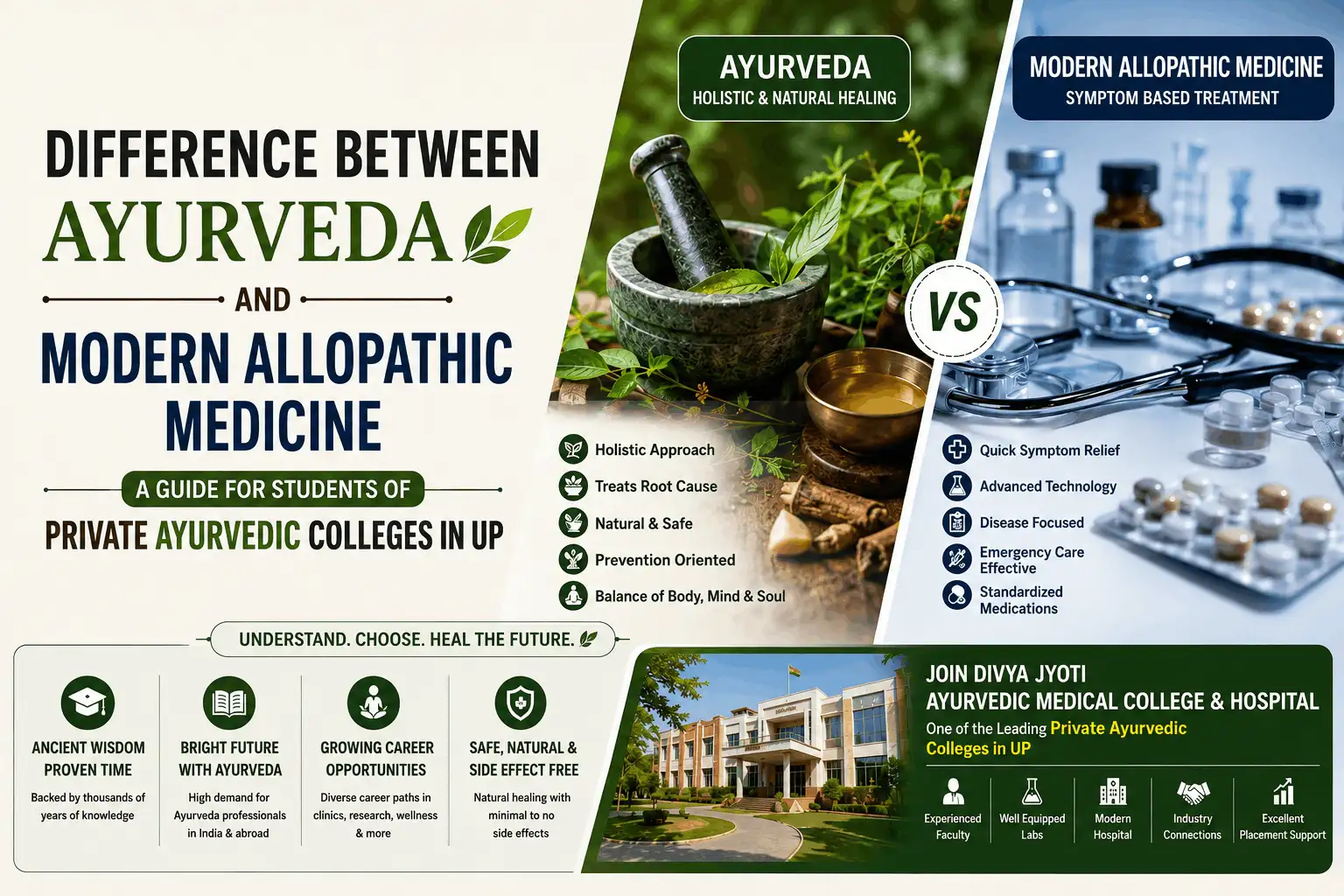
Difference Between Ayurveda and Modern Allopathic Medicine: A Guide for Students of Private Ayurvedic Colleges in UP
Ayurveda and modern allopathic medicine are two complete systems of healing that understand the human…
Can You Practise Modern Medicine With Ayurvedic Courses in Delhi?
No , a BAMS degree from ayurvedic courses in Delhi does not give a graduate…
Ancient Roots, Modern Careers: Exploring Opportunities at BAMS Colleges in Uttar Pradesh
When you hear about Ayurveda and career, what do you think of? Maybe century-old treatments,…
Best BAMS Colleges in UP: BAMS Admission 2027 Eligibility, NEET Requirements, Counselling and Fees
The best BAMS colleges in UP take admission only through NEET UG scores, followed by…
BAMS Courses and Their Rising Global Popularity
The Rise of Ayurveda Over the past few years, there has been a significant resurgence…