
What Is the Starting Salary From Private BAMS Colleges in India?
Home / BAMS / What Is the Starting Salary From Private BAMS Colleges in India?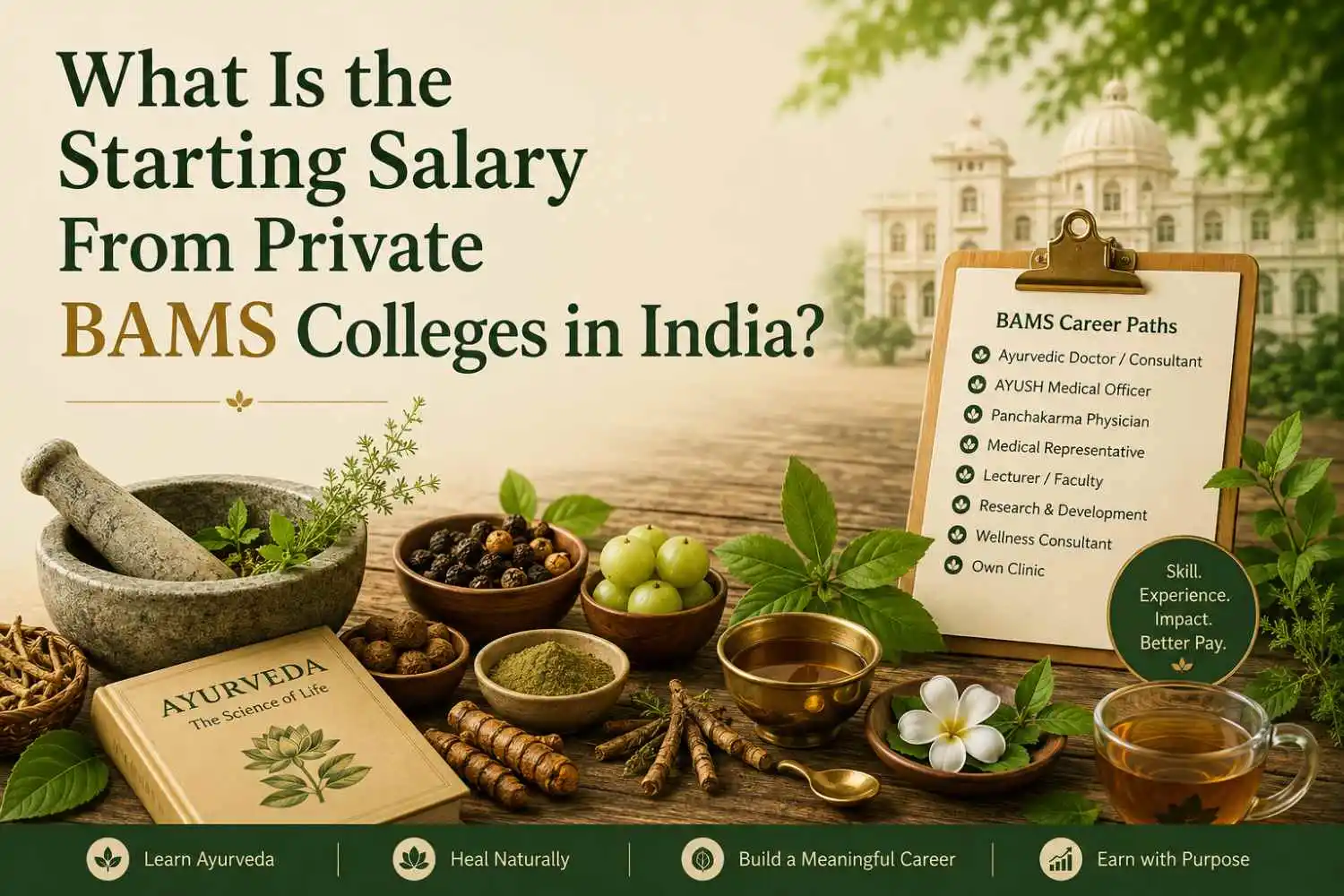
The starting salary from private BAMS colleges in India usually falls between ₹2.5 lakh and ₹6 lakh a year, which works out to roughly ₹20,000 to ₹50,000 a month. Graduates who join a busy Ayurvedic hospital, a branded wellness group or an AYUSH pharmaceutical company tend to start at the upper end of that band. Government AYUSH Medical Officer posts pay more on day one, with central Ministry of Ayush posts placed at Pay Level 10 of the 7th CPC matrix, where basic pay begins at ₹56,100 a month. Pay climbs sharply after two to five years of practice. Skill in Panchakarma, Kayachikitsa and Shalya Tantra carries the biggest premium, and the teaching hospital attached to a college shapes first-year earnings far beyond what any brochure claims.
Introduction
Every admission season, thousands of NEET-qualified students sit with their parents at the dining table and ask the same thing. If the seat is in a private Ayurvedic college, how much will the first salary actually be?
It is quite common to hear two very different answers. One group insists a BAMS doctor barely earns ₹20,000 a month at the start. Another group points to a cousin drawing ₹50,000 at a wellness chain within a year of finishing internship. Both answers are partly correct, and that is precisely what makes the question so confusing for families.
For many students, the fee cheque is the bigger worry. Five and a half years is a long stretch, and parents want to know when the money starts coming back. Not everyone is aware that first-year pay after BAMS depends far more on the hospital attached to the college than on the glossy pages of a prospectus.
This article lays out real salary figures from private BAMS colleges in India, role by role and sector by sector, with every number placed in a plain table and every source named at the bottom.
What Is the Average Starting Salary After BAMS in India?
The honest answer is that the first salary after BAMS sits in a wide band rather than at a single figure. Most freshers who take up a salaried job earn between ₹2.5 lakh and ₹6 lakh a year. A closer look at the industry shows that the number moves up quickly once a graduate builds a steady patient list or joins a recognised wellness group.
Education portals report slightly different figures because each one surveys a different pool of employers. The table below places those numbers side by side, so students can see the full picture instead of one convenient headline.
Table 1: Reported Starting and Average Salary After BAMS in India
| Source | Reported Figure | What the Figure Covers |
|---|---|---|
| Collegedunia | Starting ₹2.70 LPA; average ₹3 LPA to ₹3.6 LPA | All-India average across government and private employers |
| CollegeSearch | Average ₹4.1 LPA in private hospitals; about ₹33,300 a month overall | Private hospital and clinic roles |
| GetMyUni | ₹33,000 to ₹50,000 a month at entry level | Ayurvedic doctor, therapist, health supervisor |
| ICGI | ₹2.5 lakh to ₹4 lakh a year at entry | Fresh graduates, first job |
| Propelld | ₹2.5 lakh to ₹3 lakh in year one, rising to ₹4 lakh to ₹6 lakh after 2 to 5 years | Early-career progression |
| Desh Bhagat University | ₹3 lakh to ₹6 lakh a year for freshers | Fresh graduates across sectors |
| D.J. Ayurvedic Medical College (official BAMS page) | ₹6 lakh to ₹8.5 lakh a year for freshers | The college’s own stated fresher range |
Ranges differ because each portal surveys a different set of employers. Students may treat ₹2.5 lakh to ₹6 lakh as the common band, and figures above that as skill-led or brand-led outcomes.
Starting Salary After BAMS by Job Role
BAMS does not lead to one job. It opens roughly eight or nine doors, and each door pays differently on day one. From an employer’s point of view, a graduate who can plan and run a Panchakarma protocol without supervision commands a better packet than one who has only read about it in a textbook.
Table 2: Starting Salary After BAMS by Job Role
| Job Role | Typical Starting Pay | Where Graduates Work | Source |
|---|---|---|---|
| Ayurvedic Doctor / Consultant | ₹3.0 lakh to ₹6.0 lakh a year | Ayurvedic hospitals, private clinics | GetMyUni, Collegedunia |
| AYUSH Medical Officer (contract) | ₹4.2 lakh to ₹6.0 lakh a year | PHCs, CHCs, government dispensaries | NHM state notifications |
| Panchakarma Physician / Therapy Head | ₹3.0 lakh to ₹5.4 lakh a year | Wellness centres, Ayurveda resorts | Collegedunia |
| Medical Representative / Product Executive | ₹2.4 lakh to ₹4.5 lakh a year | Ayurvedic pharma companies | Collegedunia |
| Lecturer / Junior Faculty | ₹4.0 lakh to ₹6.0 lakh a year | BAMS colleges | GetMyUni |
| Research Assistant / Clinical Coordinator | ₹2.4 lakh to ₹4.0 lakh a year | CCRAS, research institutes | Vedantu |
| Corporate Wellness Consultant | ₹45,000 to ₹90,000 a month | Large Ayurveda and wellness brands | Vedantu |
| Own Clinic (first year) | ₹1.8 lakh to ₹3.6 lakh a year | Self practice | Propelld |
It is interesting to observe that non-clinical roles such as medical representative pay a steady packet from month one, while private practice starts slow and then overtakes almost everything by year five.
Read More: What Is Panchakarma and How Does It Work
What Factors Affect BAMS Starting Salary?
Two students from the same batch can be offered very different packets. These are the reasons why.
- The teaching hospital attached to the college. A college with a busy OPD sends out graduates who have already handled hundreds of live cases. Recruiters pick this up within ten minutes of an interview.
- Skill in Panchakarma and allied therapies. Wellness chains and Ayurvedic hospitals pay a premium for a doctor who can design a therapy plan, not merely supervise one.
- City of practice. Delhi NCR, Mumbai, Pune, Bengaluru and Kerala pay noticeably better than smaller towns, although rent absorbs part of that gap.
- Sector of entry. Government AYUSH posts, corporate wellness groups, pharmaceutical firms and self practice each follow a different pay pattern from the first month.
- Postgraduate plans. An MD or MS in Ayurveda lifts pay sharply in specialist and teaching roles.
- Patient communication. Consultation-led roles reward doctors who explain a treatment plan in language a worried family can follow.
- Internship record. A large share of first jobs come from the internship hospital itself, so the internship year is effectively a year-long interview.
Private Hospital vs Government BAMS Salary
Many parents and students still believe that only a government posting pays properly after BAMS. The reality on the ground is somewhat different. Government AYUSH jobs do pay better on day one and bring security with them. Private roles start lower but move faster for a doctor who builds a name.
For central posts, the Ministry of Ayush recruits Medical Officer and Research Officer (Ayurveda) as Group A gazetted staff in Pay Level 10 of the 7th CPC pay matrix, where basic pay starts at ₹56,100 a month before allowances and Non-Practising Allowance. State recruitment sits a little lower. The OPSC Ayurvedic Medical Officer post, for example, is placed at Level 10 with an approximate annual package of ₹5.98 lakh.
Table 3: Private Hospital vs Government BAMS Salary
| Point of Comparison |
Private Sector | Government Sector | Source |
|---|---|---|---|
| Starting pay | ₹3 lakh to ₹6 lakh a year | Basic ₹56,100 a month at Level 10 for central Ayush MO posts | CollegeSearch; Ministry of Ayush |
| How you enter | Direct interview or walk-in after internship | UPSC, State PSC or NHM contract selection | Ministry of Ayush; NHM |
| Waiting time | Usually within weeks of internship | Six months to two years of preparation | Propelld |
| Yearly increase | Negotiated, performance-linked | Fixed increment at about 3 per cent, plus DA revisions | UPSC Ayush notification |
| Extra benefits | Consultation share, therapy incentives | NPA, HRA, pension benefits, job security | Ministry of Ayush |
| Private practice | Generally permitted alongside | Usually restricted, compensated through NPA | Ministry of Ayush |
Students weighing seats at private BAMS colleges in India should note that a private start does not close the government door. Most AYUSH Medical Officer exams accept any NCISM-recognised BAMS degree, whether the college is government or private.
Salary Growth After BAMS With Experience
This is where things become interesting. The gap between a fresher and a doctor with five years of practice is usually a multiple, not a percentage.
Table 4: Salary Growth After BAMS With Experience
| Experience | Typical Annual Pay | Usual Role at This Stage | Source |
|---|---|---|---|
| 0 to 1 year (internship completed) | ₹2.5 lakh to ₹4 lakh | Junior doctor, resident medical officer | ICGI, Propelld |
| 2 to 5 years | ₹4 lakh to ₹6 lakh | Consultant, AYUSH Medical Officer | Propelld |
| 5 to 10 years | ₹6 lakh to ₹12 lakh | Senior consultant, department in-charge, faculty | Desh Bhagat University |
| 10 years and above, or with MD/MS | ₹12 lakh to ₹20 lakh and above | Specialist, clinic owner, professor | Desh Bhagat University |
| Established private practice | ₹1 lakh to ₹2 lakh a month | Independent practitioner with a settled patient base | Vedantu |
Part of the reason pay has moved up is that the sector itself has grown. As per Ministry of Ayush data reported by IBEF, the Indian AYUSH market expanded from about US$ 2.85 billion in 2014 to roughly US$ 43.3 billion in 2024, and India now supplies AYUSH medicines to over 200 countries. A growing sector needs qualified doctors, and hiring has followed.
How Can BAMS Graduates Increase Their Earning Potential?
Ask any experienced practitioner in the field, and they will tell you that the first salary matters far less than what a graduate does in the two years after it.
- Treat the internship year as paid training. Log every case, every therapy and every diagnosis in a personal record book.
- Build genuine Panchakarma competence. It is the single skill that lifts a fresher above the crowd in wellness hiring.
- Sit for AIAPGET and pick an MD or MS branch with clinical demand, such as Kayachikitsa, Panchakarma or Shalya Tantra.
- Apply for state AYUSH Medical Officer posts within two years of graduation, while age relaxation still helps.
- Add a short certification in clinical nutrition, garbhasanskar, sports medicine or hospital management.
- Start a small online consultation practice alongside a salaried job to build a patient base early.
- Publish case studies in peer-reviewed Ayurveda journals. Research work opens teaching posts that pay well and offer stability.
- Learn simple clinic accounting and pharmacy stocking before opening an independent practice.
Is BAMS From a Private College Worth It?
One question that often comes up is whether the fee at a private college is worth the first salary. The answer depends almost entirely on the fee bracket a family enters. A college charging ₹1.5 lakh to ₹3 lakh a year pays itself back within three to four working years. A deemed university charging ₹8 lakh a year takes a good deal longer.
It is worth noting that seat supply sits mostly on the private side. Collegedunia lists over 200 private BAMS colleges in the country against a much smaller government pool, and NCISM data cited by EduTech Agra puts Uttar Pradesh alone at around 73 private BAMS colleges holding about 5,600 seats. For most NEET-qualified students, a private seat is the realistic route into Ayurveda.
Table 5: BAMS Private College Fees in India Against Early Earnings
| Fee Bracket (per year) | Approximate Course Cost | Years to Recover at ₹4 Lakh a Year | Where This Bracket Is Found |
|---|---|---|---|
| ₹1.2 lakh to ₹2 lakh | ₹6 lakh to ₹10 lakh | About 3 to 4 working years | Chhattisgarh, Maharashtra aided and private colleges |
| ₹2.5 lakh to ₹4 lakh | ₹12 lakh to ₹20 lakh | About 5 to 7 working years | Uttar Pradesh, Haryana, Karnataka private colleges |
| ₹4 lakh to ₹6 lakh | ₹20 lakh to ₹30 lakh | About 8 to 10 working years | Karnataka and Maharashtra management quota seats |
| ₹8 lakh and above | ₹40 lakh and above | Over 12 working years | Deemed universities |
Fee figures compiled from Ayush Counselling, Collegedunia and Admission Xpert. Hostel, examination and university charges sit outside these numbers.
Read More: Is BAMS a Safe Career Choice In This Age of Modern Sciences?
What to Check Before Choosing Private BAMS Colleges in India
From a student’s perspective, the campus photographs decide very little. Families comparing private BAMS colleges in India with fees structure in hand should ask for the current-year fee demand letter in writing rather than accept a verbal figure, and should walk through the attached hospital on a working weekday.
Table 6: Checklist for Comparing Private Ayurvedic Colleges in India
| What to Check | What a Sound College Will Show You | Why It Decides Your Salary |
|---|---|---|
NCISM permission |
Current academic year permission letter, published on the website | Degree validity and eligibility for government AYUSH posts |
| Attached teaching hospital | 100 or more beds with working OPD and IPD | Patient contact is what recruiters actually test |
| Daily OPD footfall | Published daily patient numbers, not vague claims | More cases handled means faster hiring after internship |
| Panchakarma unit | Dedicated therapy rooms with certified therapists | Panchakarma skill carries the highest pay premium |
| Faculty strength | Department-wise teaching staff list in the public domain | Teaching quality shows up in university results |
| Fee transparency | Written fee demand plus hostel and examination charges | Decides how quickly the course pays for itself |
| Placement cell | Named recruiters and traceable alumni records | Turns a degree into a first job |
| University affiliation | A recognised state AYUSH university | Affects result timelines and degree acceptance |
Why Choose DJ Ayurvedic Medical College & Hospital?
Divya Jyoti Ayurvedic Medical College & Hospital sits at Niwari Road, Modinagar, in Ghaziabad district of Uttar Pradesh, within easy reach of Delhi NCR. The college was established in 2017, while the hospital attached to it has been running since 2012. That order matters. Students walk into a hospital that was treating patients before the college opened its doors.
The institution has been ranked first in Uttar Pradesh AYUSH Counselling for two consecutive years, in 2023 and 2024. It is approved by NCISM and affiliated to Mahayogi Guru Gorakhnath AYUSH University.
- A 100-bedded teaching hospital on campus with full OPD and IPD services, so clinical training does not depend on outside tie-ups.
- Around 200 OPD patients a day, which gives students steady contact with real cases from the second year onwards.
- 14 specialised departments, covering Panchakarma, Kayachikitsa, Shalya Tantra, Dravyaguna, Kaumarbhritya, Streeroga and the rest of the Ayurvedic branches.
- A dedicated Panchakarma centre with over 10 therapy rooms and 8 certified therapists, plus 10 specialised clinics for skin, joint and paediatric care.
- 110 plus faculty members across academic and clinical teaching.
- Over 500 graduates placed at hospitals, wellness centres and research institutions, including Yashoda Hospital, Felix Hospital, Patanjali, Sri Sri Tattva and IMS BHU.
- An active Student Support and Placement Cell with career guidance linked to Ayurveda employers.
- Published research in peer-reviewed journals such as Annals of Ayurvedic Medicine and Aryavaidyan, supported by a Research, Innovation and Entrepreneurship Development Cell.
- Regular CME programmes, seminars and clinical skill workshops, along with visits to All India Institute of Ayurveda, New Delhi and PCIM&H.
- A herbal garden, working laboratories, a digital library and an LMS supporting day-to-day study.
- Over 10 free medical camps a year serving over 5,000 people across nearby rural and urban areas, which puts students in front of community cases early.
For a student comparing options among private BAMS colleges in India, the combination of a 100-bedded hospital, a 200-patient daily OPD and a working Panchakarma centre is what turns five and a half years of study into a job offer.
Conclusion
The starting salary from private BAMS colleges in India typically ranges from ₹2.5 lakh to ₹6 lakh a year, with clinically confident graduates and those joining branded wellness or pharmaceutical employers starting higher. Government AYUSH Medical Officer posts pay more at entry but take longer to secure. Within five years, the difference between a good graduate and an average one is usually three times, not thirty per cent.
In practical terms, the college choice decides the starting line. A brochure figure counts for very little next to a busy attached hospital, an honest fee structure and a working Panchakarma unit. Families would do well to visit the campus on a working day, count the patients in the OPD and ask to meet a final-year student before signing anything.
Frequently Asked Questions
The starting salary from private BAMS colleges in India generally falls between ₹2.5 lakh and ₹6 lakh a year, which is roughly ₹20,000 to ₹50,000 a month. Graduates joining Ayurvedic hospitals, wellness chains or AYUSH pharmaceutical companies usually start at the higher end.
Government AYUSH posts pay more at entry. Central Ministry of Ayush Medical Officer posts sit at Pay Level 10 of the 7th CPC matrix, where basic pay begins at ₹56,100 a month. Private roles start lower but grow faster once a doctor builds a patient base.
A fresher usually earns ₹20,000 to ₹50,000 a month. Doctors with five to ten years of practice earn ₹50,000 to ₹1 lakh a month, and settled independent practitioners often earn ₹1 lakh to ₹2 lakh a month.
Corporate wellness consultant roles with large Ayurveda brands pay best at entry, at around ₹45,000 to ₹90,000 a month. Lecturer and AYUSH Medical Officer posts follow, at ₹4 lakh to ₹6 lakh a year.
Private BAMS college fees in India commonly run from ₹1.2 lakh to ₹6 lakh a year, so a full course costs about ₹6 lakh to ₹30 lakh. Deemed universities charge considerably more. Hostel and examination charges are separate.
Collegedunia lists over 200 private BAMS colleges in the country. NCISM data cited by EduTech Agra places Uttar Pradesh alone at around 73 private BAMS colleges with about 5,600 seats.
Yes. AYUSH Medical Officer recruitment accepts any BAMS degree from an NCISM-recognised college along with registration on the state or national register of Indian medicine. Private college graduates compete on equal terms.
Yes, considerably. An MD or MS in Ayurveda opens specialist consultancy, senior hospital posts and teaching positions, where annual pay commonly moves past ₹12 lakh.
At an annual fee of ₹1.5 lakh to ₹2 lakh and a starting salary near ₹4 lakh, most graduates recover the course cost within three to four working years. Higher fee brackets take proportionally longer.
The AYUSH market grew from about US$ 2.85 billion in 2014 to roughly US$ 43.3 billion in 2024 as per Ministry of Ayush data reported by IBEF. Hiring across hospitals, wellness groups and pharmaceutical firms has grown along with it.
BAMS runs for five and a half years, made up of four and a half years of study and a one-year compulsory internship. A candidate needs 10+2 with Physics, Chemistry and Biology, a minimum of 50 per cent marks, and a qualifying NEET score.
The official BAMS page of D.J. Ayurvedic Medical College & Hospital states a fresher range of ₹6 lakh to ₹8.5 lakh a year, and about ₹10 lakh and above for experienced professionals. Students should read this alongside the wider sector band of ₹2.5 lakh to ₹6 lakh.
Related Blogs
Ranking the Best Private BAMS Colleges: What Students Should Know
With the current era of holistic healing and alternative medicine, Ayurveda is taking center stage…
Choosing the right BAMS college in 2025–26: what should you actually check?
If you are trying to decide the best BAMS college in India, you are probably…
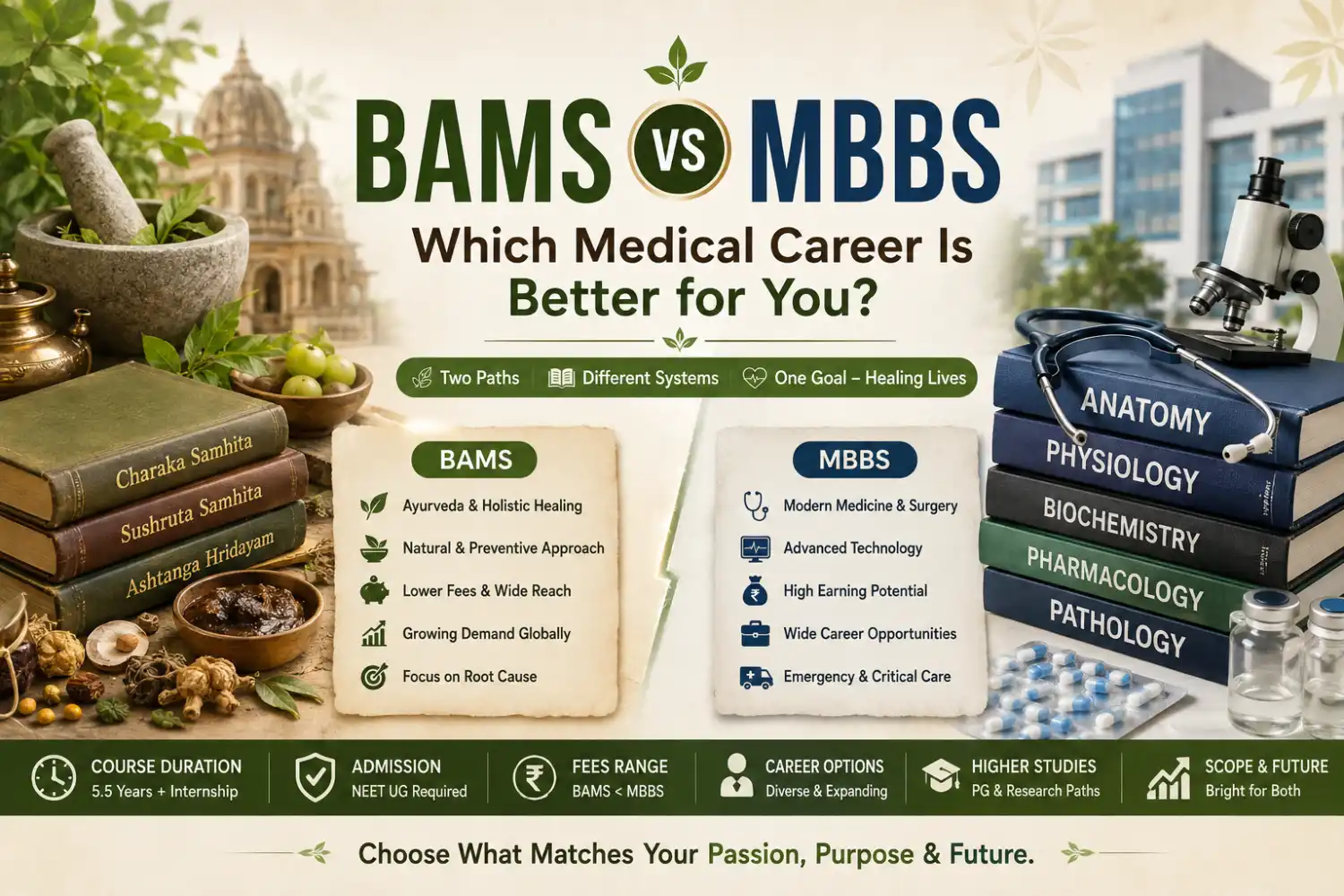
BAMS vs MBBS: Which Medical Career Is Better for You?
Neither degree is better in the abstract. MBBS trains a doctor in modern medicine and…
Which Ayurvedic medicine courses are driving genuine career growth today?
When a student considers Ayurvedic medicine courses, they are really choosing a future of healing,…
Can You Practise Modern Medicine With Ayurvedic Courses in Delhi?
No , a BAMS degree from ayurvedic courses in Delhi does not give a graduate…
Understanding Dosha Balance in Kayachikitsa: A Core Pillar of Ayurvedic Medicine Courses
INTRODUCTION Recent educational data indicate a 40% rise in global interest regarding integrative medicine, with…