
The Tridosha Theory: How Vata, Pitta and Kapha Govern the Body
Home / BAMS / The Tridosha Theory: How Vata, Pitta and Kapha Govern the Body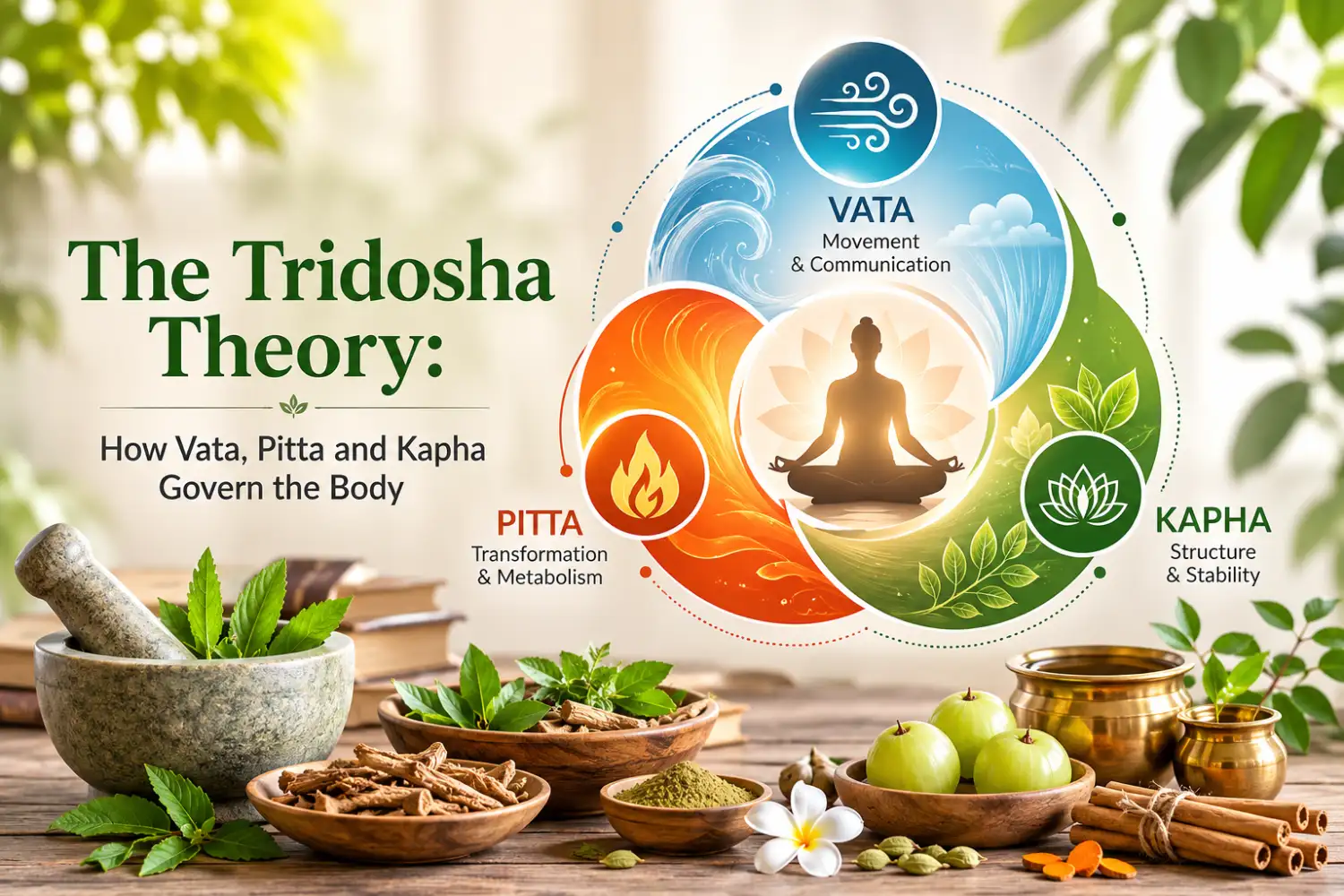
The Tridosha theory is the foundation of Ayurvedic physiology. It holds that three functional energies, Vata, Pitta and Kapha, govern every activity of the body and mind. Vata directs movement, Pitta directs transformation, and Kapha directs structure and stability. Health is the balanced interplay of these three, while illness reflects their disturbance. For medical aspirants exploring private BAMS colleges in Delhi and beyond, understanding this single idea explains how Ayurveda approaches the human body, its diagnosis and its treatment.
Key facts at a glance
- The three doshas are Vata, Pitta and Kapha, the functional energies described in classical Ayurvedic texts such as the Charaka Samhita.
- Each dosha is formed from the five elements: Vata from ether and air, Pitta from fire and water, and Kapha from earth and water.
- Vata governs movement, Pitta governs digestion and metabolism, and Kapha governs structure, immunity and lubrication.
- Your unique dosha balance at birth is called Prakriti, and it is traditionally considered stable throughout life.
- A current imbalance is called Vikriti, and restoring balance is the central aim of Ayurvedic treatment.
- The Tridosha theory is taught in the first year of the BAMS course and underpins Ayurvedic diagnosis and therapy.
What is the Tridosha theory in Ayurveda?
The Tridosha theory is the principle that three biological energies, Vata, Pitta and Kapha, control every physical and mental function of the human body. Ayurveda treats these three as the working principles behind digestion, circulation, thought, growth and repair. When they act in harmony, a person is healthy. When one or more is disturbed, discomfort and disease follow.
The Sanskrit word dosha literally means a fault, or something that has the capacity to spoil or go out of balance. This naming is deliberate. The doshas are not fixed organs you can point to on a dissection table. They are functional forces, and the same forces that keep the body running can also drive it into illness when they rise or fall too far.
Classical texts describe the doshas as one of the three pillars that hold the body together, alongside the seven dhatus (the body tissues) and the three malas (the waste products). This is the first major concept that a student meets when beginning a BAMS course, and it shapes almost everything that follows.
How do the five elements form the three doshas?
The three doshas are built from the five great elements, known in Sanskrit as the Panchamahabhuta: earth (Prithvi), water (Jala), fire (Agni), air (Vayu) and ether or space (Akasha). Ayurveda holds that every substance in nature, including the human body, is a combination of these five elements in different proportions.
Vata arises from air and ether, which is why it is light, dry and always in motion. Pitta arises from fire with a fluid medium of water, which is why it is hot, sharp and transformative. Kapha arises from earth and water, which is why it is heavy, moist, stable and cohesive. This elemental logic is not decorative. It explains why Vata feels dry and cold, why Pitta runs hot, and why Kapha is heavy and steady.
The three doshas at a glance
| Dosha | Elements (Panchamahabhuta) | Core Qualities | Primary Function | Main Seat in the Body |
|---|---|---|---|---|
| Vata | Ether and Air (Akasha, Vayu) | Dry, light, cold, mobile, subtle | Movement and transport | Large intestine (Pakvashaya) |
| Pitta | Fire and Water (Agni, Jala) | Hot, sharp, light, slightly oily, spreading | Transformation and metabolism | Small intestine (Grahani) |
| Kapha | Earth and Water (Prithvi, Jala) | Heavy, cool, oily, smooth, stable | Structure and lubrication | Chest and stomach (Amashaya) |
What does Vata dosha govern in the body?
Vata is the dosha of movement. It governs every kind of motion in the body, from breathing and the heartbeat to nerve impulses, muscle action, speech and the elimination of waste. A simple way to remember it is that wherever there is movement, Vata is at work.
The Charaka Samhita gives Vata a leading role and describes Pitta and Kapha as unable to move without it, comparing them to something lame without Vata to carry them. Its main seat is the colon, and it divides into five subtypes: Prana (inward movement, breath and the mind), Udana (upward movement, speech and effort), Samana (regulation of digestion), Vyana (circulation throughout the body) and Apana (downward movement, elimination and reproduction).
When Vata is balanced, a person tends to feel energetic, creative and regular in their functions. When it is aggravated, the dry, cold and mobile qualities show up as anxiety, dry skin, constipation, bloating, disturbed sleep and stiff joints.
What does Pitta dosha govern in the body?
Pitta is the dosha of transformation. It governs digestion, metabolism, body temperature, vision, complexion and the sharpness of the intellect. Wherever the body converts one thing into another, from food into energy to light into sight, Pitta is responsible.
Its home is the small intestine and stomach, and it is closely tied to Agni, the digestive fire that Ayurveda treats as central to health. Pitta has five subtypes: Pachaka (digestion), Ranjaka (formation and colouring of blood), Sadhaka (intellect, courage and emotion, seated in the heart), Alochaka (vision) and Bhrajaka (the lustre and warmth of the skin).
Balanced Pitta supports strong digestion, steady body heat, clear thinking and a bright complexion. Aggravated Pitta, with its hot and sharp nature, tends towards acidity, heartburn, inflammation, skin rashes, excess heat and irritability.
What does Kapha dosha govern in the body?
Kapha is the dosha of structure and cohesion. It gives the body its physical form, holds tissues together, lubricates the joints, moistens the tissues, and supports immunity, stamina and emotional steadiness. If Vata is motion and Pitta is transformation, Kapha is the substance and the glue.
Its principal seat is the chest and stomach, and it is linked with Ojas, the refined essence associated with immunity and vitality. Kapha divides into five subtypes: Kledaka (moisture of the stomach lining), Avalambaka (support for the chest, heart and back), Bodhaka (the perception of taste on the tongue), Tarpaka (nourishment of the brain and sense organs) and Shleshaka (lubrication of the joints).
In balance, Kapha brings strength, calm, good immunity and endurance. In excess, its heavy, cold and sticky qualities lead to weight gain, congestion, lethargy, fluid retention and a tendency towards attachment or resistance to change.
Signs of balance and imbalance for each dosha
| Dosha | Signs of Balance | Signs of Aggravation (Vikriti) |
|---|---|---|
| Vata | Steady energy, regular elimination, calm and alert mind, good circulation | Anxiety, dry skin, constipation, bloating, insomnia, joint stiffness, restlessness |
| Pitta | Strong digestion, stable body heat, sharp intellect, clear complexion | Acidity, heartburn, inflammation, skin rashes, excess heat, irritability |
| Kapha | Strong immunity, stable joints, calm emotions, good stamina | Heaviness, weight gain, congestion, lethargy, fluid retention, sluggish digestion |
The five subtypes of each dosha
| Dosha | Five Subtypes | What They Broadly Govern |
|---|---|---|
| Vata | Prana, Udana, Samana, Vyana, Apana | Breathing and the mind, speech, digestive regulation, circulation, elimination |
| Pitta | Pachaka, Ranjaka, Sadhaka, Alochaka, Bhrajaka | Digestion, blood formation, intellect and emotion, vision, skin complexion |
| Kapha | Kledaka, Avalambaka, Bodhaka, Tarpaka, Shleshaka | Stomach moisture, chest and heart support, taste, nourishment of the senses, joint lubrication |
What is Prakriti and how is a person’s constitution decided?
Prakriti is your individual dosha constitution, the particular balance of Vata, Pitta and Kapha that is set at the moment of conception. Classical texts describe it as stable throughout life, forming a baseline against which health and imbalance are measured.
According to the Samhitas, Prakriti is decided by the state of the doshas in the parents at conception, along with the diet and conduct of the mother during pregnancy and the conditions in the womb. This is why two people can eat the same food, live in the same climate, and yet respond very differently. Prakriti helps explain individual variation in body build, digestion, temperament and the tendency towards particular complaints.
Because Ayurveda tailors advice to a person’s constitution rather than treating everyone the same way, it is often described as an early form of personalised medicine. There are seven recognised constitutional types.
The seven Prakriti (constitutional) types
| Category | Prakriti Types | Note |
|---|---|---|
| Single Dosha | Vata, Pitta, Kapha | One dosha is clearly dominant. |
| Dual Dosha | Vata–Pitta, Pitta–Kapha, Vata–Kapha | Two doshas share dominance; this is the most common pattern. |
| Tridoshic | Vata–Pitta–Kapha (Sama) | All three doshas are balanced; traditionally considered rare. |
What happens when the doshas fall out of balance?
When a dosha increases or decreases beyond its normal range, the body moves from health into a state of imbalance called Vikriti. In Ayurvedic understanding, this imbalance, if left uncorrected, is the starting point of disease.
Two related ideas sit at the centre of this process. The first is Agni, the digestive and metabolic fire. When Agni is weak, food is not properly transformed. The second is Ama, the sticky, undigested residue that results. Ama is thought to block the srotas, the channels through which nutrients and wastes travel, and to disturb the doshas further.
Classical texts map the progression of imbalance into six stages, the Shatkriyakala: accumulation, aggravation, spread, localisation, manifestation and, finally, chronicity or differentiation. The practical value of this model is that it encourages recognition and correction at an early stage, long before a full illness appears. Common causes, or nidana, include an unsuitable diet, the wrong routine for the season, disturbed sleep and sustained mental stress.
Educational note: This section describes classical Ayurvedic concepts of health and disease. It is not medical advice. Any health concern should be assessed by a qualified and registered practitioner.
How does the Tridosha theory guide diagnosis and treatment?
In practice, the Tridosha theory guides an Ayurvedic doctor to first identify which dosha is disturbed, and then to apply the opposite qualities in order to bring it back into balance. This single rule, that like increases like and opposites reduce, sits behind most Ayurvedic decisions.
Diagnosis draws on structured observation. Nadi Pariksha, the reading of the pulse, is one well-known method. It usually sits within a wider eight-fold examination, the Ashtavidha Pariksha, which assesses the pulse, tongue, urine, stool, speech, touch, vision and general appearance. From these signs, the practitioner judges the state of each dosha.
Treatment then combines several tools: Ahara (diet), Vihara (lifestyle), Dinacharya (a daily routine), Ritucharya (a seasonal routine), herbal medicines, and, where indicated, Panchakarma, the group of five cleansing procedures. For example, a Vata imbalance, being cold and dry, is met with warm, moist and grounding measures, while a Pitta imbalance, being hot, is met with cooling and calming ones, and a heavy Kapha imbalance is met with light and stimulating ones.
Educational note: The therapies named here are described for understanding only. They are not prescriptions, and they should be undertaken solely under the supervision of a qualified registered Ayurvedic practitioner. This content is not a substitute for professional medical advice.
What does modern research say about the Tridosha theory?
Modern research treats the Tridosha theory as a classical framework that is being investigated, not as an already proven biological mechanism. The honest position, and the one taught in a good BAMS programme, is that the theory has clinical and conceptual value in Ayurveda while its correspondence to modern physiology is still being studied.
A field known as Ayurgenomics has attracted particular attention. Researchers at Indian scientific institutions have reported associations between a person’s Prakriti and patterns of gene expression and biochemical markers, which raises the possibility that constitution may map onto measurable biology. Related work has framed Prakriti-based assessment as a possible precursor to personalised medicine, since both approaches accept that individuals differ in how they respond to the same intervention.
These findings are best described as preliminary. Sample sizes are often small, methods of assessing constitution vary between studies, and results need to be replicated on a larger scale before firm conclusions can be drawn. It would be a mistake to read Tridosha as identical to any single modern system such as the nervous or endocrine system. The careful separation of classical theory from confirmed evidence is itself an important skill that Ayurvedic training aims to develop.
Tridosha Theory – How do private BAMS colleges in Delhi teach it?
Students learn the Tridosha theory at the very start of the Bachelor of Ayurvedic Medicine and Surgery (BAMS) course, and private BAMS colleges in Delhi and across the National Capital Region build their first-year teaching around it. It appears in the foundational subjects that cover Ayurvedic fundamentals and physiology, and it then returns in almost every clinical subject that follows.
The concept is usually introduced through the departments that teach the classical texts and Ayurvedic physiology, so that students read the original descriptions of Vata, Pitta and Kapha alongside their functions. It reappears in internal medicine (Kayachikitsa), in Panchakarma, and in the clinical postings where recognising a dosha pattern is part of everyday case discussion. The BAMS course runs for five and a half years, and admission across India is through the National Eligibility cum Entrance Test (NEET).
For families comparing the best private BAMS colleges in Delhi and the surrounding region, it is worth checking how a college moves the theory from the lecture room into the ward. The strongest programmes treat Tridosha not as a topic to be memorised for one examination, but as a way of reasoning that is used again and again.
BAMS course quick facts
| Aspect | Detail |
|---|---|
| Programme | Bachelor of Ayurvedic Medicine and Surgery (BAMS) |
| Duration | 5.5 years (4.5 years of academic study plus a 1-year compulsory internship) |
| Entrance Examination | NEET (National Eligibility cum Entrance Test) |
| Eligibility | Class 12 with Physics, Chemistry, and Biology, meeting the minimum qualifying marks as prescribed. |
| Regulator | National Commission for Indian System of Medicine (NCISM) |
| First-Year Foundation | Ayurvedic fundamentals and physiology, including Tridosha, Panchamahabhuta, and Saptadhatu. |
How is the Tridosha theory taught at DJ Ayurveda College?
At DJ Ayurveda College, formally the Divya Jyoti Ayurvedic Medical College and Hospital, the Tridosha theory is not confined to a single lecture. It is introduced in the first year through the departments that handle the classical Samhitas and Ayurvedic physiology, where students read the descriptions in the Charaka Samhita alongside the functional model of Vata, Pitta and Kapha. The idea then returns in clinical training, from Nadi Pariksha (pulse examination) practice to daily work in the outpatient department and the hundred-plus bedded teaching hospital, where reading dosha patterns supports real case discussion. The college teaches the five and a half year BAMS programme and is recognised by the NCISM. It is located at Niwari Road, Modinagar, in Ghaziabad district of Uttar Pradesh, within the National Capital Region and within easy reach of Delhi, which is why it appears on the shortlists of many students searching for private BAMS colleges in Delhi and the wider NCR.
What should you remember about the Tridosha theory?
The Tridosha theory turns a complex human body into three understandable forces: Vata for movement, Pitta for transformation and Kapha for structure. Grasp these three, and the logic of Ayurvedic health, diagnosis and treatment begins to make sense. For a Class 12 science student weighing a future in Ayurveda, this single framework is where the journey begins. If the ideas here interest you, it is worth exploring the BAMS programme and how it is taught at DJ Ayurveda College.
Frequently Asked Questions
The Tridosha theory states that three functional energies, Vata, Pitta and Kapha, govern every process in the body. Vata controls movement, Pitta controls transformation and metabolism, and Kapha controls structure and lubrication. Health reflects their balance, and disease reflects their disturbance, according to classical Ayurvedic texts.
Each dosha arises from the five elements, or Panchamahabhuta. Vata is formed from ether and air, Pitta from fire and water, and Kapha from earth and water. These elemental combinations explain the qualities of each dosha, such as the dryness of Vata or the heat of Pitta.
Yes. Most people have a dual constitution in which two doshas share dominance, such as Vata-Pitta or Pitta-Kapha. A single dominant dosha is less common, and a perfectly balanced Vata-Pitta-Kapha constitution is considered rare. This inborn combination is known as Prakriti.
Prakriti is your natural constitution, fixed at conception and considered stable for life. Vikriti is your current state of imbalance, which shifts with diet, season, stress and lifestyle. Ayurvedic assessment compares the two to understand how far a person has moved from their baseline.
Practitioners use structured methods such as Nadi Pariksha, the reading of the pulse, and an eight-fold examination that includes pulse, tongue, urine, stool, speech, touch, vision and general appearance. These observations, taught throughout a BAMS course, help identify which dosha is aggravated before any treatment is planned.
The Tridosha theory is a classical framework rather than a proven biomedical mechanism. Preliminary research, including work in Ayurgenomics, suggests associations between constitution and genetic or biochemical markers. These findings are exploratory, and larger, well designed studies are needed before firm scientific conclusions can be drawn.
Treatment follows the principle that opposite qualities restore balance. It combines diet, a daily routine, a seasonal routine, herbal medicines and, where indicated, Panchakarma therapies. Any treatment should be taken only under a qualified registered Ayurvedic practitioner and is not a substitute for professional medical advice.
The Tridosha theory is a first-year foundation of the BAMS course. It underpins Ayurvedic physiology, diagnosis and treatment, so students revisit it in almost every clinical subject. A clear grasp of Vata, Pitta and Kapha is essential for reasoning through cases in the later years and internship.
Students exploring private BAMS colleges in Delhi and the National Capital Region can consider institutions across the region, including DJ Ayurveda College at Modinagar in Ghaziabad. Admission is through NEET, and the five and a half year programme includes a one year internship in a teaching hospital setting.
Yes. Each dosha is divided into five subtypes. Vata includes Prana and Apana, Pitta includes Pachaka and Ranjaka, and Kapha includes Kledaka and Shleshaka, among others. These subtypes describe more specific functions, such as breathing, digestion, blood formation or joint lubrication, in different regions of the body.
Related Blogs

Student Diaries: Life and Learning at Leading BAMS Private Colleges in UP
Opening a new chapter in your studies is similar to starting a diary with blank…

Are Ayurveda Courses in India Tougher Than MBBS?
Ayurveda courses in India are not easier than MBBS. They are difficult in a different…

Ayurveda in the Age of Biohacking
You know what’s funny? We live in a world where our watches know more about…

Can You Put ‘Dr’ After Studying at an Ayurveda Institute in Delhi?
Yes, but only if the course is a full BAMS degree. A graduate of an…

Is BAMS Better Than Other AYUSH Courses?
Is BAMS better than other AYUSH courses? For most NEET students, yes. BAMS (Bachelor of…

Scope and Career After a BAMS Degree in India: What the Top Ayurvedic Courses in Delhi Lead To
A BAMS degree, the Bachelor of Ayurvedic Medicine and Surgery, qualifies a graduate to practise…