
Why Is Ayurveda Becoming Popular in Modern Healthcare? A Student’s Guide to Choosing an Ayurveda College in Noida
Home / BAMS / Why Is Ayurveda Becoming Popular in Modern Healthcare? A Student’s Guide to Choosing an Ayurveda College in Noida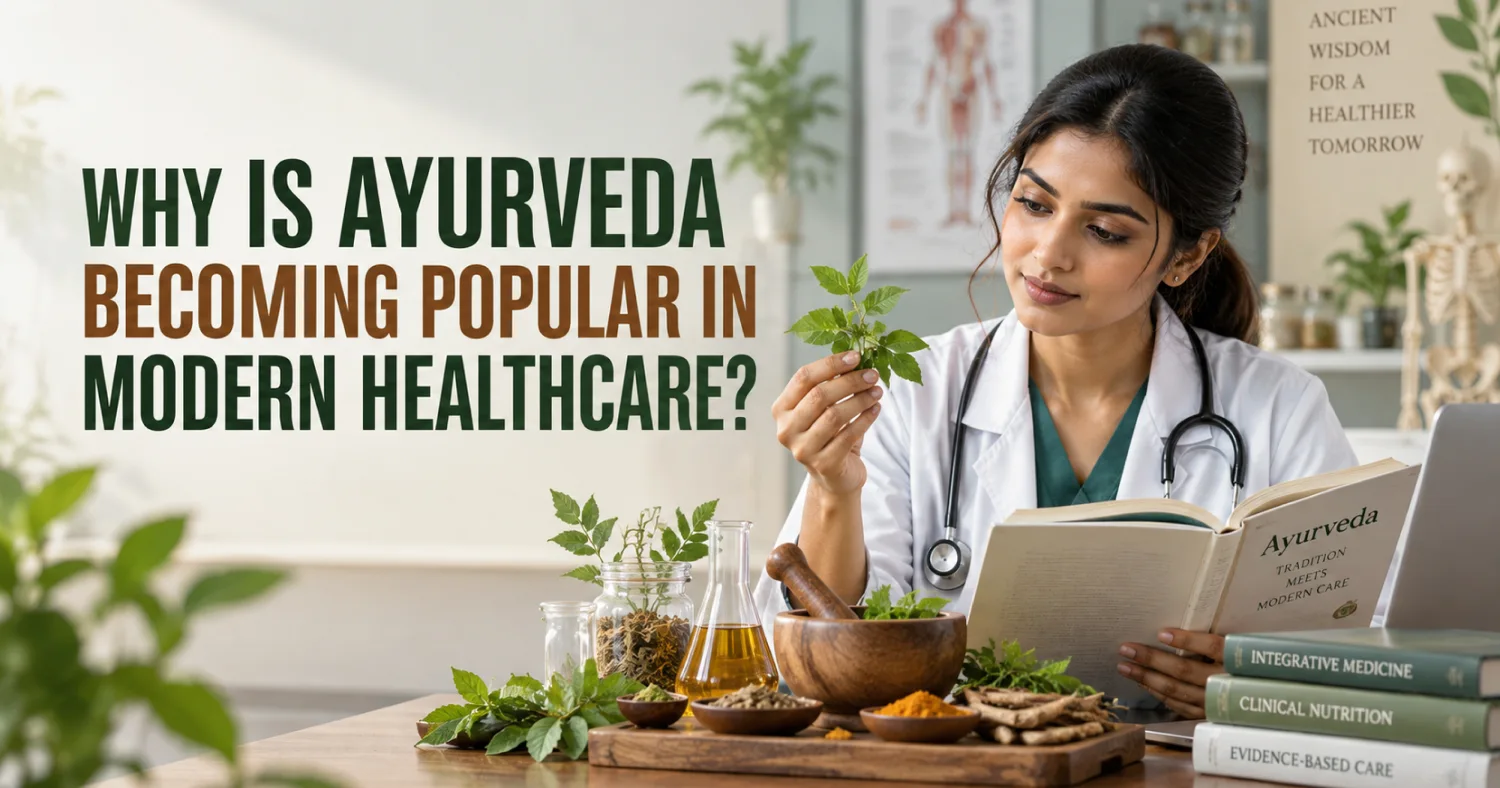
Ayurveda is becoming popular in modern healthcare because people now want care that prevents illness, not only treats it. Lifestyle diseases, government backing, WHO recognition and new research have brought it into hospitals and clinics. India’s AYUSH market grew from US$ 2.85 billion in 2014 to US$ 43.4 billion in 2023, and this has raised the demand for BAMS doctors. Students searching for an ayurveda college in Noida and the Delhi NCR often shortlist NCISM-approved colleges with teaching hospitals, such as DJ Ayurvedic Medical College & Hospital, Modinagar.
Most Indian homes grew up with some little remedies like a spoonful of turmeric in warm milk, or a pinch of ajwain for an upset stomach. For a long time, many people treated them as old family habits and nothing more.
The situation has changed considerably over the last few years. The same ideas now sit inside government hospitals, wellness centres and research labs. Big city hospitals run Panchakarma units. Doctors speak about sleep, diet and stress as openly as they speak about tablets. The World Health Organization has even set up its global traditional medicine centre in Jamnagar, Gujarat.
So what changed? And why are young students, and their parents, suddenly curious about Ayurveda as a career?
It is quite common to hear aspirants ask whether BAMS is a “proper” medical degree, or whether Ayurveda has a future next to modern medicine. These are fair questions. This blog answers them with official data and simple explanations. It also guides families looking for an ayurveda college in Noida and nearby cities on what to check before admission.
What Is Ayurveda and Where Does It Fit in Modern Healthcare?
Ayurveda is India’s traditional system of medicine. The name joins two Sanskrit words: “ayu” (life) and “veda” (knowledge). Put simply, Ayurveda is the knowledge of life. It studies the body, mind and daily habits together and tries to treat the root cause of a health problem.
Not everyone is aware that most hospitals do not use Ayurveda as a replacement for allopathy. The two usually work side by side. A few terms help students understand the basics:
- Tridosha: The three body energies, Vata, Pitta and Kapha. Good health means these stay in balance.
- Panchakarma: A five-step cleansing therapy used for chronic and lifestyle problems.
- Dinacharya: A healthy daily routine that covers sleep, food, exercise and hygiene.
- Rasayana: Rejuvenation therapy that aims to build strength and immunity.
- AYUSH: The government’s umbrella term for Ayurveda, Yoga and Naturopathy, Unani, Siddha, Sowa-Rigpa and Homoeopathy.
Why Is Ayurveda Becoming Popular in Modern Healthcare?
There is no single reason behind this rise. A mix of health worries, public trust, government policy and science has put Ayurveda back in the spotlight. Each factor is explained below.
Are Lifestyle Diseases Pushing People Towards Ayurveda?
Diabetes, high blood pressure, obesity, thyroid issues, PCOS and stress are now common even among young adults. These are long-term conditions. Tablets can control them, yet many patients also want to change the habits that caused them.
- Ayurveda gives clear advice on diet, sleep, routine and yoga.
- Patients often use it alongside their regular medicines, under a doctor’s guidance.
- Close to half of all AYUSH users in the national NSS survey used it for prevention or rejuvenation, not only to treat an illness.
How Many Indians Actually Use Ayurveda Today?
Many parents and students still believe that Ayurveda is mostly a village habit. The first all-India survey on AYUSH says otherwise. In fact, urban residents now lead rural residents in using it.
AYUSH Awareness and Use in India, Rural vs Urban
| Indicator | Rural India | Urban India |
|---|---|---|
| Aware of AYUSH | About 95% | About 96% |
| Used any AYUSH system in the last 365 days | 46.3% | 52.9% |
| Used Ayurveda for treatment (most used system) | 40.5% | 45.5% |
| Average spend per person on AYUSH treatment | Rs 472 | Rs 574 |
Source: Ministry of Statistics and Programme Implementation (MoSPI), NSS 79th Round, as reported by Business Standard and The South First; state-wise study in the National Library of Medicine (PMC).
What Is the Government Doing to Support Ayurveda?
The Ministry of AYUSH was formed in 2014. Since then, the government has worked to offer AYUSH care in the same buildings where people get allopathic care, as official PIB data shows.
- The National AYUSH Mission places AYUSH units inside Primary Health Centres, Community Health Centres and District Hospitals.
- Research councils run clinical studies and set quality standards for Ayurvedic medicines.
India’s AYUSH Healthcare Strength, Services vs Education (As on 2024)
| Area | Indicator | Number |
|---|---|---|
| Services | AYUSH hospitals | 3,844 |
| Services | AYUSH dispensaries | 36,848 |
| Workforce | Registered AYUSH practitioners | 7,55,780+ |
| Education | AYUSH undergraduate colleges | 886 |
| Education | AYUSH postgraduate colleges | 251 |
| Education | Annual UG seats vs PG seats | 59,643 vs 7,450 |
Source: Press Information Bureau (PIB), Government of India, “India’s Traditional Medicine Systems” backgrounder, 16 December 2025.
Has WHO Recognition Made Ayurveda More Credible Worldwide?
This is where things become interesting. Ayurveda’s rise is no longer only an Indian story, as the World Health Organization now gives traditional medicine a place in global health planning.
- 170 of the 194 WHO member states report the use of traditional medicine.
- In 2022, WHO and India agreed to set up the WHO Global Traditional Medicine Centre in Jamnagar, backed by a US$ 250 million investment from India.
- WHO’s Traditional Medicine Strategy 2025-2034 calls for better evidence and safety rules.
- WHO launched its Traditional Medicine Global Library at the second WHO Global Summit on Traditional Medicine, held in New Delhi in December 2025.
Is the Ayurveda Market Really Growing?
In practical terms, when more patients choose Ayurveda, the sector grows, and so does the need for trained doctors.
India’s AYUSH Sector, Then vs Now
| Indicator | Earlier | Recent | Source |
|---|---|---|---|
| AYUSH market size | US$ 2.85 billion (2014) |
US$ 43.4 billion (2023) | Ministry of AYUSH statement, Dec 2024 (Business Standard) |
| AYUSH market size (survey estimate) | US$ 2.85 billion (2014–15) |
US$ 18.1 billion (2020) | PIB, March 2023 (FITT-RIS report) |
| AYUSH exports | US$ 1.09 billion (2014) |
US$ 2.16 billion (2023) | Ministry of AYUSH statement, Dec 2024 (Business Standard) |
| AYUSH and herbal product exports | US$ 649 million (2023–24) |
Over US$ 688 million (2024–25) |
Union Health Minister, via All India Radio News, Jan 2026 |
Note: The two market-size figures use different methods, so they should not be compared directly.
Both point in the same direction.
What Do Research Firms Predict for the Global Ayurveda Market?
Research firms use different methods, so their numbers differ. Still, every major report expects double-digit growth. CAGR (compound annual growth rate) is the average yearly growth over a set period.
Ayurveda Market Forecasts Compared by Research Firm
| Research Firm | Market Covered | Base Value | Forecast Value | CAGR |
|---|---|---|---|---|
| Grand View Research | Global Ayurveda | US$ 20.4 billion (2025) | US$ 85.8 billion (2033) | 19.7% |
| Market Research Future | Global Ayurveda | US$ 20.84 billion (2025) | US$ 107.62 billion (2035) | 17.82% |
| Towards Healthcare | Global Ayurveda | US$ 20.45 billion (2025) | US$ 124.01 billion (2035) | 19.75% |
| IMARC Group | India Ayurvedic products | INR 1,017.51 billion (2025) | INR 3,728.75 billion (2034) | 15.52% |
Sources: Grand View Research, Market Research Future, Towards Healthcare and IMARC Group market reports (2026 editions).
What Should Students Know Before Joining an Ayurveda College in Noida?
For many students, all this data leads to one personal question: is BAMS the right path? Course sounds good, and the curiosity pertaining to the future and career possibilities hovers in the mind of aspirants.
What Is BAMS and Who Can Apply?
BAMS stands for Bachelor of Ayurvedic Medicine and Surgery. It is one of the most popular ayurveda medical courses in India and the main degree for becoming a registered Ayurvedic doctor. The National Commission for Indian System of Medicine (NCISM) regulates the course. Students can read the full BAMS course details on the college website.
BAMS Course at a Glance
| Feature | Details |
|---|---|
| Full form | Bachelor of Ayurvedic Medicine and Surgery |
| Duration | 5.5 years (4.5 years of study + 1-year compulsory internship) |
| Eligibility | Class 12 with Physics, Chemistry and Biology; usually a minimum of 50% for the general category, with relaxation for reserved categories as per NCISM rules |
| Entrance exam | NEET-UG (compulsory) |
| Counselling | AACCC for All India quota seats; UP AYUSH counselling for state quota seats in Uttar Pradesh |
| Regulator | NCISM, under the Ministry of AYUSH |
| Key subjects | Kriya Sharir, Rachana Sharir, Dravyaguna, Kayachikitsa, Panchakarma, Shalya Tantra, Kaumarbhritya |
Source: National Commission for Indian System of Medicine (NCISM); DJ Ayurvedic Medical College & Hospital BAMS course page.
What Career Paths Can Students Explore After BAMS?
It is really a wise decision to dive into the field of Ayurveda if a student enjoys science and patient care. Ask any experienced professional in the field, and they will tell you that BAMS opens many new doors today.
- Ayurvedic physician in a private clinic or hospital
- Medical officer in state AYUSH departments and National AYUSH Mission centres
- Resident or emergency medical officer in multispeciality hospitals
- Panchakarma consultant in wellness centres and resorts
- MD or MS (Ayurveda) after clearing AIAPGET
- Research, drug development and quality control roles in Ayurvedic pharma companies
- Telemedicine consultant, lecturer, or owner of a clinic or wellness brand
From an employer’s point of view, a graduate trained in a busy teaching hospital is far easier to hire.
Is South India Still Ahead in Ayurveda Education?
There is a general notion that South India, especially Kerala, is quite ahead of others in this particular field. The reality on the ground is somewhat different. Fathoming the consequence of this growing demand, private Ayurveda colleges in North India have expanded their hospitals, labs and herbal gardens to attract students from different regions to study BAMS and explore the possibilities.
Is an Ayurveda College in Noida and the NCR a Smart Choice?
Noida, Ghaziabad and Delhi form one of India’s busiest healthcare belts. It is worth noting that many families searching for an ayurveda college in Noida also consider nearby Ghaziabad district, as both fall within the same NCR region.
- A large patient flow means more cases to learn from.
- National institutes like the All India Institute of Ayurveda (AIIA), New Delhi, are close enough for visits and seminars.
- Many private hospitals and wellness brands across the NCR hire BAMS doctors.
What Should Families Check Before Admission?
A short checklist can save a lot of worry later:
- Is the college NCISM approved and affiliated to a recognised university?
- How many beds and daily OPD patients does the attached hospital have?
- Where have past students been placed after internship?
Why Choose DJ Ayurvedic Medical College & Hospital?
Parents who compare lists of the top ayurveda medical college in India often look at three things: approval, hospital strength and results. For students looking for an ayurveda college in Noida, DJ Ayurvedic Medical College & Hospital (Divya Jyoti) in Modinagar, Ghaziabad, meets all three and sits within easy reach of Noida and Delhi. Many families who search for an ayurvedic medical college in Noida shortlist it because of its full teaching hospital on campus.
- Ranked No. 1 in UP AYUSH Counselling for two years in a row (2023 and 2024), and NCISM approved.
- A 5.5-year BAMS programme that blends classical Ayurvedic texts with modern, evidence-based teaching across 14 specialised departments.
- Daily clinical learning in a 100+ bedded teaching hospital with full OPD and IPD services and over 200 OPD patients a day.
- A Panchakarma centre with over 10 therapy rooms and 8 certified therapists, plus over 10 speciality clinics.
- Graduates placed at Yashoda Hospital, Felix Hospital, Patanjali, Sri Sri Tattva, IMS BHU and more.
- Research published in journals such as Annals of Ayurvedic Medicine and Aryavaidyan, plus CMEs on Nadi Pariksha and Shalya Tantra.
- Over 10 free medical camps a year serving over 5,000 people, with herbal garden, digital library, LMS and lively campus life.
DJ Ayurvedic Medical College & Hospital at a Glance
| Feature | Details |
|---|---|
| Established | College in 2017; hospital running since 2012 |
| Approval and affiliation | NCISM; Mahayogi Guru Gorakhnath AYUSH University |
| Counselling rank | No. 1 in UP AYUSH Counselling (2023 and 2024) |
| Faculty | 110+ expert faculty members |
| Hospital | 100+ beds with OPD and IPD; 200+ OPD patients daily |
| Departments and clinics | 14 departments; 10+ speciality clinics |
| Graduates placed | 500+ in India and abroad |
| Location | Niwari Road, Modinagar, Ghaziabad, Uttar Pradesh 201204 (Delhi NCR) |
Source: DJ Ayurvedic Medical College & Hospital official website (djayurvedacollege.com) and college records.
Conclusion: Is Ayurveda a Smart Career Choice Today?
Ayurveda’s rise is no passing trend. It rests on patient trust, public policy, WHO support and steady research. It would not be wrong to say that the need for skilled BAMS doctors will keep rising.
Every student hopes to join the best ayurveda medical college in India. In practical terms, the best choice offers approval, real patients and caring mentors. For those searching for an ayurveda college in Noida and the NCR, a campus visit to DJ Ayurvedic Medical College & Hospital in Modinagar can help families decide with confidence. Students can read the BAMS course page, take a virtual campus tour or contact the admissions team.
Frequently Asked Questions
Ayurveda is becoming popular because people want to prevent illness, not just treat it. Lifestyle diseases, support from the Ministry of AYUSH, WHO recognition and new research have all played a part. The NSS 2022-23 survey found that 46.3% of rural and 52.9% of urban Indians used an AYUSH system within a year.
Yes. Under the National AYUSH Mission, AYUSH services run inside Primary Health Centres, Community Health Centres and District Hospitals. Many large government hospitals also have AYUSH departments. In most cases, Ayurveda works alongside allopathy rather than replacing it.
BAMS is a good choice for students who like biology and patient care. India has over 7.5 lakh registered AYUSH practitioners and 3,844 AYUSH hospitals. Graduates can work in clinics, hospitals, wellness centres, pharma companies, research and government AYUSH services, or study further for MD or MS (Ayurveda).
The BAMS course takes 5.5 years. This includes 4.5 years of academic study and a one-year compulsory internship in a hospital. Students learn classical Ayurveda along with anatomy, physiology, pathology and surgery.
Students must pass Class 12 with Physics, Chemistry and Biology, usually with at least 50% marks for the general category. Reserved categories get relaxation as per NCISM rules. A valid NEET-UG score is also compulsory.
Yes. NEET-UG is compulsory for BAMS admission across India. Seats are filled through AACCC counselling for the All India quota and through state counselling, such as UP AYUSH counselling, for state quota seats.
Students looking for an ayurvedic medical college in Noida often shortlist DJ Ayurvedic Medical College & Hospital in Modinagar, Ghaziabad, within the Delhi NCR. It is NCISM approved, has a 100+ bedded teaching hospital and was ranked No. 1 in UP AYUSH Counselling in 2023 and 2024.
The college is on Niwari Road, Modinagar, in the Ghaziabad district of Uttar Pradesh (PIN 201204). It falls within the Delhi NCR and welcomes students from Noida, Ghaziabad, Delhi, Meerut and all over Uttar Pradesh.
Yes. DJ Ayurvedic Medical College & Hospital is approved by the National Commission for Indian System of Medicine (NCISM) and is affiliated to Mahayogi Guru Gorakhnath AYUSH University, Gorakhpur.
Students first qualify NEET-UG and then register for UP AYUSH counselling. Seats are given on the basis of NEET rank, choice filling and category. The admissions team helps families with documents, counselling steps and the fee structure.
Students train in a 100+ bedded hospital that sees over 200 OPD patients every day. They also learn in the Panchakarma centre, over 10 speciality clinics and the free medical camps held each year in villages and towns.
After BAMS, graduates can practise as Ayurvedic doctors, join hospitals as medical officers, work in wellness and Panchakarma centres, take up research or pharma roles, or pursue MD or MS (Ayurveda) through AIAPGET. Some also start their own clinics.
Related Blogs
Panchamahabhuta: The Five Elements Behind Ayurvedic Medicine
Panchamahabhuta refers to the five great elements that Ayurveda regards as the building blocks of…

Best Private BAMS Colleges in Uttar Pradesh: Do They Really Teach Surgery?
Yes. Every NCISM-approved BAMS course, including the best private BAMS colleges in Uttar Pradesh, carries…
Is BAMS a Safe Career Choice In This Age of Modern Sciences?
INTRODUCTION Current healthcare trends indicate a seismic shift in patient preference. The Ayush sector in…
Ayurveda in the Age of AI – How Technology is Changing BAMS Careers
When you think of courses after BAMS, what comes to mind, traditional specializations, or something…
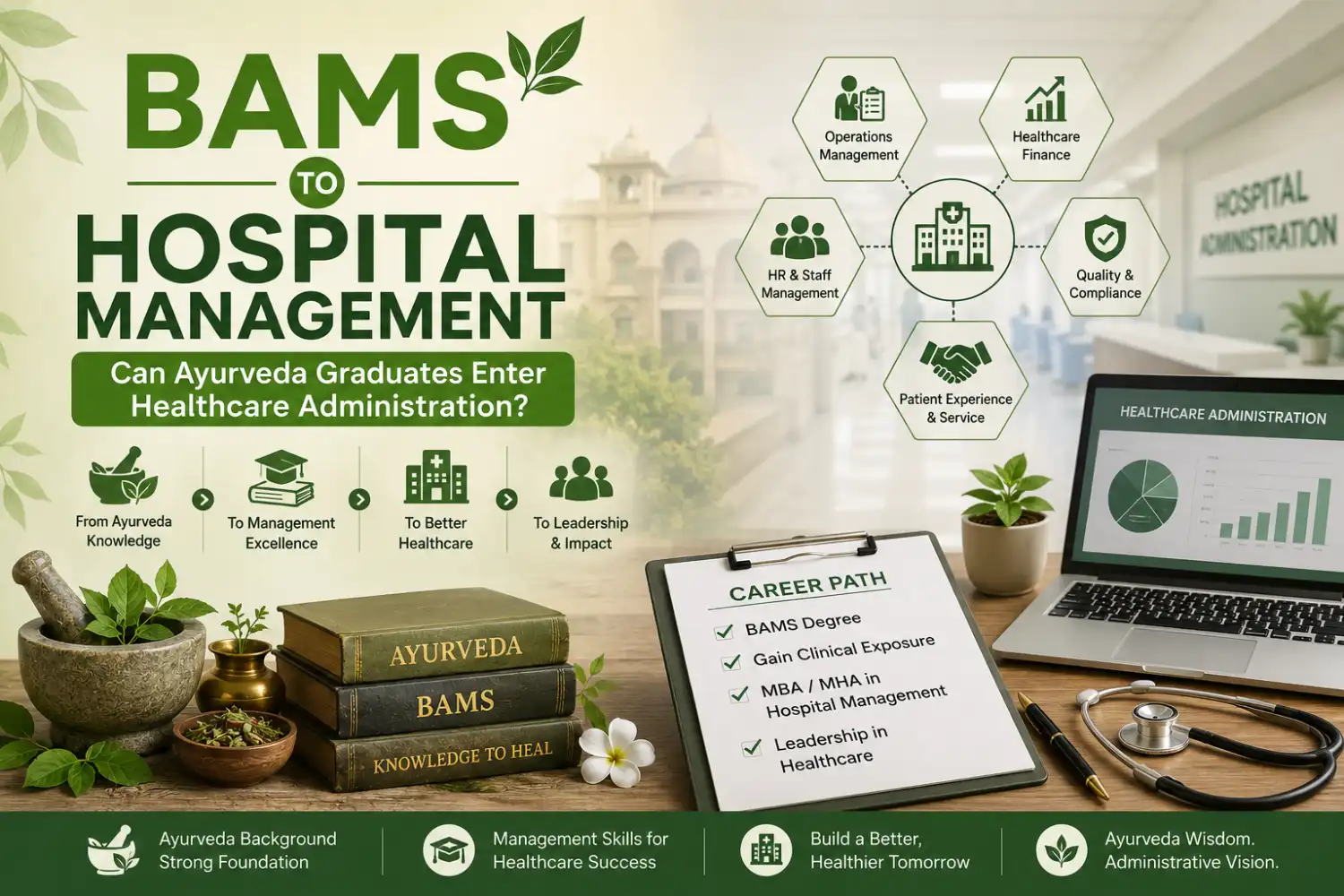
BAMS to Hospital Management: Can Ayurveda Graduates Enter Healthcare Administration?
Yes. A BAMS graduate can move into healthcare administration. Most MBA and MHA programmes in…
Best BAMS Colleges in UP: BAMS Admission 2027 Eligibility, NEET Requirements, Counselling and Fees
The best BAMS colleges in UP take admission only through NEET UG scores, followed by…