BAMS to Hospital Management: Can Ayurveda Graduates Enter Healthcare Administration?
Home / BAMS / BAMS to Hospital Management: Can Ayurveda Graduates Enter Healthcare Administration?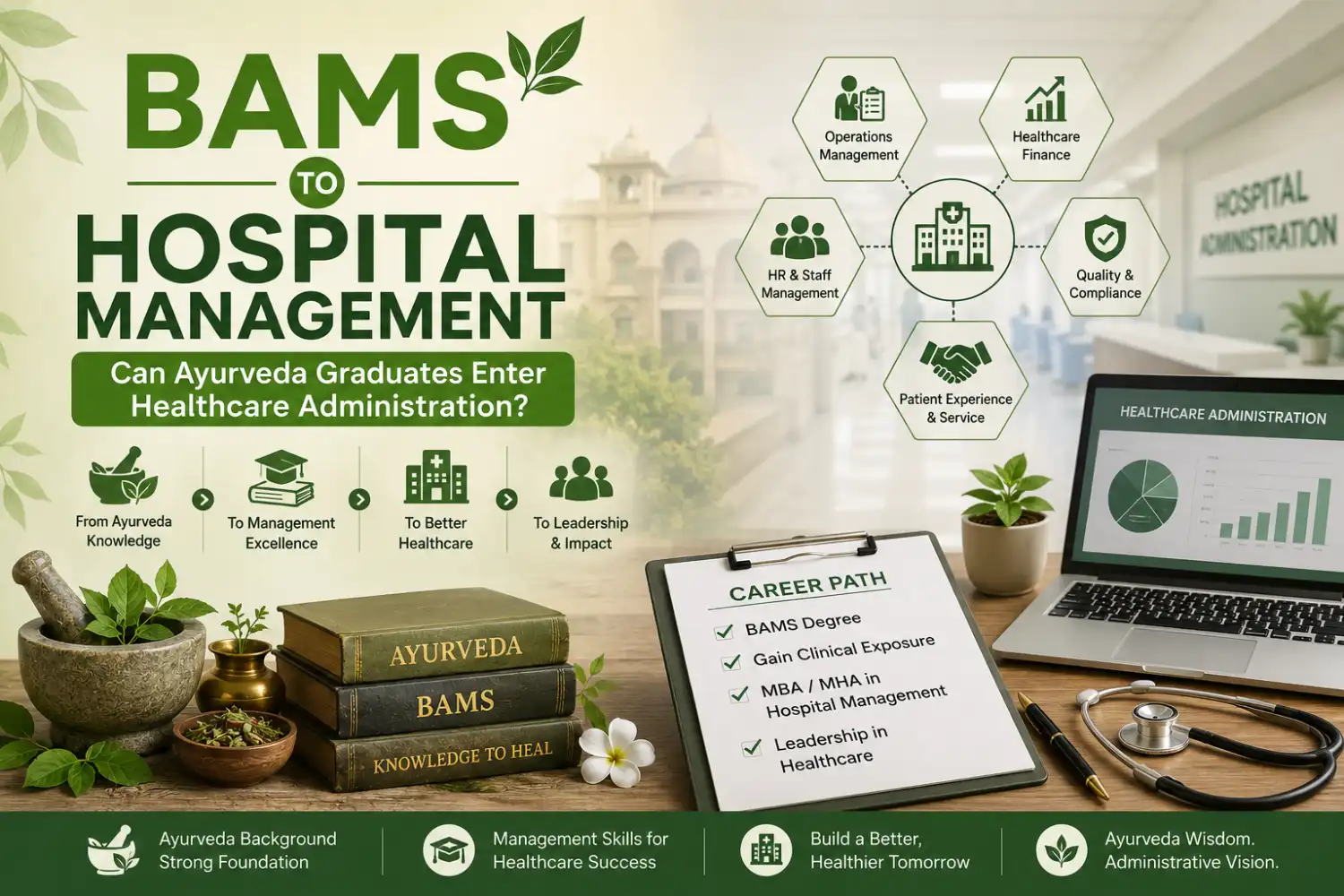
Yes. A BAMS graduate can move into healthcare administration. Most MBA and MHA programmes in hospital management accept any bachelor’s degree, and several name BAMS in their eligibility list. The usual route is BAMS, then an entrance test such as CAT, MAT or CMAT, then a two-year management degree. Students planning this path often start at BAMS colleges in Ghaziabad and the wider Delhi NCR belt, where hospital work sits close by.
Why Do Ayurveda Students Start Asking About Management?
It usually happens in the internship year. A student spends twelve months inside a hospital and starts noticing things that have nothing to do with medicine. Why the OPD queue moves the way it does. Why one ward runs smoothly and another does not. Who decides how many staff work the night shift.
For many students, that curiosity turns into a career question. They enjoy healthcare but find they are drawn to how the place is run rather than to sitting in a consulting room all day.
It is quite common to hear that this door is shut to Ayurveda graduates, and that hospital administration belongs to MBBS doctors alone. The reality on the ground is somewhat different.
This article covers what hospital management actually is, whether a BAMS graduate is eligible, which entrance tests apply, what the course covers, and what the career looks like afterwards. It also covers where to study the degree in the first place, since the BAMS colleges in Ghaziabad sit inside the Delhi NCR healthcare belt.
What Is BAMS, and What Does It Teach?
BAMS stands for Bachelor of Ayurvedic Medicine and Surgery. It runs five and a half years, being four and a half years of study plus one year of compulsory rotating internship. It is regulated by the National Commission for Indian System of Medicine under the Ministry of Ayush, and admission is through NEET UG followed by AYUSH counselling.
A graduate registers with the state board of Indian medicine and practises as an Ayurveda doctor. The training covers anatomy, physiology, pathology and pharmacology alongside classical Ayurvedic subjects such as Kayachikitsa, Panchakarma, Dravyaguna and Shalya Tantra.
That internship year matters here. It is the reason a BAMS graduate walks into a management classroom already knowing how a hospital works from the inside. This is also why the BAMS colleges in Ghaziabad with a busy attached hospital give a stronger start than those without one.
What Is Hospital Management?
Hospital management, also called healthcare administration, is the business side of running a health facility. It covers staffing, finance, procurement, quality standards, patient flow, records, insurance claims and regulatory compliance.
Ask any experienced hospital administrator and they will tell you the job is closer to running a mid-sized company than to practising medicine. The difference is that the product is patient care, and the cost of a bad decision is measured in outcomes rather than only in money.
Table 1: Clinical Practice and Hospital Management Compared
| Point of comparison | Clinical practice after BAMS | Hospital management |
|---|---|---|
| Main work | Diagnosing and treating patients | Running the systems that let treatment happen |
| Day to day | OPD, IPD, Panchakarma and follow-ups | Staffing, budgets, audits, quality and compliance |
| Qualification needed | BAMS and state board registration | A bachelor’s degree plus an MBA or MHA in hospital management |
| Regulator | NCISM and the state board of Indian medicine | No separate practice licence; NABH sets the quality standards hospitals follow |
| Where the work happens | Clinics, AYUSH hospitals, wellness centres | Hospitals, hospital chains, insurers, health-tech firms, consultancies |
| Growth path | Specialisation through AIAPGET, then MD or MS | Department head, then administrator or operations head |
Source: NCISM practice regulations, NABH accreditation standards and published MBA hospital management course outlines.
Why Do BAMS Graduates Choose an MBA in Hospital Management?
From an employer’s point of view, a clinician who understands spreadsheets is rarer than a manager who understands medicine. A BAMS graduate already reads case sheets, understands infection control and knows why a Panchakarma slot cannot simply be double-booked. The management degree adds the part they lack.
The sector has also grown. India’s healthcare market is now put at roughly USD 372 to 400 billion in the 2026 financial year, and the hospital segment alone accounts for close to 80 per cent of it. India has 13,88,185 registered allopathic doctors and 7,51,768 AYUSH practitioners as of February 2026. Somebody has to run the places where all of them work.
What Is the Eligibility for an MBA in Healthcare Management or Hospital Administration?
Not everyone is aware of how open these programmes are. Most accept any bachelor’s degree of at least three years, and several name BAMS directly in the eligibility clause alongside MBBS, BDS, BHMS and BUMS.
Table 2: Typical Eligibility for MBA and MHA in Hospital Management
| Requirement | What most institutes ask for |
|---|---|
| Degree | Any bachelor’s degree of minimum three years. Many list BAMS, BHMS, BUMS, MBBS, BDS, B.Pharm, B.Sc Nursing and general degrees together |
| Minimum marks | 50 per cent aggregate, commonly relaxed to 45 per cent for SC and ST candidates |
| Final-year students | Usually allowed to apply, subject to producing the degree and marksheet at admission |
| Entrance test | A valid score in an accepted national or state test, or the institute’s own test |
| Work experience | Not compulsory for most full-time programmes, though healthcare experience is valued |
| Selection rounds | Written score, then group discussion and personal interview at many institutes |
Source: Published eligibility clauses of Indian hospital management programmes, including institutes that list BAMS explicitly. Eligibility wording differs from one institute to another. A few clinical-track programmes restrict entry to MBBS holders, so read the prospectus for the year of application rather than a summary.
Which Entrance Tests Are Accepted?
There is no single national entrance for hospital management. Institutes accept a mix of general management tests and their own papers.
Table 3: Entrance Tests Commonly Accepted
| Test | Conducted by | Where it is generally used |
|---|---|---|
| CAT | The IIMs | Top business schools and several healthcare management programmes |
| MAT, CMAT and ATMA | AIMA, NTA and AIMS respectively | A wide set of private institutes and universities |
| XAT and SNAP | XLRI and Symbiosis International University | XLRI, and Symbiosis Institute of Health Sciences for SNAP |
| TISSNET | Tata Institute of Social Sciences | The TISS Master of Hospital Administration |
| AIIMS MHA entrance | AIIMS New Delhi | The AIIMS Master of Hospital Administration |
| IIHMR-MAT | IIHMR University | IIHMR Jaipur and its associated campuses |
| CUET PG and state CETs | NTA and state authorities | Central and state universities offering MHA or MBA in healthcare |
Source: Admission notifications published by TISS, AIIMS New Delhi, IIHMR University, Symbiosis Institute of Health Sciences and state counselling authorities for the 2026-27 cycle.
How Long Is the Course, and What Does It Cover?
A full-time MBA or MHA in hospital management runs two years across four semesters, usually with a summer internship between the first and second year and a dissertation in the final semester.
Table 4: Course Structure and Main Subject Areas
| Stage | What it covers |
|---|---|
| Semester 1 | Management principles, accounting, organisational behaviour, healthcare systems in India, medical terminology |
| Semester 2 | Hospital operations, human resource management, health economics, marketing of health services, quality standards |
| Summer internship | Six to ten weeks placed inside a hospital or healthcare organisation, working on a live problem |
| Semester 3 | Hospital planning and design, materials and supply chain, health insurance and claims, medical records, health informatics |
| Semester 4 | Business strategy in healthcare, healthcare law and ethics, accreditation and audit, dissertation or capstone project |
| Indicative fees | About Rs 2 lakh to Rs 10 lakh for the full programme, rising higher at leading private institutes |
Source: Published curricula and fee notifications of Indian MBA and MHA hospital management programmes. Subject names and sequence differ between universities.
What Changes in the Career After the Management Degree?
A closer look at the industry shows two different ladders, and a BAMS graduate can stand on either. It is worth noting that the management route does not cancel the clinical one. Many administrators keep a limited practice alongside the desk job.
Table 5: Career Scope After BAMS Alone and After BAMS With Hospital Management
| Area | After BAMS alone | After BAMS plus an MBA or MHA |
|---|---|---|
| Typical first role | Ayurveda doctor in a clinic, AYUSH hospital or wellness centre | Management trainee or executive in hospital operations |
| Government route | Medical officer in AYUSH dispensaries and Health and Wellness Centres | Administrative posts under health missions and state health directorates |
| Quality and compliance | Limited to clinical protocols | NABH coordinator, quality manager, accreditation lead |
| Industry roles | Ayurvedic pharmaceutical and product companies | Health insurance, health-tech, hospital chains, consultancy |
| Higher study | MD or MS in Ayurveda through AIAPGET | Doctoral study in health management or public health |
| Indicative starting pay | Reported around Rs 6 lakh to Rs 8.5 lakh a year on the DJ Ayurveda BAMS page | Commonly reported at Rs 4 lakh to Rs 8 lakh a year for freshers, higher from leading institutes |
Source: DJ Ayurvedic Medical College BAMS page, published placement summaries of Indian hospital management programmes and AYUSH admission portals. Pay depends on city, employer and institute.
So, Can Ayurveda Graduates Enter Healthcare Administration?
Yes, and the route is ordinary rather than exceptional. Finish BAMS, complete the internship, sit an accepted entrance test, and apply. There is no rule anywhere that reserves hospital administration for MBBS holders.
One point deserves care. A BAMS graduate working as an administrator is working as a manager, not as a doctor of modern medicine. The clinical registration stays what it always was, an Ayurveda registration, and any clinical work has to stay inside that scope.
Which BAMS Colleges in Ghaziabad Should a Student Consider?
The plan starts well before the MBA. It starts with the BAMS college, because a management career built on a degree from a college without a working hospital tends to stall at the first interview.
Ghaziabad district has only a small number of Ayurveda colleges. Listing sites differ, with some showing one and others two, so the count is worth checking on the NCISM list rather than on an aggregator. It is also worth checking the district itself, since several colleges that market themselves as Ghaziabad institutions actually sit in neighbouring Hapur or Meerut.
When comparing private BAMS colleges in Ghaziabad, the checks that matter are the same ones that matter later in a management interview.
- Current NCISM permission for the running session, verified on ncismindia.org.
- The affiliating university, since the degree comes from the university and not the college.
- The attached teaching hospital and the number of beds actually in use.
- Daily OPD numbers, which decide how much a student sees before the internship year.
- Whether all fourteen departments are running, as the syllabus requires.
- Full-time faculty strength measured against the sanctioned intake.
- A working Panchakarma unit rather than a room with a signboard.
- The approved fee notification for the current session, in writing.
Why Choose DJ Ayurvedic Medical College and Hospital?
Divya Jyoti Ayurvedic Medical College and Hospital is on the DJ Group campus at Niwari Road, Modinagar, in Ghaziabad district. It is approved by NCISM and affiliated to Mahayogi Guru Gorakhnath AYUSH University, and its published intake disclosure lists 100 sanctioned BAMS seats.
For a student thinking about administration later, the useful detail is that the hospital came first. It opened in 2012 and the college followed in 2017, so students learn inside a hospital that was already running. Measured against the checklist above, that is what separates the BAMS colleges in Ghaziabad worth shortlisting from the rest.
- Ranked first in UP AYUSH counselling for two consecutive years, in 2023 and 2024, as stated by the college.
- One hundred sanctioned BAMS seats, listed in the intake capacity disclosure.
- A teaching hospital with over 100 beds, running full OPD and IPD services on campus.
- Around 200 patients in the OPD daily, which is where a student first sees how patient flow is actually managed.
- Fourteen specialised departments and over 10 specialised clinics covering skin, joint and paediatric care.
- A Panchakarma centre with over 10 therapy rooms and eight certified therapists.
- Over 110 teaching faculty members handling academic and clinical mentoring.
- Over 500 graduates working in hospitals, wellness centres and research bodies, including Yashoda Hospital, Felix Hospital, Patanjali, Sri Sri Tattva and IMS BHU.
- An active Student Support and Placement Cell offering career guidance.
- Research published in peer-reviewed journals such as Annals of Ayurvedic Medicine and Aryavaidyan, backed by a dedicated research and entrepreneurship development cell.
- Institutional collaborations with healthcare organisations, plus study visits to the All India Institute of Ayurveda, New Delhi and to PCIM and H.
- A campus in Modinagar, well connected for students across western Uttar Pradesh and Delhi NCR.
Conclusion
The move from BAMS into healthcare administration is a normal career path, not a loophole. The degree qualifies a student for the entrance tests, the internship year supplies the ground knowledge that most management applicants lack, and the sector is large enough to absorb people who understand both sides.
It would not be wrong to say that the students who make this move successfully are the ones who trained somewhere busy. Five and a half years in a quiet building teaches very little about running a hospital.
So the decision starts earlier than most families expect. Judge the BAMS colleges in Ghaziabad on the hospital, the OPD register and the NCISM permission, and the management option stays open for whoever wants it later.
Frequently Asked Questions
Yes. Most MBA and MHA programmes in hospital management accept any bachelor's degree of at least three years, and several name BAMS directly in the eligibility clause alongside MBBS, BDS, BHMS and BUMS. The candidate needs the required aggregate marks and a valid entrance test score.
No. There is no rule reserving healthcare administration for MBBS holders. Programmes admit candidates from Ayurveda, homoeopathy, dentistry, nursing, pharmacy and general degrees. A few clinical-track programmes do restrict entry to MBBS, so eligibility should be checked institute by institute.
It depends on the target institute. CAT, MAT, CMAT, ATMA, XAT and SNAP are widely accepted. TISS uses TISSNET, AIIMS New Delhi runs its own MHA entrance, and IIHMR University conducts IIHMR-MAT. Several state universities accept CUET PG or a state CET.
Two years full time, spread over four semesters. Most programmes include a summer internship of six to ten weeks between the first and second year, and a dissertation or capstone project in the final semester. Part-time and executive formats also exist for working candidates.
No. The Ayurveda registration with the state board stays valid. A management degree adds an administrative qualification alongside it. Many graduates keep a limited clinical practice while working in administration, provided the clinical work stays within the Ayurveda scope.
Hospital operations roles, quality and NABH accreditation coordination, medical records and health informatics, insurance and claims management, procurement, and roles with health-tech firms, hospital chains and consultancies. Government administrative posts under health missions are also open.
Roughly Rs 2 lakh to Rs 10 lakh for the full two-year programme at most institutes, rising higher at leading private business schools. Fees vary widely, so candidates should confirm the current figure from the institute's own admission notification.
Only a small number. Listing websites differ on how many BAMS colleges in Ghaziabad they show, with some listing one Ayurveda college in the district and others two. Several colleges advertised as Ghaziabad institutions are actually in neighbouring Hapur or Meerut, so the district should be verified on the NCISM college list.
It can be, because Ghaziabad sits inside the Delhi NCR healthcare belt, which puts large hospitals, insurers and health-tech employers within reach for internships and early roles. What matters more is whether the college itself runs a busy teaching hospital.
No, and most do not. The interest usually appears during the internship year. What helps is choosing a BAMS college with a working hospital and real patient numbers, because that experience is what makes a management application competitive later.
Related Blogs

Why The Ayurvedic Doctor Course Is A Scientifically Robust Career Choice
Recent educational statistics reveal a significant shift in medical studies, with a 25% rise in…

New Government Initiatives Boosting Careers in Ayurveda and BAMS
Over the last few years, the landscape of Ayurveda education has been transformed by active…

Ayurveda in the Age of Biohacking
You know what’s funny? We live in a world where our watches know more about…
Can You Practise Modern Medicine With Ayurvedic Courses in Delhi?
No , a BAMS degree from ayurvedic courses in Delhi does not give a graduate…

Student Diaries: Life and Learning at Leading BAMS Private Colleges in UP
Opening a new chapter in your studies is similar to starting a diary with blank…

What Is Sapta Dhatu in Ayurveda? The Best BAMS Colleges in India Explain
Sapta Dhatu refers to the seven foundational tissues that build the human body: Rasa (plasma),…