Can You Practise Modern Medicine With Ayurvedic Courses in Delhi?
Home / BAMS / Can You Practise Modern Medicine With Ayurvedic Courses in Delhi?
No , a BAMS degree from ayurvedic courses in Delhi does not give a graduate the legal right to practise modern allopathic medicine so Delhi’s rule upheld by the Delhi High Court keeps Ayurveda and allopathy as two separate systems. BAMS students study basic modern medicine subjects such as anatomy, physiology and pharmacology but this classroom knowledge does not carry permission to prescribe allopathic drugs or run an allopathic clinic in Delhi.
Introduction
Every year thousands of class 12 students search for ayurvedic courses in Delhi hoping to build a career in India’s oldest healing system and many of them carry one common doubt in their mind. If BAMS books cover anatomy, physiology and pharmacology, does that mean an Ayurveda doctor can also treat patients the way an MBBS doctor does?
This is not a small doubt so parents want to know if their child’s degree will be respected everywhere. Students want to know if they can open a clinic and treat patients using both Ayurvedic and modern methods and working professionals ask the same question before joining a BAMS course in Delhi.
This blog looks at what ayurvedic courses in Delhi actually teaches and what the law says about mixing Ayurveda with allopathy and what a student should check before choosing a BAMS college. It also explains why DJ Ayurvedic Medical College & Hospital is a strong option for BAMS in the Delhi NCR region.
What Do Ayurvedic Courses in Delhi Teach?
BAMS, short for Bachelor of Ayurvedic Medicine and Surgery, is a 5.5 year programme approved by the National Commission for Indian System of Medicine (NCISM). Out of this, 4.5 years go into classroom and practical study, and one full year is spent as a compulsory rotatory internship inside a teaching hospital.
The course is built around classical Ayurveda texts such as Charaka Samhita and Sushruta Samhita, but it does not stop there. Every student on a BAMS course in Delhi also studies basic modern science subjects. The table below shows how the subjects are spread across the three professional years.
| Professional Year | Duration | Key Subjects Covered | Focus Area |
|---|---|---|---|
| 1st Professional | 18 months | Sanskrit, Padartha Vigyan, Ayurved Itihas, Rachana Sharir (Anatomy), Kriya Sharir (Physiology) | Foundation of body science |
| 2nd Professional | 18 months | Dravyaguna Vigyan (Pharmacology), Roga Nidan (Pathology), Agad Tantra (Toxicology), Rasashastra | Disease and drug study |
| 3rd Professional | 18 months | Prasuti Tantra (Gynaecology), Kaumarbhritya (Paediatrics), Swasthavritta, principles of modern medicine | Specialised clinical subjects |
| Internship | 12 months | Kayachikitsa (Internal Medicine), Shalya Tantra (Surgery), Shalakya Tantra (ENT & Eye), Panchakarma | Hospital-based patient care |
Source: NCISM syllabus framework, as reported by GetMyUni and Propelld (see Sources section below).
Read More: Difference Between Ayurveda and Modern Allopathic Medicine
Do BAMS Students Study Modern Medicine?
Yes, students on ayurvedic courses in Delhi do study modern medicine subjects such as anatomy, physiology, pathology and basic pharmacology. These subjects sit alongside Ayurveda subjects right from the first year. This is one of the reasons BAMS is considered a wider course than some other AYUSH degrees.
However, the depth of this study is not equal to what an MBBS student learns. The table below sets out the difference so that modern medicine subjects in BAMS can be understood clearly against MBBS.
| Subject | Taught in BAMS? | Taught in MBBS? | Depth of Study in BAMS |
|---|---|---|---|
| Anatomy | Yes | Yes | Basic level, alongside Ayurvedic Rachana Sharir |
| Physiology | Yes | Yes | Basic level, alongside Kriya Sharir |
| Pharmacology | Yes (mostly Ayurvedic, some allopathic basics) | Yes (full allopathic depth) | Limited allopathic drug pharmacology |
| Pathology | Yes | Yes | Introductory, under Roga Nidan |
| Forensic Medicine | Yes (Agad Tantra) | Yes | Different scope and case type |
Source: BAMS syllabus comparison based on NCISM curriculum data, GetMyUni and Vedantu (see Sources section below).
Can Ayurveda Graduates Practise Modern Medicine in Delhi?
This is the part most students get wrong. Studying BAMS and allopathy subjects in college does not automatically give a legal right to prescribe allopathic drugs after graduation. The right to practise a particular system of medicine depends on the state’s own rules, not just on what was in the syllabus.
In Delhi specifically, the Delhi High Court ruled in 2016, in a case filed by the Delhi Medical Association, that practitioners of Indian Systems of Medicine, including BAMS, BUMS and BIMS graduates, cannot practise the modern scientific system of medicine within Delhi. This means a BAMS graduate registered in Delhi cannot independently prescribe allopathic medicines or run a clinic offering allopathic treatment in the capital.
Some other states have taken a different path. Uttar Pradesh, Maharashtra, Karnataka, Bihar, Haryana and Punjab have issued state notifications permitting Ayurveda graduates to prescribe a limited list of allopathic medicines, mostly at rural primary health centres. The Supreme Court has upheld the validity of such state notifications where they exist. But these notifications apply only within the state that issued them, so a rule in Uttar Pradesh does not carry over to Delhi.
| State / UT | Cross-Practice Allowed? | Key Point |
|---|---|---|
| Delhi | Not allowed for independent allopathic practice | Delhi High Court, 2016: ISM practitioners cannot practise modern scientific medicine in Delhi |
| Uttar Pradesh | Allowed in defined circumstances | State notification permits limited allopathic prescribing, mainly at rural health posts |
| Maharashtra, Karnataka, Bihar, Haryana, Punjab | Allowed under respective state notifications | Restricted drug list, generally for primary health centre level service |
| States without such notification | Not allowed | Ayurveda registration alone is not sufficient without a specific state order |
Source: Indian Medical Association, Medical Dialogues report on Delhi High Court judgment, The Tribune, and Careers360 . This section is general information and not legal advice. Students should confirm the current position with NCISM or the concerned state medical council before making any career decision.
Why Choose DJ Ayurvedic Medical College & Hospital
Once a student decides to join ayurvedic courses in Delhi NCR, the next question is which college to pick. DJ Ayurvedic Medical College & Hospital, located in Modinagar, Ghaziabad, is one option worth a close look for a BAMS course in Delhi NCR seeker.
- Ranked number one in UP AYUSH Counselling for two years running, 2023 and 2024.
- Set up in 2017, with its attached hospital running since 2012, making it one of UP’s established private Ayurveda colleges.
- Approved by NCISM and affiliated to Mahayogi Guru Gorakhnath AYUSH University.
- A 5.5 year BAMS programme that places classical Ayurveda principles next to evidence-based modern learning.
- Over 500 graduates now working across hospitals, wellness centres and research institutions in India and abroad.
- More than 110 faculty members guiding academic and clinical work.
- A 100+ bedded teaching hospital on campus with full OPD and IPD facilities.
- More than 200 patients visit the OPD daily, giving students steady contact with real cases.
- 14 specialised departments, covering Panchakarma, Kayachikitsa, Shalya Tantra, Dravyaguna and more.
- A dedicated Panchakarma centre with over 10 therapy rooms and 8 certified therapists.
- Placement links with Yashoda Hospital, Felix Hospital, Patanjali, Sri Sri Tattva and IMS BHU, among others.
- Published research in journals such as Annals of Ayurvedic Medicine and Aryavaidyan.
The table below places these points next to the general profile of other Ayurveda colleges that students in Delhi NCR often compare before applying.
| College | Location | NCISM Approved |
Teaching Hospital |
Notable Point |
|---|---|---|---|---|
DJ Ayurvedic Medical College & Hospital |
Modinagar, Ghaziabad (Delhi NCR) | Yes | 100+ bedded, on-campus | Ranked No. 1 in UP AYUSH Counselling, 2023 & 2024 |
| GS Ayurveda Medical College & Hospital, Pilkhuwa | Hapur, Uttar Pradesh | Yes | Attached hospital | Check official website for current seat matrix and hospital capacity |
| SGT University | Gurugram, Haryana | Yes | Attached hospital | Multi-faculty university with an Ayurveda department |
| Ishan Ayurvedic Medical College & Research Centre | Greater Noida, Uttar Pradesh | Yes | Attached hospital | Check official website for current seat matrix and hospital capacity |
| Rama University | Kanpur, Uttar Pradesh | Yes | Attached hospital | Multi-faculty university with an Ayurveda department |
| Glocal University | Saharanpur, Uttar Pradesh | Yes | Attached hospital | Check official website for current seat matrix and hospital capacity |
| Institute of Ayush Medical Sciences | Lucknow, Uttar Pradesh | Yes | Attached hospital | Check official website for current seat matrix and hospital capacity |
Note: Figures for DJ Ayurvedic Medical College & Hospital are as shared by the college. Details for other colleges should be confirmed on their respective official websites, since bed count, faculty strength and seat numbers can change each academic year. Source: DJ Ayurveda College official course page (see Sources section below).
Read More: How NEP 2020 Is Transforming Ayurvedic Education in India
Important Things to Know Before Choosing BAMS
Before locking in on a BAMS course in Delhi NCR, it helps to check a short list of facts rather than going only by advertisements.
- NCISM approval and university affiliation, since an unapproved college’s degree may not be valid for registration.
- Whether the college runs its own teaching hospital, and how many beds and daily OPD patients it handles.
- Faculty strength across departments such as Kayachikitsa, Shalya Tantra and Panchakarma.
- Placement record and the names of hospitals or organisations where past students now work.
- NEET score cut-off for the previous year, and total intake for the BAMS course eligibility criteria.
- Location and travel connectivity, particularly for students coming from Delhi and nearby NCR towns.
The table below gives a quick snapshot of the standard eligibility rules that apply across BAMS colleges in India, including DJ Ayurvedic Medical College & Hospital.
| Criteria | Requirement |
|---|---|
| Qualifying Exam | Class 12 with Physics, Chemistry and Biology (PCB) |
| Entrance Exam | NEET (UG) |
| Minimum Age | 17 years as on 31 December of the admission year |
| Course Duration | 5.5 years (4.5 years academic study plus 1 year internship) |
| Regulatory Body | National Commission for Indian System of Medicine (NCISM) |
| Approving University for DJ Ayurvedic College | Mahayogi Guru Gorakhnath AYUSH University |
Source: NCISM admission guidelines, as reflected on DJ Ayurveda College’s official course page (see Sources section below).
Conclusion
So, can a student of ayurvedic courses in Delhi go on to practise modern medicine? Based on current rules, the honest answer is no, not on their own and not in Delhi. BAMS gives a solid grounding in both Ayurveda and basic modern science, which helps graduates understand patients from more than one angle, but it does not replace an MBBS degree for allopathic practice.
What BAMS does offer is a full career inside Ayurveda itself, from clinical practice and Panchakarma therapy to research, teaching and AYUSH government posts. For students who want strong hospital training alongside a well-structured BAMS programme, DJ Ayurvedic Medical College & Hospital, ranked number one in UP AYUSH Counselling for two years running, is worth a serious look before making a final decision.
Frequently Asked Questions
Ayurvedic courses in Delhi, mainly the BAMS programme, teach classical Ayurveda texts such as Charaka Samhita alongside modern science subjects like anatomy, physiology, pathology and basic pharmacology. The course runs for 5.5 years, including one year of hospital internship.
No. BAMS (Bachelor of Ayurvedic Medicine and Surgery) trains students in the Ayurvedic system of diagnosis and treatment, while MBBS trains students in allopathic or modern Western medicine. Both are recognised degrees, but they lead to separate medical registers.
In Delhi, a BAMS graduate cannot independently prescribe allopathic medicines or run an allopathic clinic. The Delhi High Court held in 2016 that practitioners of Indian Systems of Medicine cannot practise the modern scientific system of medicine within Delhi.
Some states, including Uttar Pradesh, Maharashtra, Karnataka, Bihar, Haryana and Punjab, have issued their own notifications allowing Ayurveda graduates to prescribe a limited list of allopathic medicines, mainly at rural health centres. Rules differ by state, so students should check the current position before assuming any right to prescribe.
A candidate needs to pass class 12 with Physics, Chemistry and Biology (PCB) and must qualify NEET (UG). The minimum age requirement is generally 17 years as on 31 December of the admission year.
BAMS is a 5.5 year programme. This includes three professional years of 18 months each, followed by one year of compulsory rotatory internship in a teaching hospital.
Yes. BAMS students study modern anatomy, physiology, pathology, basic pharmacology and community medicine alongside Ayurveda subjects. However, the depth of allopathic pharmacology in BAMS is far lower than in an MBBS course.
NCISM stands for the National Commission for Indian System of Medicine. It replaced the Central Council of Indian Medicine and sets the syllabus, admission rules and quality standards for BAMS colleges across India, including those serving the Delhi NCR region.
Yes. A BAMS graduate can work in a multi-speciality or Ayurvedic hospital under an Ayurveda designation, and can refer patients for allopathic care when needed. What they cannot do in Delhi is independently prescribe allopathic drugs under their own name.
Graduates can register as Ayurveda medical practitioners, join government AYUSH posts, work in Panchakarma and wellness centres, pursue postgraduate specialisation, or move into Ayurveda-linked research and pharmaceutical roles.
DJ Ayurvedic Medical College & Hospital was ranked number one in UP AYUSH counselling for two years in a row, 2023 and 2024. It runs a 100+ bedded teaching hospital, has 14 specialised departments and gives students daily contact with over 200 outpatients.
Ayurveda looks at the balance of the body's doshas and uses herbal formulations, diet and therapies such as Panchakarma. Modern medicine relies on biochemical drug action and diagnostic technology. BAMS courses introduce students to both views, but the treatment method used in practice depends on the system the practitioner is legally registered under.
Related Blogs
Ashwagandha in Ayurveda: Benefits, Classical Use, and How Private BAMS Colleges in UP Teach It
Ashwagandha is one of the most important rejuvenating herbs in Ayurveda. Classical texts classify it…
New Government Initiatives Boosting Careers in Ayurveda and BAMS
Over the last few years, the landscape of Ayurveda education has been transformed by active…
Choosing the right BAMS college in 2025–26: what should you actually check?
If you are trying to decide the best BAMS college in India, you are probably…
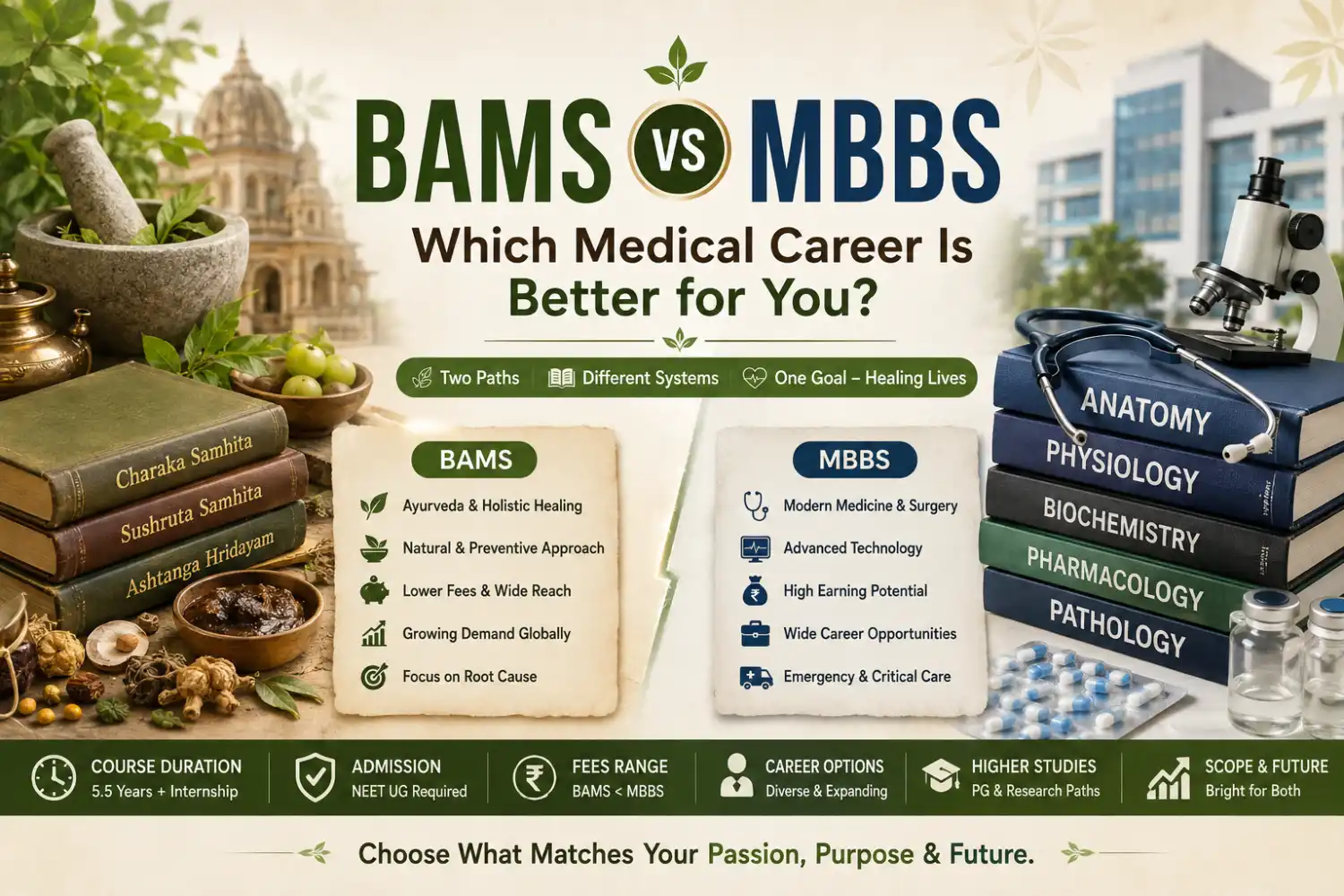
BAMS vs MBBS: Which Medical Career Is Better for You?
Neither degree is better in the abstract. MBBS trains a doctor in modern medicine and…
Can You Put ‘Dr’ After Studying at an Ayurveda Institute in Delhi?
Yes, but only if the course is a full BAMS degree. A graduate of an…
Sinusitis Cure in Ayurveda: Shalakya Tantra Guide
INTRODUCTION Current healthcare data suggests that chronic sinusitis impacts over 30 million individuals annually, creating…