Low NEET Score? You Can Still Get Into One of the Top 10 Private BAMS Colleges in UP
Home / BAMS / Low NEET Score? You Can Still Get Into One of the Top 10 Private BAMS Colleges in UP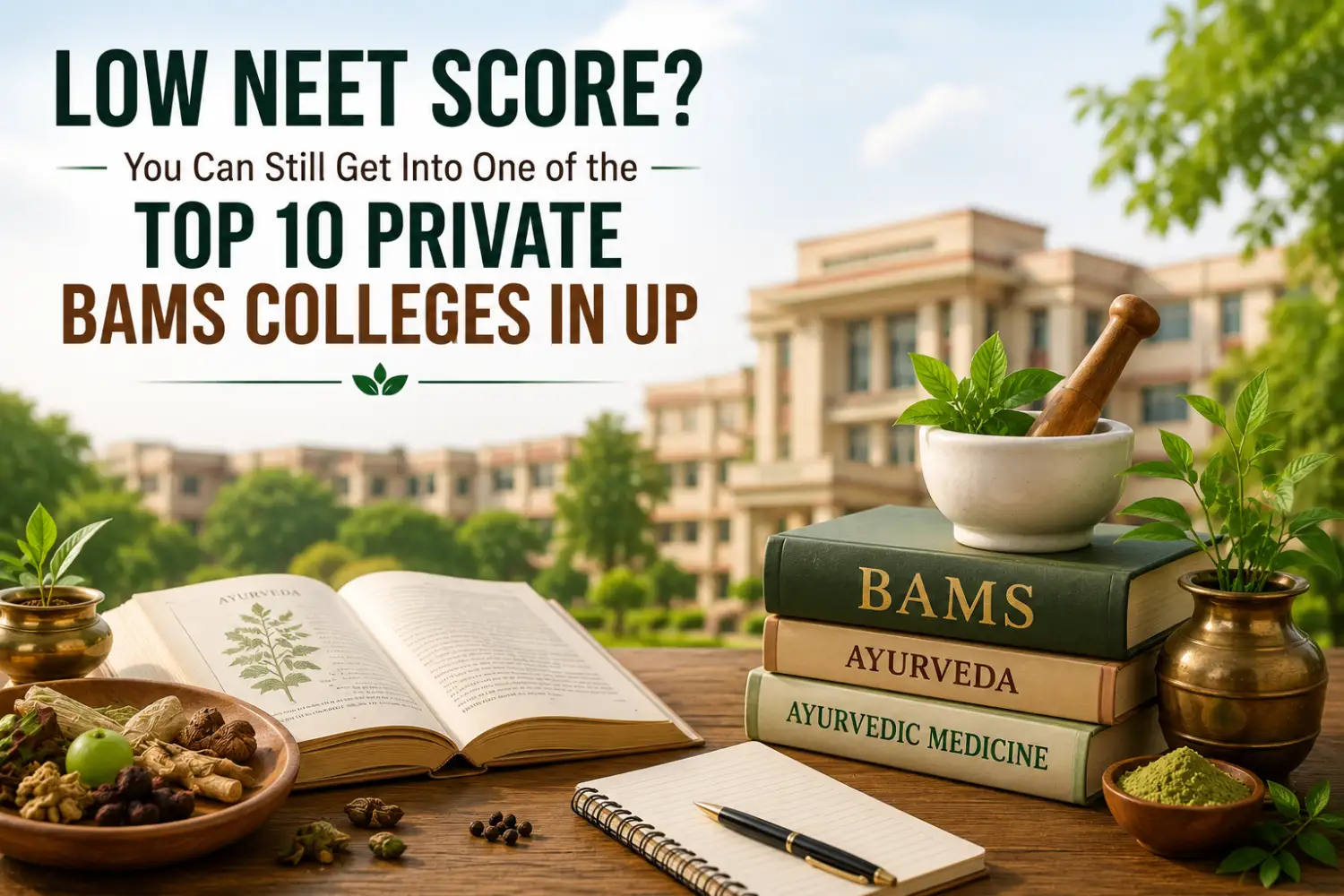
A low NEET score does not end an Ayurveda career. Uttar Pradesh runs one of the largest AYUSH seat pools in India, with 82 BAMS colleges and 6,213 seats, and only around nine of those colleges are government run. Any NEET-qualified student can apply through UP AYUSH counselling and still reach one of the top 10 private BAMS colleges in UP, such as DJ Ayurvedic Medical College and Hospital in Modinagar, Ghaziabad.
Why a Low NEET Score Feels Like the End, and Why It Is Not
The day NEET results come out, a lot of homes go quiet. A student opens the scorecard, sees a number lower than expected, and starts to believe the medical dream is finished. Parents begin talking about a drop year. Friends start sharing college lists that feel out of reach.
The reality on the ground is somewhat different. A NEET score decides which door opens first. It does not decide whether a student can become a doctor at all. Every year, thousands of NEET-qualified students in Uttar Pradesh begin an ayurvedic medical degree with scores that would never fetch a government MBBS seat. Five and a half years later they walk out as registered doctors with their own OPD.
Not everyone is aware of how big the Ayurveda seat pool in Uttar Pradesh actually is. That single fact is why a modest score can still lead to one of the top 10 private BAMS colleges in UP. This article explains how that works, what the numbers really say, and what a BAMS degree is worth once the course is over.
What Does a Low NEET Score Actually Mean in 2026?
A low NEET score means only one thing. It rules out the most competitive seats. It does not rule the student out of medicine.
NEET UG 2026 was re-conducted on 21 June 2026 after the May paper was cancelled, and the result came on 16 July 2026. Close to 20 lakh students appeared. Around 11.21 lakh of them qualified. Uttar Pradesh alone produced over 1.70 lakh qualified candidates, the highest of any state in the country.
Now place that beside the seat position. India has roughly 1.37 lakh MBBS seats in total. So lakhs of qualified students every year have to look past MBBS. Ayurveda is where a large share of them land, and many are glad they did.
NEET UG 2026 in Numbers
| Particular | Figure |
|---|---|
| Registered candidates | 22,79,743 |
| Candidates who appeared | 19,99,895 |
| Candidates who qualified | 11,21,185 |
| Qualified candidates from Uttar Pradesh | Over 1.70 lakh, the highest of any state |
| Qualifying marks, General and EWS (50th percentile) | 715 to 213 |
| Qualifying marks, OBC, SC and ST (40th percentile) | 212 to 177 |
| Women share of qualified candidates | Above 58 per cent |
Source: National Testing Agency NEET UG 2026 result statement, as reported by PW Live and Careers360.
How Low Is Low When It Comes to a BAMS Seat?
One question that often comes up is this. What score is enough for Ayurveda?
There is no fixed answer, and any website that gives one is guessing. Closing ranks are published by the counselling authority only after each round is finished. What earlier cycles do show is a steady pattern. Government Ayurveda colleges close at much higher scores. Private colleges keep moving down through the later rounds, and seats are often still available in mop-up and stray vacancy rounds.
The table below shows the broad pattern from earlier years. Treat it as a planning guide, not a promise.
What Different NEET Score Bands Have Typically Opened (General Category, Indicative)
| NEET score band | What earlier cycles suggest |
|---|---|
| 500 and above | Government Ayurveda colleges and premier institutes such as the National Institute of Ayurveda, Jaipur |
| 350 to 500 | Better placed government colleges and the leading private Ayurveda colleges |
| 250 to 350 | A wide choice of BAMS private colleges in UP across the main counselling rounds |
| 213 to 250 | Private BAMS seats, mostly in later rounds and mop-up rounds |
| Below the qualifying mark | Not eligible for any AYUSH counselling in that cycle |
Source: Previous-year AYUSH counselling trends compiled by Careers360 and Collegedunia. Reserved category thresholds are lower. Official 2026 closing ranks are released only after each counselling round.
Read More: NEET UG 2026 and Your Path to a Bachelor Degree in Ayurvedic Medicine
Key Facts to Know Before Choosing Among the Top 10 Private BAMS Colleges in UP
These are the fixed rules of the game. Every student should know them before choice filling opens.
- NEET UG is compulsory for every BAMS seat in Uttar Pradesh, including management and NRI seats. There is no direct admission route under current NCISM rules.
- Seats are split into a 15 per cent All India Quota, handled by AACCC at aaccc.gov.in, with the balance filled through UP AYUSH counselling at upayushcounseling.upsdc.gov.in.
- Uttar Pradesh has 82 BAMS colleges holding 6,213 seats. Around nine are government colleges, which means private colleges hold the large majority of seats.
- The BAMS course runs for 5.5 years. That is 4.5 years of academic study followed by one year of compulsory rotating internship.
- Eligibility is 10+2 with Physics, Chemistry, Biology and English, at 50 per cent marks for General candidates and 40 per cent for reserved categories, with a minimum age of 17 years.
- Every college must hold a valid NCISM permission for the running session and must be affiliated to a recognised university. Both can be checked online in a few minutes.
Why Should a Student Earn an Ayurvedic Medical Degree?
Because the demand side of Ayurveda has changed, and the numbers say so plainly.
Many parents and students still believe that Ayurveda is a fallback option. A closer look at the sector shows that this belief is now out of date. The Government of India created a separate Ministry of Ayush in 2014. Since then Ayurveda has grown from a small market into a large one, with hospitals, wellness centres, insurance cover and export demand attached to it.
An ayurvedic medical degree also carries a legal standing that most people underestimate. A BAMS graduate registers with the state board and practises as a doctor. That is a licence to treat patients, not a certificate of attendance.
How the AYUSH Sector Has Grown
| Indicator | Figure |
|---|---|
| AYUSH market size in 2014 | USD 2.85 billion |
| AYUSH market size in 2023 | USD 43.4 billion |
| Registered AYUSH practitioners in India | Over 7,55,780 |
| AYUSH undergraduate colleges in India | 886 |
| AYUSH hospitals | 3,859 |
| AYUSH dispensaries | 37,385 |
| AYUSH Health and Wellness Centres | 8,168 |
| Indians who used an AYUSH system in the previous year | About 46 per cent rural and 53 per cent urban |
Source: Ministry of Ayush figures released through the Press Information Bureau, the Invest India AYUSH sector page, and the all-India AYUSH household survey conducted between July 2022 and June 2023.
It is worth noting what sits behind that survey figure. Ayurveda was the system most commonly used in both rural and urban India. A student joining a BAMS programme today is training for a patient base that already exists.
What Career Possibilities Open Up After a BAMS Degree?
A career after BAMS degree is wider than most Class 12 students expect. The obvious route is clinical practice. The less obvious routes are often the better paying ones.
From an employer’s point of view, a BAMS graduate brings something a plain science graduate does not. Clinical training sits alongside knowledge of herbal pharmacology. That mix is now wanted in the wellness business, in the Ayurvedic pharmaceutical industry and in government health programmes.
Career Paths After a BAMS Degree
| Career path | What the work involves | Indicative starting pay per year |
|---|---|---|
| Ayurvedic doctor in private practice | Own clinic, OPD consultation and Panchakarma treatment | Rs 6 lakh to Rs 8.5 lakh, as stated on the DJ Ayurveda BAMS page |
| Medical officer in a government AYUSH set-up | Postings in AYUSH dispensaries, wellness centres and hospitals | Rs 5 lakh to Rs 12 lakh, as reported by AYUSH admission portals |
| MD or MS in Ayurveda through AIAPGET | Specialisation in Panchakarma, Kayachikitsa, Shalya Tantra and other branches | Rises after postgraduate qualification |
| Ayurvedic pharmaceutical industry | Product development, quality control and medical advisory roles | Varies by employer and location |
| Wellness and Panchakarma centres | Therapy planning and clinical supervision in India and abroad | Varies by employer and location |
| Research and teaching | Work with research councils and teaching posts in Ayurveda colleges | Varies by role and institution |
Source: Career and salary bands published on the DJ Ayurvedic Medical College BAMS page and on AYUSH admission portals. Actual pay depends on city, employer and experience.
Read More: BAMS Courses and Their Rising Global Popularity
How Should a Student Judge the Top 10 Private BAMS Colleges in UP?
Here is something worth saying plainly. No government body publishes an official ranked list of the top 10 private BAMS colleges in UP. NCISM regulates and permits colleges, it does not rank them, and NIRF has no separate Ayurveda category. So every top ten list a student reads online is somebody’s opinion.
That does not make the search pointless. It only means the student has to judge on facts that can be checked. The table below sets out what really separates a strong private Ayurveda college from a weak one.
A Checklist for Shortlisting BAMS Private Colleges in UP
| What to check | Why it matters | Where to verify |
|---|---|---|
| NCISM permission for the current session | A college without valid permission cannot admit students that year | ncismindia.org and the college NCISM disclosure page |
| Affiliating university | The degree is awarded by the university, not by the college | Official university website |
| Attached teaching hospital and bed count | Ayurveda is learnt at the bedside, not only in the classroom | College NCISM disclosure documents |
| Daily OPD numbers | More patients each day means more real cases during training | College hospital page and OPD records |
| Number of departments | Fourteen departments are needed to cover the full BAMS syllabus | College academics page |
| Full-time teaching staff | Directly affects teaching quality and clinical guidance | Teaching staff list on the college website |
| Panchakarma facility | Panchakarma is a core clinical skill and a major earner later | College hospital page |
| Approved fee notification | Private fees are re-approved every year by the state authority | Official fee notification for the session |
Source: NCISM minimum standards for undergraduate Ayurveda colleges and attached teaching hospitals, and college disclosure requirements published at ncismindia.org.
Why Choose DJ Ayurvedic Medical College and Hospital?
Divya Jyoti Ayurvedic Medical College and Hospital sits on the DJ Group campus at Niwari Road, Modinagar, in Ghaziabad district. That location places it inside the Delhi NCR belt, which matters for students travelling from western Uttar Pradesh and from Delhi.
The college is approved by NCISM and affiliated to Mahayogi Guru Gorakhnath AYUSH University. Its published NCISM intake disclosure lists 100 sanctioned BAMS seats. The hospital opened first, in 2012, and the college followed in 2017. That order matters, because the hospital is where students actually learn.
- Ranked first in UP AYUSH counselling for two years running, in 2023 and 2024, as stated by the college.
- One hundred sanctioned BAMS seats, as listed in the college intake capacity disclosure.
- A teaching hospital with over 100 beds, running full OPD and IPD services on the same campus.
- Around 200 patients in the OPD every day, so students see real cases from the early years of the course.
- Fourteen specialised departments, covering Panchakarma, Kayachikitsa, Shalya Tantra, Dravyaguna and the rest of the syllabus.
- A dedicated Panchakarma centre with over 10 therapy rooms and eight certified therapists.
- Over 110 teaching faculty members handling academic and clinical mentoring.
- Over 500 graduates now working in hospitals, wellness centres and research bodies in India and abroad.
- Graduates placed at Yashoda Hospital, Felix Hospital, Patanjali, Sri Sri Tattva and IMS BHU, among others.
- Research published in peer-reviewed journals including Annals of Ayurvedic Medicine and Aryavaidyan.
- Study visits to the All India Institute of Ayurveda, New Delhi and to PCIM and H.
- A herbal garden, working laboratories, a digital library and a learning management system for students.
- Over 10 free medical camps every year, serving above 5,000 people in nearby rural and urban areas.
For a student who has qualified NEET with a modest score and wants an ayurvedic medical hospital attached to the classroom rather than a distant tie-up, this is the kind of college that belongs on a serious shortlist of the top 10 private BAMS colleges in UP.
Conclusion
A NEET scorecard is a starting point, not a verdict. It tells a student which seats are already gone. It says nothing about the kind of doctor that student will become.
Uttar Pradesh has the seats. The AYUSH sector has the patients and the jobs. What a student still has to find is a college with a working hospital, valid permission, enough teachers and a proper Panchakarma unit. Judged on those four things rather than on a random online list, a place among the top 10 private BAMS colleges in UP is well within reach, even for a student whose score fell short of an MBBS seat.
It would not be wrong to say that the students who do best in Ayurveda are rarely the ones with the highest NEET scores. They are the ones who picked a college where patients walk in every morning.
Frequently Asked Questions
Yes. A student only needs to clear the NEET qualifying percentile, which is the 50th percentile for General and EWS candidates and the 40th percentile for OBC, SC and ST candidates. Private Ayurveda colleges in Uttar Pradesh fill seats at much lower scores than government colleges, especially in later counselling rounds.
For NEET UG 2026 the qualifying range was 715 to 213 marks for General and EWS candidates, and 212 to 177 marks for OBC, SC and ST candidates. Clearing this range only makes a student eligible for counselling. The actual admission cut-off is decided round by round.
Uttar Pradesh has 82 BAMS colleges offering 6,213 seats in the state counselling pool. Around nine of these are government colleges, so the large majority of seats sit with private colleges. Different listing websites report slightly different totals, so always check the official seat matrix.
Yes. NEET UG qualification is compulsory for every BAMS seat in Uttar Pradesh, in both government and private colleges. This includes management and NRI seats. Under current NCISM rules there is no direct admission route to any Ayurveda college in India.
Two bodies handle it. The AYUSH Admissions Central Counselling Committee runs the 15 per cent All India Quota at aaccc.gov.in. The Department of AYUSH, Government of Uttar Pradesh, runs state counselling for the remaining seats at upayushcounseling.upsdc.gov.in. Students must register separately for each.
The BAMS programme runs for 5.5 years in total. This covers 4.5 years of academic study across four professional years, followed by one year of compulsory rotating internship in an attached teaching hospital. The internship is where most clinical confidence is built.
No. NCISM regulates and permits Ayurveda colleges but does not rank them, and NIRF has no separate Ayurveda category. Any top ten list found online reflects the opinion of that website. Students should judge colleges on hospital size, OPD numbers, faculty strength and current NCISM permission.
A candidate must have passed 10+2 with Physics, Chemistry, Biology and English. General candidates need 50 per cent marks in the science subjects, while reserved category candidates need 40 per cent. The minimum age is 17 years, and a valid NEET UG score is mandatory.
Graduates practise as registered Ayurvedic doctors, work as medical officers in government AYUSH set-ups, join Ayurvedic pharmaceutical companies, run Panchakarma and wellness centres, or move into research and teaching. Many also sit for AIAPGET and take an MD or MS in Ayurveda for higher pay.
Ayurveda is a clinical subject. Students learn pulse reading, case taking and Panchakarma by treating patients under supervision, not from textbooks alone. A college with a busy OPD and a well-staffed teaching hospital gives far better training than one with a hospital that stays empty.
Related Blogs
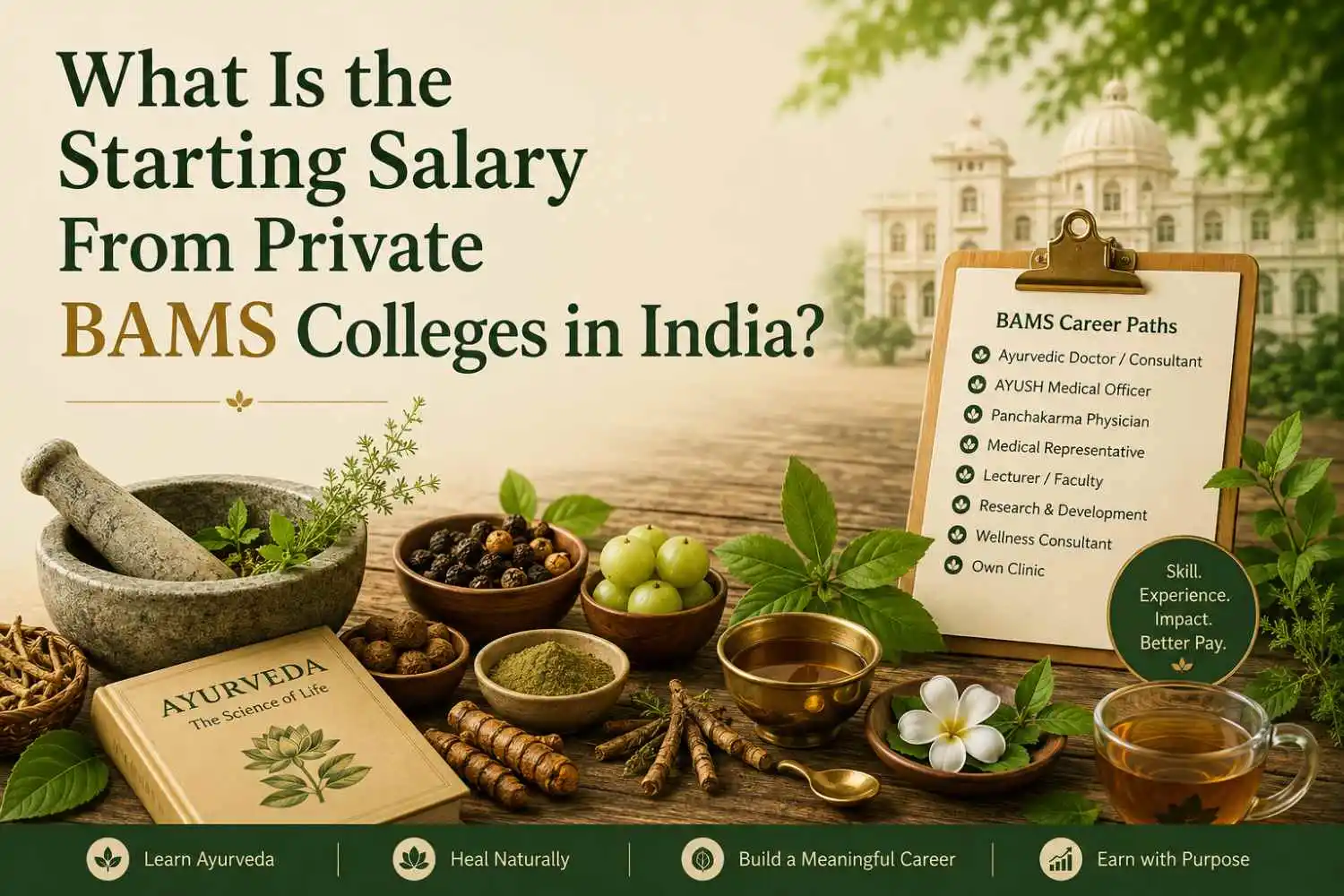
What Is the Starting Salary From Private BAMS Colleges in India?
The starting salary from private BAMS colleges in India usually falls between ₹2.5 lakh and…
Best BAMS Colleges in UP: BAMS Admission 2027 Eligibility, NEET Requirements, Counselling and Fees
The best BAMS colleges in UP take admission only through NEET UG scores, followed by…
Panchamahabhuta: The Five Elements Behind Ayurvedic Medicine
Panchamahabhuta refers to the five great elements that Ayurveda regards as the building blocks of…
Panchakarma Specialisation After BAMS: Career Opportunities and Scope for Students
A student walks into the Panchakarma block for the first time in third year. Warm…
Kaumarbhritya: Career Scope in Ayurvedic Paediatrics After BAMS at an Ayurvedic Medical College
What is Kaumarbhritya, and what career does it offer? Kaumarbhritya is the paediatrics branch of…
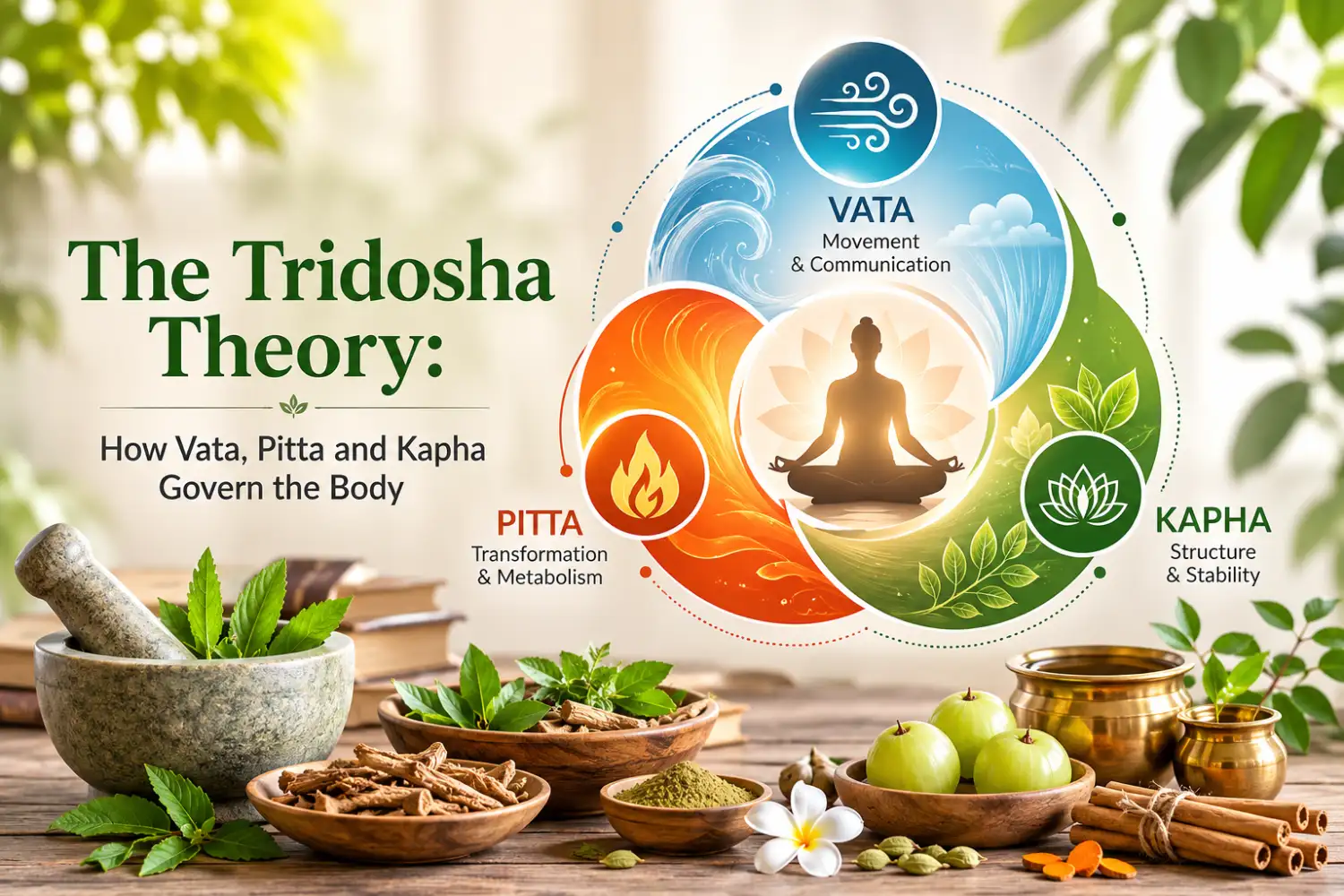
The Tridosha Theory: How Vata, Pitta and Kapha Govern the Body
The Tridosha theory is the foundation of Ayurvedic physiology. It holds that three functional energies,…