
Kaumarbhritya: Career Scope in Ayurvedic Paediatrics After BAMS at an Ayurvedic Medical College
Home / BAMS / Kaumarbhritya: Career Scope in Ayurvedic Paediatrics After BAMS at an Ayurvedic Medical College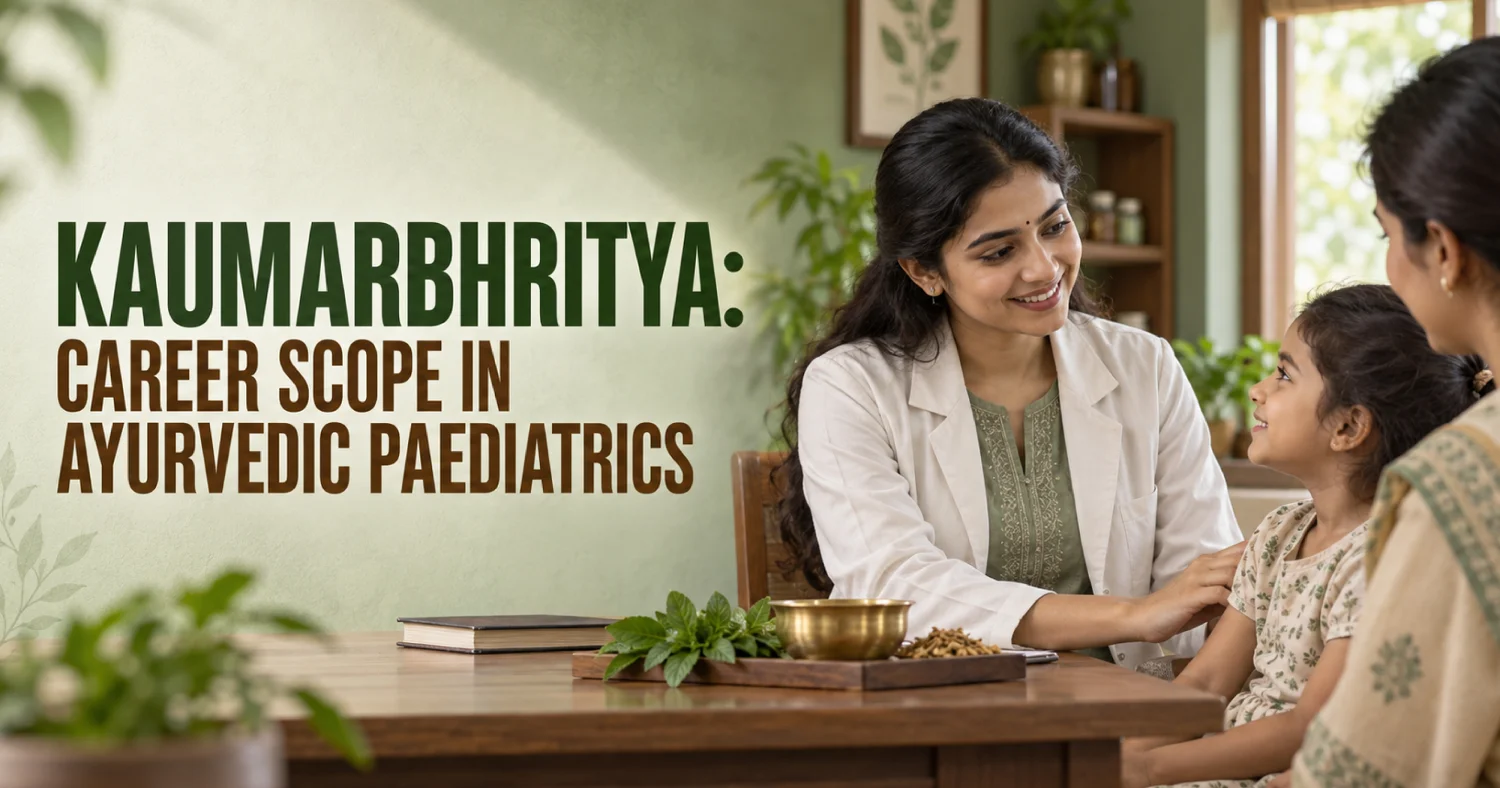
| What is Kaumarbhritya, and what career does it offer?
Kaumarbhritya is the paediatrics branch of Ayurveda. It covers child care from birth to sixteen years, along with newborn care, breastfeeding guidance, growth problems, immunity and common childhood illness. After BAMS, a graduate can do an MD in Kaumarbhritya, run a child care clinic, work in an Ayurveda hospital, join a government Ayush post, teach, or work in research and child nutrition projects. The subject is taught in the third year of BAMS at every ayurvedic medical college approved by NCISM. |
Parents worry most about one thing. Their child. A baby who refuses food, a toddler who falls sick every month, a five year old who is shorter than the rest of the class. These are the cases that fill a paediatric OPD every single morning.
Kaumarbhritya is the Ayurveda branch built around these worries. It is often called Bala Chikitsa, or child treatment. While the course is popular, there is much more to it than most people realise. It covers newborn care, feeding advice, growth tracking, immunity building and the treatment of common child illness.
At some point, most students wonder whether child care in Ayurveda can support a full career. The answer sits in the numbers. This blog explains what Kaumarbhritya is, where it fits in the Ayurveda classifications, what a specialist treats, the kaumarbhritya career routes after BAMS, and what a student should check in an ayurvedic medical college before filling counselling choices. All data comes from NFHS-5, the Ministry of Ayush and NCISM, with links at the bottom.
What Is Kaumarbhritya in Ayurveda?
Kaumar means child. Bhritya means care or upbringing. So Kaumarbhritya means the care of children. In plain words, it is Ayurvedic paediatrics.
The subject covers four clear stages:
- Navajata Shishu: newborn care right after birth, including first feeds and cord care
- Ksheerap: the milk fed stage, up to about one year
- Ksheerannad: the mixed stage, when milk and soft food run together
- Annad: the food eating stage, when the child eats a normal diet
Kashyapa Samhita is the main classical text for this branch. It is the oldest Ayurveda work fully built around child health, and it still guides teaching today.
Where Does Kaumarbhritya Sit in the Ayurveda Classifications?
Ayurveda classifications place all treatment under eight branches, called Ashtanga Ayurveda. Kaumarbhritya is one of them.
| Branch of Ayurveda | Closest Modern Subject | Main Area of Work |
|---|---|---|
| Kayachikitsa | General medicine | Long standing whole body disorders |
| Kaumarbhritya | Paediatrics | Newborn care, child growth, child illness |
| Shalya Tantra | Surgery | Wounds, piles, fistula, Kshar Sutra work |
| Shalakya Tantra | ENT and ophthalmology | Eye, ear, nose, throat and teeth |
| Bhoot Vidya | Psychiatry | Mind, behaviour and mental health |
| Agada Tantra | Toxicology | Poisons and medico legal work |
| Rasayana | Geriatrics and immunity | Ageing, strength and disease prevention |
| Vajikarana | Reproductive medicine | Fertility and reproductive health |
Table 1: The eight Ayurveda classifications, with Kaumarbhritya as the child health branch. Source: NCISM undergraduate Ayurveda curriculum and Ministry of Ayush.
What Does a Kaumarbhritya Doctor Treat?
It is quite common to hear that Ayurveda only handles adult problems. The reality on the ground is somewhat different. A child OPD in any teaching hospital runs full through the year.
| Common Child Problem | Ayurvedic Approach Taught in Kaumarbhritya |
|---|---|
| Poor appetite and weak digestion | Agni correction with Deepan and Pachan medicines, diet timing |
| Repeated cough, cold and throat trouble | Sitopaladi, Vyaghri Haritaki, steam and seasonal routine |
| Low immunity and frequent infection | Suvarnaprashan drops, given on Pushya Nakshatra days |
| Slow weight gain and low strength | Lehana therapy with medicated ghee and herbal pastes |
| Delayed milestones and weak muscle tone | Bala Taila Abhyanga massage with Medhya herbs |
| Worm infestation, called Krimi | Vidangadi group formulations and diet correction |
| Skin rashes and nappy problems | Herbal oils, powders and change of feeding pattern |
| Bedwetting, poor sleep and restlessness | Medhya Rasayana herbs and daily routine correction |
Table 2: Child conditions handled under Kaumarbhritya. Source: Kashyapa Samhita based NCISM syllabus for Kaumarbhritya.
Suvarnaprashan is the point that brings most parents in. It is a gold based immunity drop given to children, usually on Pushya Nakshatra days. Many an ayurvedic medical college now runs a monthly Suvarnaprashan camp, and students handle the queue themselves.
Why Does India Need More Child Health Doctors?
Numbers answer this better than opinions. The National Family Health Survey, run by the Ministry of Health and Family Welfare, gives the clearest picture.
| Child Health Indicator | Figure for India | Source |
|---|---|---|
| Children under five who are stunted | 35.5 per cent | NFHS-5, 2019-21 |
| Children under five who are wasted | 19.3 per cent | NFHS-5, 2019-21 |
| Children under five who are underweight | 32.1 per cent | NFHS-5, 2019-21 |
| Children aged 6 to 59 months who are anaemic | 67.1 per cent | NFHS-5, 2019-21 |
| Severe wasting in children under five | 7.7 per cent, up from 7.5 per cent | NFHS-5 compared with NFHS-4 |
| Indian children under five who are stunted | About 37 million | UN State of Food Security and Nutrition report, 2025 |
Table 3: Child health data for India. Source: NFHS-5 and United Nations SOFI report.
A closer look at the industry shows why this matters. Weak digestion, low immunity and poor weight gain are day to day Kaumarbhritya cases. Demand for child health support is not a future guess. It is already on the ground.
What Career Paths You Can Explore After Studying Kaumarbhritya?
A kaumarbhritya career starts with BAMS and grows with an MD. The routes below cover both clinical and non clinical work.
| Career Option | Where You Work | What You Need |
|---|---|---|
| Child care Ayurveda physician | Ayurveda hospital child OPD and IPD | BAMS with state council registration |
| Own paediatric Ayurveda clinic | Private clinic in a town or city | Registration and a clinic licence |
| MD Kaumarbhritya specialist | Consultant in hospitals and clinics | Three year MD through AIAPGET |
| College teaching faculty | Kaumarbhritya department of a college | MD in Kaumarbhritya |
| Ayush Medical Officer | Government dispensary, Ayushman Arogya Mandir | State PSC or Ayush department notice |
| Child nutrition and public health work | NGO projects, government nutrition schemes | BAMS, often with an MPH |
| Research associate | CCRAS, universities, college research cells | MD or research project openings |
| Ayurveda pharma, child products | Herbal drug and baby care product firms | BAMS with product or QC training |
| Panchakarma and Suvarnaprashan services | Wellness centres and child clinics | BAMS with therapy training |
Table 4: Kaumarbhritya career options after BAMS. Source: Ministry of Ayush career streams and NCISM postgraduate subject list.
What Pay Can a Kaumarbhritya Doctor Expect?
Pay depends on the city, the sector and the skill of the doctor. Government posts follow the pay matrix. Private pay starts lower and rises with reputation.
| Stage or Role | Reported Monthly Pay (INR) | Source |
|---|---|---|
| Fresh BAMS graduate, private clinic | 20,000 to 40,000 | Vedantu BAMS salary guide |
| BAMS doctor, national average | About 33,000 | Collegedunia, AmbitionBox data |
| Government Ayush Medical Officer, start | 70,000 to 85,000 in hand | SalaryInsight, pay matrix Level 10 |
| After MD in Ayurveda | 60,000 to 1,20,000 | Vedantu BAMS salary guide |
| Settled own practice | 50,000 to 2,00,000 and above | SalaryInsight |
Table 5: Indicative pay after BAMS and MD. Actual pay varies by state and employer.
How Do You Become a Kaumarbhritya Specialist?
The path is fixed and the same across the country. It runs through NEET UG, then BAMS, then a postgraduate degree.
| Step | Stage | Time Taken |
|---|---|---|
| 1 | Class 12 with Physics, Chemistry, Biology and English, 50 per cent in PCB | 2 years |
| 2 | Qualify NEET UG, held by the National Testing Agency | Same year |
| 3 | UP AYUSH Counselling for state quota, or AACCC for all India quota | A few months |
| 4 | BAMS course, with Kaumarbhritya taught in the third professional year | 4.5 years |
| 5 | Rotating internship, including a paediatric posting | 1 year |
| 6 | State council registration as an Ayurveda practitioner | A few weeks |
| 7 | AIAPGET, then MD in Kaumarbhritya | 3 years |
Table 6: Step by step route to becoming a Kaumarbhritya specialist. Source: NCISM regulations and AACCC information bulletin.
Every NCISM approved ayurvedic medical college follows this same pattern, so the student only has to pick the campus with the better child OPD and teaching staff.
What Should You Check in an Ayurvedic Medical College Before Joining?
Brochures look almost the same. The real difference shows inside the hospital, not in the reception area.
| What to Check | Why It Matters for Kaumarbhritya | DJ Ayurvedic Medical College & Hospital |
|---|---|---|
| NCISM approval and university | Decides degree validity and registration | NCISM approved, affiliated to Mahayogi Guru Gorakhnath AYUSH University |
| Working child OPD | Child cases cannot be learnt from books alone | Around 200 daily OPD patients across departments |
| Paediatric clinic on campus | Gives focused child case practice | 10 plus special clinics, including paediatric care |
| Teaching hospital beds | IPD cases build clinical judgement | 100 bedded hospital, running since 2012 |
| Departments on campus | Kaumarbhritya needs support from allied subjects | 14 departments across all Ayurveda branches |
| Faculty strength | Bedside teaching depends on it | Over 110 teaching faculty members |
| Workshops and CME | Keeps students current on child care methods | Regular workshops, including one on Kaumarbhritya |
| Placement record | Shows where past students reached | 500 plus graduates placed, including Patanjali and Felix Hospital |
Table 7: Checklist for comparing Ayurveda colleges. Source: NCISM college standards and DJ Ayurvedic Medical College & Hospital records.
From a student’s perspective, the child OPD number decides everything. Any ayurvedic medical college in Uttar Pradesh with a quiet paediatric clinic cannot teach child case handling, whatever its brochure claims.
Why Choose DJ Ayurvedic Medical College & Hospital?
The campus sits in Modinagar, Ghaziabad. Students from Delhi NCR, Meerut, Noida and western Uttar Pradesh reach it without much travel trouble.
- Ranked number one in UP AYUSH Counselling for two years in a row, 2023 and 2024
- NCISM approved and affiliated to Mahayogi Guru Gorakhnath AYUSH University
- College founded in 2017, with its attached hospital running since 2012
- Full 5.5 year BAMS course joining classical Ayurveda teaching with modern clinical study
- 100 bedded teaching hospital with OPD and IPD on campus
- Around 200 daily OPD patients, so students see real cases through the year
- 14 departments, covering Kaumarbhritya, Kayachikitsa, Panchakarma, Shalya Tantra and Dravyaguna
- 10 plus special clinics, including paediatric care, skin disease and joint disorders
- Panchakarma centre with 10 therapy rooms and 8 certified therapists
- Over 110 faculty members for classroom and bedside teaching
- Clinical skill workshops on Kaumarbhritya, Nadi Pariksha and Shalya Tantra
- 500 plus graduates working with Yashoda Hospital, Felix Hospital, Patanjali, Sri Sri Tattva and IMS BHU
- Around 10 free medical camps a year, serving close to 5,000 people in nearby areas
- Herbal garden, well fitted laboratories, digital library and an online learning system
- Research papers published in Annals of Ayurvedic Medicine and Aryavaidyan
- Study visits to the All India Institute of Ayurveda, New Delhi and PCIM&H
- Student support and placement cell that handles career guidance
For a student aiming at child health, DJ Ayurveda works well as an ayurvedic medical college in Uttar Pradesh, because the paediatric clinic and the free camps both bring in child cases through the year.
Conclusion
It would not be wrong to say that Kaumarbhritya is one of the most settled branches in Ayurveda practice. Parents keep coming back with their children, and a paediatric clinic builds a loyal patient base faster than most other branches.
NFHS-5 shows that over one third of Indian children under five are stunted and two thirds are anaemic. Those figures alone explain the room available for a kaumarbhritya career. The degree is only the start though. What matters is how many children a student has examined before internship ends. So pick an ayurvedic medical college with a busy child OPD, a paediatric clinic and teachers who take rounds. DJ Ayurvedic Medical College & Hospital, Modinagar, offers all three, and admission runs through NEET UG and UP AYUSH Counselling.
Frequently Asked Questions
Kaumarbhritya is the paediatrics branch of Ayurveda. Kaumar means child and Bhritya means care. It covers newborn care, breastfeeding guidance, child growth, immunity and the treatment of common childhood illness, usually up to the age of sixteen.
Yes. Ayurveda classifications divide treatment into eight branches, known as Ashtanga Ayurveda. Kaumarbhritya is the child health branch. The other seven are Kayachikitsa, Shalya Tantra, Shalakya Tantra, Bhoot Vidya, Agada Tantra, Rasayana and Vajikarana.
A graduate can work in a child OPD, open a paediatric Ayurveda clinic, do an MD in Kaumarbhritya, teach in a college, join a government Ayush post, or work in child nutrition projects, research and herbal baby care product firms.
Clear Class 12 with PCB and English, qualify NEET UG, join BAMS through counselling, finish 4.5 years of study and one year of internship, register with the state council, then clear AIAPGET and complete a three year MD in Kaumarbhritya.
Kaumarbhritya is taught in the third professional year of the BAMS course, along with Swasthavritta, Agad Tantra and Prasuti Tantra, as per the NCISM curriculum.
Suvarnaprashan is a gold based immunity preparation given to children as drops. It is usually given on Pushya Nakshatra days. Many Ayurveda colleges and clinics run monthly Suvarnaprashan camps for children.
Kashyapa Samhita is the main classical text for Kaumarbhritya. It is the oldest Ayurveda work fully built around child health and it still guides teaching in colleges today.
Career portals report about 20,000 to 40,000 rupees a month for fresh BAMS graduates in private clinics. Pay after an MD is reported between 60,000 and 1,20,000 a month. Government Ayush Medical Officer posts follow Level 10 of the pay matrix.
Yes. NEET UG is compulsory for every BAMS seat in India, including private, management and NRI quota seats.
BAMS runs for 5.5 years. That covers 4.5 years of study and one full year of rotating internship in the attached teaching hospital.
Look for a campus with a working child OPD, a paediatric clinic, enough hospital beds and regular workshops. DJ Ayurvedic Medical College & Hospital, Modinagar, ranked first in UP AYUSH Counselling in 2023 and 2024 and runs a 100 bedded teaching hospital with paediatric care.
Yes. Ayush Medical Officers posted at Ayushman Arogya Mandir centres and district Ayush units take part in child nutrition and health programmes. Some graduates also work with NGOs running child nutrition projects.
Related Blogs
What Is Panchakarma and How Does It Work
Panchakarma is a structured system of five Ayurvedic cleansing procedures designed to remove accumulated toxins,…
Panchakarma Specialisation After BAMS: Career Opportunities and Scope for Students
A student walks into the Panchakarma block for the first time in third year. Warm…
Ayurvedic Doctor Course: Major Specialisations, Courses and Career Scope
An ayurvedic doctor course in India means the BAMS degree. It runs for 5.5 years,…
How WHO’s Push for Traditional Medicine is Influencing Ayurveda Courses in India
If you have ever thought about studying Ayurveda, you might have noticed that the conversation…
Why Is Ayurveda Becoming Popular in Modern Healthcare? A Student’s Guide to Choosing an Ayurveda College in Noida
Ayurveda is becoming popular in modern healthcare because people now want care that prevents illness,…
Re-NEET UG Result 2026 Out: Know Toppers, Cut-Offs and Your BAMS Admission Roadmap
The Re-NEET UG Result 2026 is out. The National Testing Agency declared it on 16…