BAMS Course vs Other AYUSH Courses: Differences in Eligibility, Study Duration and Career Paths
Home / BAMS / BAMS Course vs Other AYUSH Courses: Differences in Eligibility, Study Duration and Career Paths
The BAMS course (Bachelor of Ayurvedic Medicine and Surgery) is the largest of India’s AYUSH degrees. The others are BHMS (Homoeopathy), BUMS (Unani), BSMS (Siddha) and BNYS (Naturopathy and Yoga). BAMS, BHMS, BUMS and BSMS each take 5.5 years, including a one-year internship, and need NEET-UG. BUMS adds an Urdu rule and BSMS a Tamil rule. BNYS admission rules differ by state. Ayurveda has the most doctors, with 3,55,416 registered practitioners.
Introduction
At some point, most students who clear NEET wonder about one thing. Should they pick the BAMS course, or BHMS, BUMS or BSMS? All of them lead to the title “Dr”. All of them fall under the Ministry of Ayush. Yet the subjects, the rules and the jobs are quite different.
It is quite common to hear that all AYUSH degrees are the same. The reality on the ground is somewhat different. India had 7,51,768 registered AYUSH practitioners as on 1 January 2023, and almost half of them practise Ayurveda. This guide puts each course side by side, so students and parents can decide with facts, not rumours.
What Do AYUSH Courses Include?
AYUSH stands for Ayurveda, Yoga and Naturopathy, Unani, Siddha, Sowa-Rigpa and Homoeopathy. Each system has its own degree.
- BAMS: Bachelor of Ayurvedic Medicine and Surgery.
- BHMS: Bachelor of Homoeopathic Medicine and Surgery.
- BUMS: Bachelor of Unani Medicine and Surgery.
- BSMS: Bachelor of Siddha Medicine and Surgery.
- BNYS: Bachelor of Naturopathy and Yogic Sciences.
- Sowa-Rigpa: The Tibetan system, taught in only 7 colleges across India.
The National Commission for Indian System of Medicine (NCISM) regulates Ayurveda, Unani, Siddha and Sowa-Rigpa. The National Commission for Homoeopathy (NCH) regulates BHMS.
What Is the BAMS Course?
The BAMS course trains students to become Ayurvedic doctors. It mixes classical Ayurveda with modern medical science.
BAMS course details at a glance
- Duration: 5.5 years, made up of 4.5 years of study and a 1-year internship.
- Entrance: NEET-UG is compulsory.
- Regulator: NCISM.
- Core subjects: Kayachikitsa (medicine), Panchakarma, Shalya Tantra (surgery), Dravyaguna (herbs), Kaumarbhritya (child care) and Prasuti Tantra (obstetrics).
- Modern subjects: Anatomy, physiology, pathology and diagnosis.
You can read the full year-wise plan in the BAMS course details at DJ Ayurveda.
BAMS Course vs Other AYUSH Courses: Side-by-Side Comparison
This table gives a quick view of every AYUSH degree. It covers the basics students ask about first.
Table 1: AYUSH Degrees Compared (Sources: NCISM regulations via Medical Dialogues, Tamil Nadu DIM&H, Careers360, Dinamalar, MahaCET)
| Course | System | Regulator | Duration | NEET | Extra Rule |
|---|---|---|---|---|---|
| BAMS | Ayurveda | NCISM | 5.5 years (incl. 1-year internship) | Yes | None |
| BHMS | Homoeopathy | NCH | 5.5 years (incl. internship) | Yes | None |
| BUMS | Unani | NCISM | 5.5 years (incl. 1-year internship) | Yes | Urdu, Arabic or Persian, or study Urdu in year one |
| BSMS | Siddha | NCISM | 5.5 years (incl. internship) | Yes | Tamil, or study Tamil in year one |
| BNYS | Naturopathy and Yoga | State rules | 5.5 years (incl. 1-year internship) | Varies by state | State domicile rules in some states |
Eligibility: How Does the BAMS Course Compare?
Not everyone is aware that eligibility is nearly the same for most AYUSH degrees. The differences sit in language and state rules.
Common rules for BAMS, BHMS, BUMS and BSMS
- Pass Class 12 with Physics, Chemistry, Biology (or Biotechnology) and English.
- Qualify NEET-UG: the 50th percentile for general and the 40th percentile for SC, ST and OBC candidates.
- Be at least 17 years old by 31 December of the admission year.
- For the BAMS course, NCISM removed the old 50% PCB marks rule from the 2025 session.
Extra rules for BUMS, BSMS and BNYS
- BUMS: Students without Urdu, Arabic or Persian in Class 10 or 12 must study Urdu, Arabic and Logic in the first year, as per NCISM’s 2022 Unani regulations.
- BSMS: Students need Tamil up to Class 10 or 12, or must study Tamil in the first year.
- BNYS: Rules change by state. In Tamil Nadu, the 2025 notice said NEET was not needed, but only Tamil Nadu natives could apply.
Is NEET needed for the BAMS course and every other AYUSH course?
NEET is compulsory for the BAMS course, BHMS, BUMS and BSMS across India. BNYS is the main exception, as some states admit students on Class 12 marks. Students who plan to try both NEET-based and state-based options should track AACCC and state counselling dates side by side, since rounds often overlap in September and October.
AYUSH Course Duration: Is Any Course Shorter?
One question that often comes up is whether any AYUSH degree is quicker. The short answer is no.
- Every main AYUSH degree takes about 5.5 years, so no course saves time over another.
- The AYUSH course duration is set by each regulator, so colleges cannot shorten it.
- The last year is always a compulsory internship in a hospital.
- A PG degree (MD or MS) adds 3 more years. Ayurveda, Unani, Siddha and Homoeopathy graduates sit AIAPGET for PG seats.
How the 5.5 years of the BAMS course are split
- First professional: Basic principles, Sanskrit, Rachana Sharir (anatomy) and Kriya Sharir (physiology).
- Second professional: Dravyaguna, Rasashastra (pharmacy), pathology and Agad Tantra (toxicology).
- Third professional: Kayachikitsa, Panchakarma, Shalya, Shalakya, Prasuti Tantra and Kaumarbhritya.
- Internship: 12 months of supervised work in OPD, wards and Panchakarma units.
How Big Is Each AYUSH System in India?
The size of a system matters. More doctors and colleges usually mean more jobs, clinics and teaching posts.
Table 2: Registered Practitioners and Colleges by AYUSH System (Source: Ministry of Ayush, Lok Sabha Q. 3048, 13 December 2024)
| System | Registered Practitioners (1 Jan 2023) | Colleges (1 Apr 2023) | Share of Practitioners |
|---|---|---|---|
| Ayurveda (BAMS) | 3,55,416 | 541 | 47.3% |
| Homoeopathy (BHMS) | 3,30,407 | 270 | 44.0% |
| Unani (BUMS) | 51,969 | 58 | 6.9% |
| Siddha (BSMS) | 9,531 | 17 | 1.3% |
| Naturopathy (BNYS) | 4,379 | 49 (Yoga & Naturopathy) | 0.6% |
| Sowa-Rigpa | 66 | 7 | Below 0.1% |
| Total | 7,51,768 | 942 | 100% |
Ayurveda leads on both counts. The number keeps rising too. IBEF reports 563 Ayurveda colleges as of February 2026, and Medical Dialogues counts over 40,000 BAMS seats.
AYUSH Career Path: What Can Each Graduate Do?
Every AYUSH graduate can register and practise in their own system. The job market, though, is not the same size for each.
Table 3: AYUSH Career Path by Course (Sources: Ministry of Ayush data, Vedantu, SalaryInsight, AmbitionBox)
| Course | Common Career Paths | Where Demand Is Strongest |
|---|---|---|
| BAMS | Ayurvedic physician, Panchakarma specialist, AYUSH medical officer, pharma advisor, teacher after MD/MS, own clinic | All over India; wellness centres and Ayurvedic pharma companies |
| BHMS | Homoeopathic physician, own clinic, government dispensaries, teaching | All over India; strong in private practice |
| BUMS | Unani physician, Unani pharmacy, teaching | UP, Telangana, Maharashtra, Delhi and other Urdu-speaking regions |
| BSMS | Siddha physician, Siddha pharmacy, teaching | Mainly Tamil Nadu |
| BNYS | Naturopathy and yoga therapist, wellness resorts, lifestyle clinics | Wellness and lifestyle centres |
BAMS career options and salary
A BAMS career offers the widest set of roles among ayurvedic courses. Pay grows with skill and experience.
- Freshers earn ₹2 lakh to ₹5.4 lakh a year (AmbitionBox, 0 to 2 years).
- Government Ayurvedic hospital roles pay about ₹25,000 to ₹40,000 a month (SalaryInsight).
- Senior doctors with 5+ years earn ₹60,000 to ₹1,20,000+ a month (Vedantu).
- Ayurvedic brands such as Dabur, Himalaya and Patanjali hire BAMS doctors as medical advisors.
It would not be wrong to say that an ayurvedic career depends heavily on clinical training. Students who see real patients daily build confidence faster.
Which AYUSH Course Should You Choose?
There is no single right answer. These pointers can help students match a course to their interests.
- Choose the BAMS course if you want the largest system, surgery and Panchakarma training, and jobs across India.
- Choose BHMS if you like homoeopathy and plan a private clinic.
- Choose BUMS if you know Urdu or plan to work in Urdu-speaking regions.
- Choose BSMS if you know Tamil and want to work in Tamil Nadu.
- Choose BNYS if you prefer drug-free care, diet and yoga therapy.
Where Can You Study the BAMS Course in UP and Delhi NCR?
Uttar Pradesh has 9 government and 92 private BAMS colleges, as per Edufever (July 2026). Tuition in private colleges sits in a narrow band, so the hospital and faculty make the real difference.
Table 4: BAMS Course Seats and Annual Tuition in UP and NCR Colleges
| College | Location | Seats | Annual Tuition |
|---|---|---|---|
| DJ Ayurvedic Medical College & Hospital | Modinagar, Ghaziabad | 100 | ₹2,60,600 |
| GS Ayurveda Medical College | Pilkhuwa, Hapur | 100 | ₹2,59,700 |
| Ishan Ayurvedic Medical College | Greater Noida | 100 | ₹2,45,000 |
| Rama Ayurvedic Medical College (Rama University) | Kanpur | 100 | ₹2,36,500 |
| Glocal Ayurvedic College (Glocal University) | Saharanpur | 60 | ₹2,64,000 |
| Institute of Ayush Medical Sciences | Lucknow | 100 | ₹2,51,200 |
| SGT University (Haryana) | Gurugram | N/A | ₹2.86 lakh |
Note: Hostel, mess and exam fees are extra. Check each college’s latest fee notice.
What DJ Ayurveda offers BAMS students
DJ Ayurvedic Medical College & Hospital, Modinagar, opened in 2017. Its hospital has served patients since 2012. It is NCISM approved and affiliated to Mahayogi Guru Gorakhnath AYUSH University, Gorakhpur.
- Ranked No. 1 in UP AYUSH counselling in 2023 and 2024, as per the college.
- A 100+ bedded teaching hospital with 200+ OPD patients daily.
- 14 departments and 110+ faculty members.
- A Panchakarma centre with 10+ therapy rooms and 8 certified therapists.
- 10+ free medical camps a year, serving 5,000+ people.
- Alumni at Yashoda Hospital, Felix Hospital, Patanjali, Sri Sri Tattva and IMS BHU.
- Study visits to AIIA, New Delhi, regular CME programmes, a herbal garden and a digital library.
See the BAMS fee structure 2026-27 for full costs.
Conclusion: Is the BAMS Course the Right AYUSH Choice?
All AYUSH degrees share the same 5.5-year length and, except BNYS, the same NEET route. The real gaps lie in language rules, system size and job reach. Ayurveda has the most doctors, the most colleges and the widest AYUSH career path. For students who want that reach, the BAMS course is a sound pick. At DJ Ayurvedic Medical College in Modinagar, BAMS students train in a 100+ bed hospital with 200+ daily OPD patients, close to Delhi NCR. To check seats and counselling dates, contact the admission cell.
Frequently Asked Questions
BAMS teaches Ayurveda and is regulated by NCISM. BHMS teaches Homoeopathy and is regulated by the National Commission for Homoeopathy. Both take 5.5 years and need NEET.
It depends on your interest and language. BAMS is the largest system, with 3,55,416 registered practitioners and 541 colleges as of 2023, so it offers the widest job reach.
The BAMS course lasts 5.5 years. This includes 4.5 years of study and a compulsory 1-year internship.
Both BUMS and BSMS take 5.5 years, including a one-year internship, the same as BAMS.
NEET is compulsory for BAMS, BHMS, BUMS and BSMS. BNYS admission rules vary, and some states such as Tamil Nadu have admitted students without NEET.
Students without Urdu, Arabic or Persian in Class 10 or 12 can still join BUMS. They must study Urdu in the first year, as per NCISM rules.
Yes, but the student must study Tamil as a subject in the first professional year.
Pass Class 12 with Physics, Chemistry, Biology or Biotechnology and English, qualify NEET-UG and be at least 17 years old by 31 December of the admission year.
BAMS offers the widest choice, from Ayurvedic physician and Panchakarma specialist to pharma advisor, government medical officer and teacher after MD or MS.
Freshers usually earn ₹2 lakh to ₹5.4 lakh a year. Senior doctors can earn ₹60,000 to over ₹1,20,000 a month.
BAMS covers Shalya Tantra, the basics of Ayurvedic surgery. Advanced surgical work needs an MS (Ayurveda) degree after BAMS.
DJ Ayurvedic Medical College & Hospital in Modinagar, Ghaziabad offers 100 BAMS seats, is NCISM approved and runs a 100+ bed teaching hospital.
Related Blogs
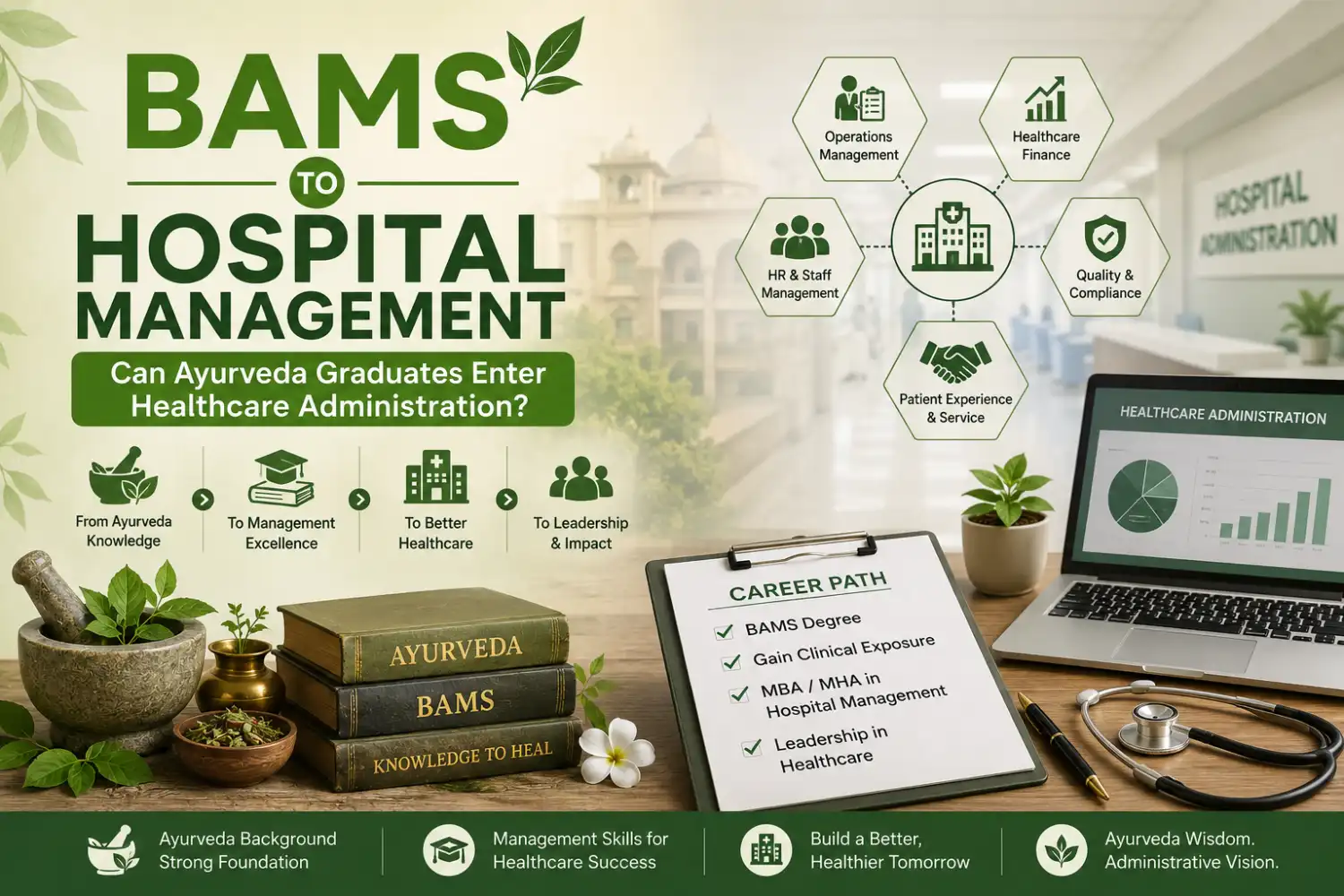
BAMS to Hospital Management: Can Ayurveda Graduates Enter Healthcare Administration?
Yes. A BAMS graduate can move into healthcare administration. Most MBA and MHA programmes in…
Why Ayurveda Courses Are Attracting Students from All Medical Backgrounds
In the rapidly changing world of healthcare today, there is one compelling trend that cannot…
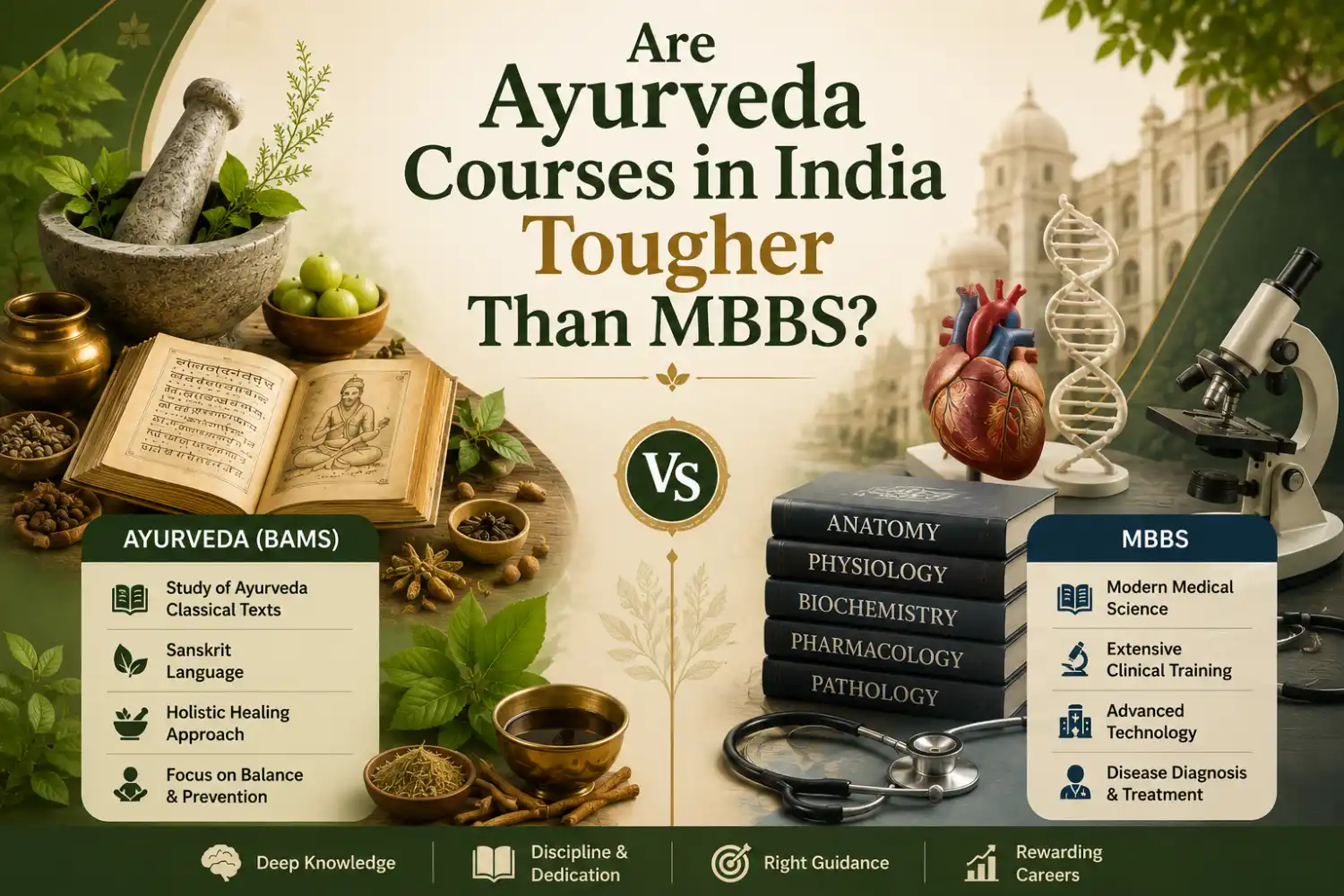
Are Ayurveda Courses in India Tougher Than MBBS?
Ayurveda courses in India are not easier than MBBS. They are difficult in a different…
Kayachikitsa in Ayurveda: Career Scope and Opportunities from an Ayurvedic Medical College in Delhi NCR
What is Kayachikitsa, and what career follows after BAMS? Kayachikitsa is the general medicine branch…
Best BAMS Colleges in UP: BAMS Admission 2027 Eligibility, NEET Requirements, Counselling and Fees
The best BAMS colleges in UP take admission only through NEET UG scores, followed by…
What Can You Do After BAMS? 10 Career Options for Ayurveda Graduates from the Best Private BAMS Colleges in UP
What can you do after BAMS? A BAMS graduate can work as an Ayurvedic physician,…