
What Is Sapta Dhatu in Ayurveda? The Best BAMS Colleges in India Explain
Home / BAMS / What Is Sapta Dhatu in Ayurveda? The Best BAMS Colleges in India Explain
Sapta Dhatu refers to the seven foundational tissues that build the human body: Rasa (plasma), Rakta (blood), Mamsa (muscle), Meda (fat), Asthi (bone), Majja (marrow), and Shukra (reproductive tissue). Each forms sequentially from the one before it, governed by its own metabolic fire, dhatvagni. Assessing tissue quality helps a practitioner judge a patient’s underlying strength and guide treatment, which is why the topic is foundational across the BAMS curriculum.
Key Facts
- The order of formation is Rasa, Rakta, Mamsa, Meda, Asthi, Majja and Shukra, each nourished by the one before it.
- Charaka counts thirteen agni in the body: one jatharagni, five bhutagni and seven dhatvagni, one per dhatu (Charaka Samhita, Chikitsa Sthana 15).
- Sushruta states the full cycle from rasa to shukra takes about one month; the Charaka tradition gives roughly six days (Sushruta Samhita, Sutra Sthana 14/14).
- Sushruta counts 300 asthi and Charaka 360, against 206 bones in modern adult anatomy (Sushruta Samhita, Sharira Sthana 5; Charaka Samhita, Sharira Sthana 7/6).
- For comparison, a red blood cell survives about 120 days, and roughly 10 percent of fat cells turn over every year (Spalding et al., Nature, 2008).
- India has 7,51,768 registered AYUSH practitioners and 3,885 AYUSH hospitals with over 62,000 beds; the AYUSH sector crossed US$ 43 billion in 2023 (Ministry of AYUSH, 2024; Rajya Sabha reply).
- NEET UG 2026 saw 11.21 lakh candidates qualify out of just under 20 lakh who appeared, with Uttar Pradesh producing the most qualifiers of any state, over 1.7 lakh (National Testing Agency, July 2026).
- The WHO Global Traditional Medicine Centre at Jamnagar carries US$ 250 million of Indian government backing, part of a system 170 of 194 WHO member states report using (WHO, 2022).
What Is Sapta Dhatu in Ayurveda?
Sapta Dhatu is the Ayurvedic classification of the seven tissues that build the body’s structure and keep it functioning. The Sanskrit root dha means to hold or support, so a dhatu is literally that which holds the body together. Vagbhata frames the body as resting on three things: dosha, dhatu, and mala, the functional energies, the tissues they govern, and the wastes cleared along the way (Ashtanga Hridaya, Sutra Sthana 11/1). Each dhatu is dominated by a particular mahabhuta, the five great elements; bone by earth and air, plasma by water, which lets a student predict how a tissue behaves once disturbed, rather than only memorise seven names.
What Are the Seven Dhatus and What Does Each One Do?
| Dhatu | Nearest modern tissue | Defining function |
|---|---|---|
| Rasa | Plasma, lymph, interstitial fluid | Nourishment and satisfaction of every tissue |
| Rakta | Blood, chiefly red cells | Sustaining life, colour and vitality |
| Mamsa | Skeletal and smooth muscle | Covering and plastering the skeletal frame |
| Meda | Adipose tissue | Lubrication and insulation |
| Asthi | Bone and cartilage | Holding the body upright |
| Majja | Marrow and nervous tissue | Filling bone and channel cavities |
| Shukra | Reproductive tissue | Capacity for reproduction |
Because the chain is sequential (after Sushruta Samhita, Sutra Sthana 15/5), a deficiency early on carries forward: long-standing poor nutrition shows first as pallor and fatigue, then muscle wasting, and only later as bone or reproductive complaints, a pattern BAMS students learn to read in the outpatient department.
How Long Does the Body Take to Build Each Tissue, and How Does That Compare With Measured Biology?
Classical estimates differ: Sushruta gives about one month for the full rasa-to-shukra cycle, the Charaka tradition roughly six days, and Vagbhata records three competing views without settling the matter. This shapes therapeutic timing; rasayana and tissue-level treatment are planned in weeks and months, not days. Measured turnover in modern biology points the same direction: a red blood cell survives about 120 days, the intestinal lining renews in three to five days, spermatogenesis takes roughly 64 to 74 days, and about 10 percent of fat cells are replaced every year at any adult age (Spalding et al., Nature, 2008). More everyday still, the heart beats around 100,000 times a day sustaining rakta dhatu, and the skin sheds an estimated 500 million cells daily as mamsa’s covering layer renews. These are classical positions on tissue metabolism, taught as a framework rather than measured constants, not an individual treatment schedule.
What Happens When a Dhatu Is Depleted or Increased?
Every dhatu has recognised signs of kshaya (depletion) and vriddhi (excess), the everyday clinical use of this chapter (after Charaka Samhita, Sutra Sthana 17; Sushruta Samhita, Sutra Sthana 15).
| Dhatu | Kshaya (depletion) | Vriddhi (excess) |
|---|---|---|
| Rasa | Fatigue, dryness, palpitation on mild exertion | Heaviness, nausea, reduced appetite |
| Rakta | Rough dry skin, pallor, poorly filled vessels | Redness of eyes and skin, vascular congestion |
| Meda | Dryness of joints, craving fatty food | Breathlessness on exertion, excess sweating |
| Asthi | Falling hair, brittle nails and teeth | Excess growth of bone and teeth |
This section is educational and describes classical theory. It is not a diagnostic tool. Assessment and treatment should be carried out only by a qualified, registered Ayurvedic practitioner.
How Does Sapta Dhatu Compare With Modern Tissue Biology?
Sapta Dhatu is a functional classification, not a histological one, so it overlaps with modern biology without matching it exactly. Adult blood volume is approximately five litres, and the marrow releases roughly 200 billion red cells a day. Skeletal muscle makes up about 40 percent of body mass across more than 600 named muscles (Janssen et al., Journal of Applied Physiology, 2000). The adult skeleton holds 206 bones against Sushruta’s 300 and Charaka’s 360, a gap explained by classical enumeration counting teeth, cartilage, and nail beds as asthi. The adult brain carries an estimated 86 billion neurons (Azevedo et al., 2009), the modern correlate of majja’s nervous-tissue role. Treating any of these as fixed equivalence, rather than a teaching bridge, is the error examiners mark down most often.
What Does a BAMS Degree Lead To, in Numbers?
| Indicator | Figure |
|---|---|
| AYUSH sector size, 2023 | Crossed US$ 43 billion (Ministry of AYUSH, 2024), up from US$ 2.85 billion in 2014–15 |
| Registered AYUSH practitioners | 7,51,768, against 13,86,150 registered allopathic doctors (Ministry of Health and Family Welfare) |
| AYUSH hospitals and beds | 3,885 hospitals with more than 62,000 beds |
| AYUSH exports | US$ 2.16 billion in 2023, up from US$ 1.09 billion in 2014 |
| NEET UG 2026 | 11.21 lakh qualified of just under 20 lakh who appeared; Uttar Pradesh led all states with over 1.7 lakh qualifiers (NTA, July 2026) |
| WHO recognition | Global Traditional Medicine Centre established at Jamnagar, backed by US$ 250 million from the Government of India. |
Every BAMS seat, government and private, is filled through NEET UG and AYUSH counselling; there is no direct-admission route. Among the best private BAMS colleges in India, what separates institutions is rarely the syllabus, which NCISM standardises, but whether the attached teaching hospital gives students enough patient volume to practise dhatu sara at the bedside rather than only in a textbook.
DJ Ayurveda College Perspective
At Divya Jyoti Ayurvedic Medical College and Hospital, Modinagar, Ghaziabad, Sapta Dhatu is introduced in Kriya Sharir and carried forward through Rognidan, Kayachikitsa, Dravyaguna and Panchakarma. The college runs 14 departments across fundamentals, clinical sciences and therapeutics, backed by a 100-plus bedded teaching hospital with OPD and IPD facilities, where dhatu sara assessment becomes a bedside skill rather than a textbook exercise. The 5.5-year BAMS programme is recognised by NCISM and affiliated to Mahayogi Gorakhnath University, Gorakhpur. Recent graduates have moved into roles at Yashoda Superspeciality Hospital, Felix Hospital Noida and Patanjali Yogpeeth, among others.
Frequently Asked Questions
The seven tissues Ayurveda considers the body's building material: Rasa, Rakta, Mamsa, Meda, Asthi, Majja and Shukra, each formed from the one before it.
The metabolic fire is specific to each tissue, seven in total, part of the thirteen agni Charaka counts in the body. A weak dhatvagni leaves its tissue poorly formed even when digestion appears normal.
Sushruta gives about one month; the Charaka tradition gives roughly six days; Vagbhata records three views without settling the question (Sutra Sthana 14/14).
Sushruta counts 300 asthi and Charaka 360, against 206 in modern anatomy, because the classical count includes teeth, cartilage, and nail beds that modern osteology classifies separately.
Tissue excellence, one of ten parameters in the Dashavidha Pariksha, used to judge a patient's underlying strength before treatment is planned (Charaka Samhita, Vimana Sthana 8).
Roughly 20 lakh candidates appeared and 11.21 lakh qualified, about 56 percent, with Uttar Pradesh producing the highest number of qualifiers of any state.
Introduced in first-year Kriya Sharir, then reapplied in Rognidan for pathogenesis, Kayachikitsa for managing tissue depletion, and Panchakarma, where therapies act on specific dhatus.
Related Blogs

Is Direct Admission Possible in Private BAMS Colleges in Delhi?
No. Direct admission is not possible, and there are two separate reasons for that. There…
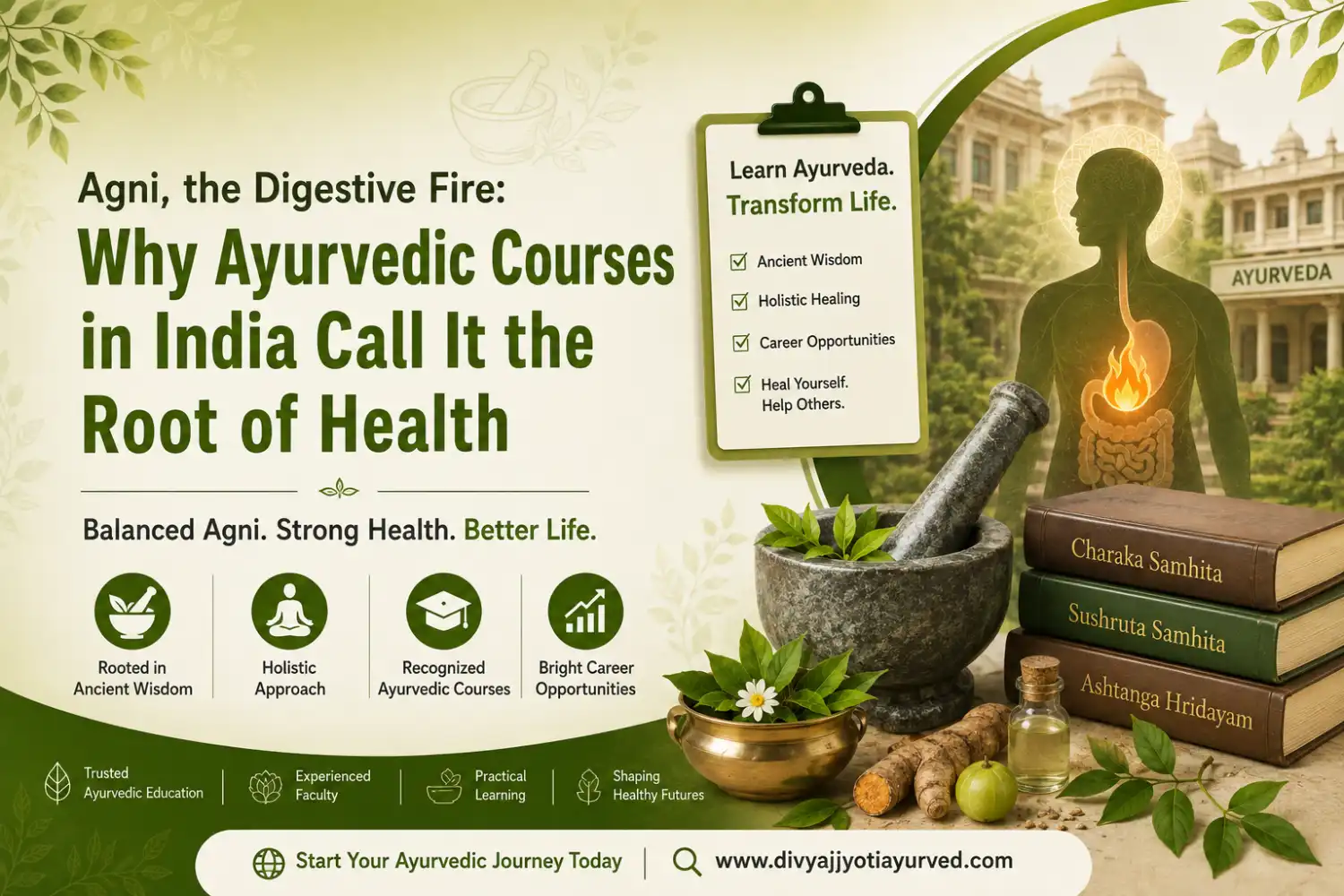
Agni, the Digestive Fire: Why Ayurvedic Courses in India Call It the Root of Health
Agni is the digestive and metabolic fire that Ayurveda places at the very centre of…
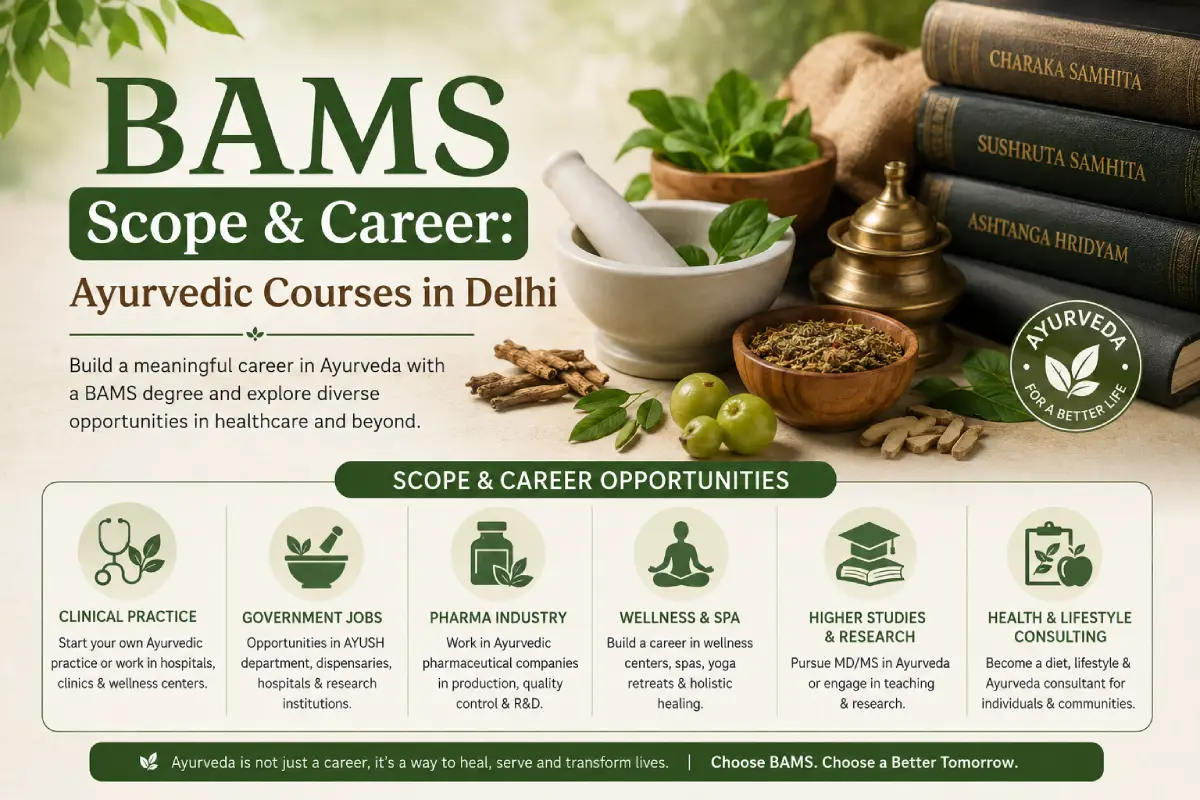
Scope and Career After a BAMS Degree in India: What the Top Ayurvedic Courses in Delhi Lead To
A BAMS degree, the Bachelor of Ayurvedic Medicine and Surgery, qualifies a graduate to practise…

BAMS vs MBBS: Which Course Is Better After NEET?
MBBS suits students with a high NEET rank who want to practise modern medicine and…
Understanding Dosha Balance in Kayachikitsa: A Core Pillar of Ayurvedic Medicine Courses
INTRODUCTION Recent educational data indicate a 40% rise in global interest regarding integrative medicine, with…

Student Diaries: Life and Learning at Leading BAMS Private Colleges in UP
Opening a new chapter in your studies is similar to starting a diary with blank…