
What Is Ama? The Ayurvedic Understanding of Toxins and Disease
Home / BAMS / What Is Ama? The Ayurvedic Understanding of Toxins and Disease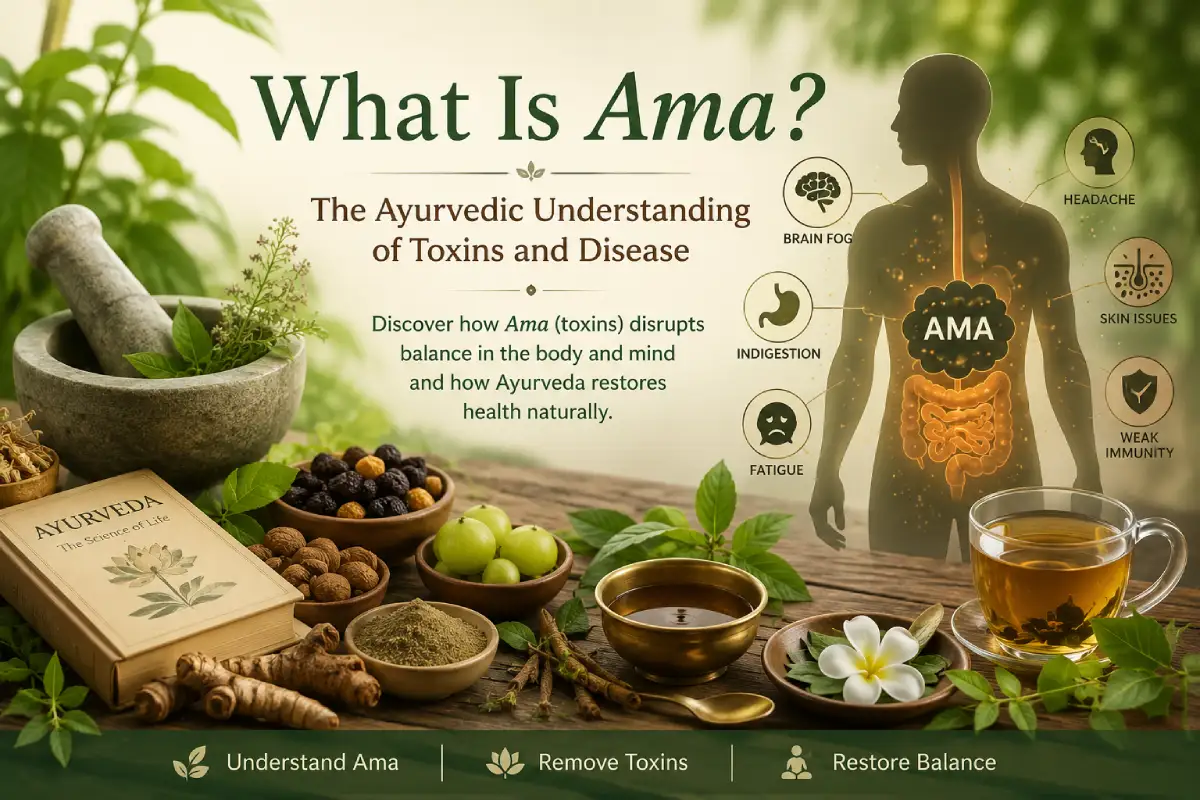
Quick Update
Ama is the heavy, sticky residue formed when agni, the digestive fire, is too weak to fully metabolise food. It behaves as an internal toxin, marking the first stage of disease. It is identified through a coated tongue, lethargy and channel obstruction, and precedes conditions such as joint pain, grahani dosha and metabolic disease. Treatment begins with fasting and restoring agni; purification follows only once ama has cleared.
Key Facts
- Ama forms when jatharagni functions below capacity (Source: Charaka Samhita, Chikitsa Sthana 15).
- Vagbhata devotes a full chapter to ama and its management (Source: Ashtanga Hridaya, Sutrasthana 13).
- Ten cardinal signs define the sama state, from channel obstruction to unexplained fatigue (Source: Ashtanga Hridaya, Sutrasthana 13).
- Ayurveda counts thirteen digestive fires in total: one jatharagni, five bhutagni and seven dhatvagni, and ama can form at any of them.
- Rheumatoid arthritis, the condition most discussed alongside amavata, affects an estimated 0.75 percent of Indian adults, roughly seven million people (Source: Rheumatology International, 1993).
- The ICMR-INDIAB study of 113,043 people found 11.4 percent diabetes prevalence, 15.3 percent prediabetes, 35.5 percent hypertension and 81.2 percent dyslipidaemia nationally (Source: The Lancet Diabetes and Endocrinology, 2023).
- WHO reports that 40 to 90 percent of the population uses traditional medicine across most member states, yet under 1 percent of global health research funding supports it (Source: WHO Global Traditional Medicine Centre, December 2025).
- A community-based Indian study put IBS, the condition closest to grahani dosha, at 4.2 percent prevalence against an 11 percent global average (Source: IBS Global Impact Report, 2018).
What Is Ama in Ayurveda?
Ama is the product of incomplete digestion. When agni works below capacity, food is not fully converted, and what remains is a heavy, sticky residue behaving as an internal toxin rather than nourishment. Charaka ties health directly to agni, and records that a person falls ill when it is disturbed and dies when it is extinguished (Source: Charaka Samhita, Chikitsa Sthana 15/3-4). Ama is not dirt, nor a single chemical. It is a functional state, and a stage in samprapti, the chain of pathogenesis, rather than a diagnosis in itself.
How Does Ama Form When Agni Weakens?
Ama forms whenever the load on agni exceeds its capacity to transform it, whether from excess intake, difficult food, or agni already weakened by illness or stress. Charaka classifies agni into four states, of which only one is healthy.
| State | Presentation | Ama link |
|---|---|---|
| Samagni | Regular appetite, complete digestion | No ama; the state of health |
| Mandagni | Poor appetite, coated tongue, heaviness | Principal cause of ama (kapha) |
| Tikshnagni | Rapid hunger, burning, fast weight loss | Tissue depletion, not ama (pitta) |
| Vishamagni | Unpredictable appetite, bloating | Intermittent ama (vata) |
Ayurveda recognises thirteen agnis: jatharagni for primary digestion, five bhutagni for elemental material, and seven dhatvagni, one per tissue. Ama can form at any of the thirteen; weak medo dhatvagni is linked to obesity, which ICMR-INDIAB estimates affects 254 million Indians generally and 351 million abdominally (Source: The Lancet Diabetes and Endocrinology, 2023).
What Are the Ten Signs of Ama, and How Is It Examined?
Vagbhata lists ten features of the sama state (Source: Ashtanga Hridaya, Sutrasthana 13): channel obstruction, disproportionate loss of strength, heaviness, sluggish vata, lethargy, incomplete digestion, excess salivation, retention of wastes, loss of appetite and unexplained fatigue. Their absence defines the nirama state, and the distinction decides the order of treatment.
| Parameter | Sama (with ama) | Nirama (free of ama) |
|---|---|---|
| Tongue | Thick coating, scalloped edges | Clean, pink, moist |
| Stool | Foul, sticky, sinks in water | Formed, floats, evacuates fully |
| Treatment order | Langhana and pachana first; oleation contraindicated | Snehana, shodhana and rasayana may be considered |
Jihva pariksha, tongue examination, is the fastest bedside indicator and is read alongside mala pariksha and nadi pariksha, never in isolation.
Which Diseases Does Ayurveda Attribute to Ama?
Ama is a precursor, not a disease. Once formed, it settles in an already weakened channel or tissue, and the resulting condition takes its character from that site.
| Condition | Classical picture | Indian data |
|---|---|---|
| Amavata | Migratory joint pain, morning stiffness, swelling | Rheumatoid arthritis: ~0.75% of adults, ~7 million people (Rheumatology International, 1993); Maharashtra COPCORD survey: 0.5-0.7% (Indian Journal of Rheumatology, 2015) |
| Grahani dosha | Alternating loose/hard stool, bloating | IBS prevalence in India: 4.2% (community study) against an 11% global average (IBS Global Impact Report, 2018) |
| Medoroga | Ama at medo dhatvagni; excess adipose with reduced strength | 254 million with generalised obesity, 351 million with abdominal obesity (ICMR-INDIAB, The Lancet Diabetes and Endocrinology, 2023) |
| Prameha | Kapha-meda-mutravaha vitiation | 101 million with diabetes, 136 million with prediabetes nationally (ICMR-INDIAB, 2023) |
The pairing of amavata with rheumatoid arthritis, or prameha with diabetes, is a teaching parallel rather than an equivalence; classical Ayurvedic nosology does not map one-to-one onto biomedical categories.
Does Modern Science Describe Anything Comparable to Ama?
Modern medicine has no exact equivalent, but metabolic endotoxemia is structurally close: bacterial lipopolysaccharide crosses a compromised gut barrier and drives chronic low-grade inflammation, originally defined as a diet-induced two- to three-fold rise in circulating lipopolysaccharide, now linked to insulin resistance and hepatic steatosis (Source: Frontiers in Immunology, 2021; Nature Reviews Cardiology, 2022). The downstream burden is considerable: 35.5 percent hypertension and 81.2 percent dyslipidaemia prevalence nationally (Source: ICMR-INDIAB, The Lancet Diabetes and Endocrinology, 2023), and rheumatic disorders as a group affect an estimated 25 to 30 percent of Indians (Source: Indian Journal of Rheumatology, 2024). Globally, 67 percent of WHO member states report 40 to 99 percent population usage of traditional medicine, yet under 1 percent of global health research funding reaches the field (Source: WHO, December 2025). The convergence is structural, not proof of equivalence.
How Is Ama Treated in Ayurvedic Practice?
Ama is removed by restoring the capacity that failed, in fixed order: nidana parivarjana (removing the cause), langhana (lightening), deepana (kindling agni), pachana (digesting the ama), shodhana (purification, only once nirama), and rasayana with pathya (maintenance). Oleation is contraindicated while ama is present, because it mobilises a substance the body cannot yet process.
This section is educational and describes principles of classical management. It is not a prescription and does not include dosages. Ayurvedic treatment should be undertaken only under a qualified registered Ayurvedic practitioner.
Why Does Ama Matter to a Student Choosing a Private BAMS College in Uttar Pradesh?
Ama runs across the entire 5.5-year BAMS programme: introduced in year one, applied in Dravyaguna’s drug groups in year two, examined as samprapti in Rognidan, and assessed at the bedside in Kayachikitsa and Panchakarma. For 2025-26, approximately 536 Ayurveda institutions were approved nationally, offering roughly 40,000 undergraduate BAMS seats (Source: NCISM, November 2025). Uttar Pradesh holds the largest concentration in North India: 9 government colleges with 613 seats and 73 private colleges with approximately 5,600 seats (Source: NCISM college data, 2025). The sector is expanding: the AYUSH industry was estimated at 18.1 billion United States dollars in 2020-21, and exports rose from 1.09 billion to 1.54 billion dollars between 2014 and 2020 (Source: Press Information Bureau, Ministry of AYUSH).
DJ Ayurveda College
At Divya Jyoti Ayurvedic Medical College and Hospital, Modinagar, Ghaziabad, ama is taught across fourteen departments, anchored to a hospital of over one hundred beds established in 2012. Students meet sama presentations repeatedly through OPD and IPD postings rather than only in a textbook. The college is recognised by NCISM and affiliated to Mahayogi Gorakhnath University, Gorakhpur, and offers the standard 5.5-year BAMS programme with a one-year compulsory internship.
Frequently Asked Questions
Ama is undigested residue left when agni cannot complete metabolism. It circulates, blocks the channels, and is regarded as the earliest identifiable stage of disease.
Ten classical features, including channel obstruction, heaviness, lethargy and loss of appetite (Source: Ashtanga Hridaya, Sutrasthana 13). A coated tongue is the sign most easily recognised.
Clinically, chiefly through jihva pariksha (tongue examination), alongside mala pariksha and nadi pariksha and a detailed dietary history, not by laboratory test.
No. Ama is a functional category. Its nearest modern parallel is metabolic endotoxemia, a measurable rise in circulating lipopolysaccharide (Source: Frontiers in Immunology, 2021); the resemblance is structural, not an equivalence.
Amavata, grahani dosha, medoroga and prameha are the conditions most closely associated with it in classical and contemporary literature.
Largely, through dinacharya and ritucharya: regular meal timing, avoiding incompatible combinations, not suppressing natural urges, and managing sustained stress, which classical texts list as a direct cause.
5.5 years in total: four and a half years of academic study plus a one-year compulsory rotating internship, with admission through NEET and AYUSH counselling.
Related Blogs

Ranking the Best Private BAMS Colleges: What Students Should Know
With the current era of holistic healing and alternative medicine, Ayurveda is taking center stage…

Ancient Roots, Modern Careers: Exploring Opportunities at BAMS Colleges in Uttar Pradesh
When you hear about Ayurveda and career, what do you think of? Maybe century-old treatments,…

Low NEET Score? You Can Still Get Into One of the Top 10 Private BAMS Colleges in UP
A low NEET score does not end an Ayurveda career. Uttar Pradesh runs one of…
Choosing the right BAMS college in 2025–26: what should you actually check?
If you are trying to decide the best BAMS college in India, you are probably…

Student Diaries: Life and Learning at Leading BAMS Private Colleges in UP
Opening a new chapter in your studies is similar to starting a diary with blank…

What Is Panchakarma and How Does It Work
Panchakarma is a structured system of five Ayurvedic cleansing procedures designed to remove accumulated toxins,…