
Agni, the Digestive Fire: Why Ayurvedic Courses in India Call It the Root of Health
Home / BAMS / Agni, the Digestive Fire: Why Ayurvedic Courses in India Call It the Root of Health
Agni is the digestive and metabolic fire that Ayurveda places at the very centre of health. It transforms food into the nourishment that builds every tissue, sustains immunity, and steadies the mind. When Agni is balanced, digestion is clean and energy is stable. When it weakens, an undigested residue called Ama accumulates and, according to classical texts, disease begins. This is why Agni is among the first principles taught in Ayurvedic courses in India, and why students of Ayurveda courses in India return to it throughout their clinical training.
Key facts at a glance
- Agni (the biological fire of digestion and metabolism) is described in Ayurveda as the factor on which lifespan, strength, complexion, and immunity depend.
- Classical Ayurveda recognises thirteen types of Agni: one central digestive fire (Jatharagni), five elemental fires (Bhutagni), and seven tissue fires (Dhatvagni).
- Agni functions in four states: balanced (Samagni), irregular (Vishamagni), sharp (Tikshnagni), and weak (Mandagni).
- Weak digestive fire (Mandagni) is said to produce Ama, a toxic undigested residue that classical texts link to the origin of many diseases.
- Ojas, the essence responsible for vitality and immunity, is understood as the final product of well functioning Agni.
- Agni is a foundational subject in Ayurvedic courses in India, taught within Ayurvedic physiology and applied throughout clinical practice.
What is Agni in Ayurveda?
Agni is the biological fire responsible for all digestion, absorption, and transformation in the body. In Ayurveda, the term does not mean an actual flame. It refers to the sum of the body’s capacity to break down food, convert it into usable nutrition, and power every metabolic process, from cellular repair to clear thinking.
The Charaka Samhita, one of the foundational texts of Ayurveda, treats Agni as central to life itself. It describes how longevity, strength, vitality, complexion, immunity, and even mental clarity rest upon the proper working of this fire. When the fire burns evenly, the body is nourished. When it falters, nourishment fails at its source.
A useful way to picture Agni is as a kitchen fire beneath a cooking pot. Food placed on a strong, steady flame cooks completely. Food left on a weak or erratic flame remains raw, and what is raw cannot nourish. Ayurveda applies this same logic to the human body, and much of its guidance on diet and routine is really about keeping this inner fire well tended.
Why does Ayurveda call Agni the root of health?
Ayurveda calls Agni the root of health because every tissue, and ultimately immunity itself, depends on what Agni produces. Nothing a person eats becomes part of the body until Agni has transformed it.
The sequence works like this. Food is first digested by the central fire into a nutritive essence known as Ahara Rasa (the digested product of food). This essence then nourishes the seven bodily tissues, or Dhatus, in a defined order: plasma, blood, muscle, fat, bone, marrow, and reproductive tissue. The refined end product of this whole chain is Ojas (the subtle essence of vitality and immunity). Strong, orderly Agni yields abundant Ojas, which Ayurveda associates with resilience, steady energy, and a calm mind.
The reverse is equally important. When Agni is weak, food is not fully transformed. The unprocessed residue, called Ama, accumulates and spreads through the body’s channels. Classical texts, including the Ashtanga Hridaya, hold that a large share of disease begins with this failure of digestion. This is the reasoning behind the well known Ayurvedic principle that most illnesses can be traced back to weakened Agni.
What are the different types of Agni?
Ayurveda does not describe a single digestive fire. It describes thirteen. Together they govern digestion at every level, from the food in the stomach to the transformation happening inside each individual tissue.
The central fire, Jatharagni, sits in the digestive tract and is considered the chief of all the others. Its strength influences every downstream fire. Beneath it work five Bhutagnis, which act on the five elemental qualities of food, and seven Dhatvagnis, which govern the formation of each tissue.
| Category | Number | What It Governs |
|---|---|---|
| Jatharagni (Central Digestive Fire) | 1 | The primary digestion of food in the gastrointestinal tract; regarded as the chief fire that regulates all the others. |
| Bhutagni (Elemental Fires) | 5 | Digestion of the five elemental qualities in food, corresponding to earth, water, fire, air, and space. |
| Dhatvagni (Tissue Fires) | 7 | Metabolism within each of the seven tissues: plasma, blood, muscle, fat, bone, marrow, and reproductive tissue. |
Because Jatharagni sets the pace for the elemental and tissue fires, Ayurveda gives it particular attention. If the central fire is disturbed, the fires that depend on it rarely function well.
What are the four states of Agni?
Agni is not simply strong or weak. Ayurveda describes four distinct states, each shaped by the balance of the three doshas (the functional bio energies of Vata, Pitta, and Kapha). Recognising which state a person tends toward is a routine part of Ayurvedic assessment.
| State of Agni | Governing Dosha | How Digestion Behaves | Common Signs |
|---|---|---|---|
| Samagni (Balanced) | All three doshas in equilibrium | Regular, complete, comfortable | Timely hunger, easy digestion, steady energy, regular elimination |
| Vishamagni (Irregular) | Vata | Unpredictable, sometimes strong and sometimes poor | Bloating, gas, variable appetite, alternating constipation |
| Tikshnagni (Sharp) | Pitta | Rapid and excessive, burning through food quickly | Intense hunger, acidity, heartburn, irritability when meals are missed |
| Mandagni (Weak) | Kapha | Slow, heavy, incomplete | Low appetite, heaviness after eating, sluggishness, weight gain |
Samagni is the goal. It is the state in which food is digested cleanly, tissues are nourished, and waste is eliminated on time. The other three represent digestion pulled out of balance by one dosha or another, and a great deal of Ayurvedic dietary and lifestyle guidance aims to return a person toward Samagni.
What is Ama, and how is it linked to weak Agni?
Ama is the sticky, toxic residue left behind when Agni fails to digest food completely. The word itself means unripe or uncooked, and that is precisely what Ama is: nutrition that was never properly processed.
When the digestive fire is weak, particularly in the Mandagni state, food ferments and stagnates rather than transforming into clean nourishment. The resulting Ama is described in classical texts as heavy, cloudy, and foul smelling. It clogs the body’s channels, or Srotas, and interferes with the normal flow of nutrients and waste.
Ayurveda regards Ama as a starting point for a wide range of complaints. A coated tongue in the morning, persistent heaviness, dullness, bad breath, and a general sense of being unwell are all traditionally read as signs of Ama. Because Ama and weak Agni travel together, Ayurvedic treatment often focuses first on rekindling the fire and clearing the residue before anything else is attempted.
A brief note of caution. These descriptions come from classical Ayurvedic theory. They should be understood as an educational framework rather than a modern diagnostic test, and any persistent digestive symptom deserves assessment by a qualified practitioner.
How can you tell if your Agni is balanced or disturbed?
Balanced Agni tends to announce itself quietly through good appetite, comfortable digestion, and steady energy, while disturbed Agni tends to make itself felt through bloating, heaviness, and fatigue. Ayurveda pays close attention to these everyday signals, because they reveal the state of the fire long before any serious complaint appears.
| Aspect | Balanced Agni | Disturbed Agni |
|---|---|---|
| Appetite | Arrives at regular times, genuine and clear | Absent, excessive, or unpredictable |
| After Meals | Light, comfortable, energised | Heavy, bloated, or drowsy |
| Tongue | Clean and pink | Coated, especially in the morning |
| Elimination | Regular and well formed | Irregular, sticky, or with undigested food |
| Energy and Mind | Stable energy, clear thinking | Fatigue, dullness, mental fog |
| Breath and Taste | Fresh | Bad breath, altered taste in the mouth |
None of these signs is a diagnosis on its own. Taken together, however, they give a practical picture of how well the digestive fire is working, which is why Ayurvedic clinicians ask about them in detail during consultation.
How does Ayurveda support and protect Agni?
Ayurveda protects Agni mainly through diet, daily routine, and seasonal living rather than through any single remedy. The guiding idea is simple: give the fire the right fuel, at the right time, in the right amount.
Two classical strategies sit at the heart of this. Deepana refers to measures that kindle appetite and strengthen the fire, while Pachana refers to measures that help digest existing Ama. Warming culinary spices are the everyday tools of both approaches.
| Approach | What It Involves | Purpose in Classical Terms |
|---|---|---|
| Warm, Freshly Cooked Food | Eating meals warm and freshly prepared rather than cold or stale. | Supports the digestive fire rather than dampening it. |
| Digestive Spices | Ginger, cumin, ajwain, black pepper, and long pepper (pippali). | Traditionally used to kindle Agni and ease digestion. |
| Mindful Meal Timing | Taking the main meal at midday, when Agni is considered strongest. | Aligns eating with the body’s natural peak of digestion. |
| Right Quantity | Eating to satisfaction rather than fullness, leaving some room in the stomach. | Prevents overloading a fire of limited capacity. |
| Langhana (Lightening) | Light eating or a short fast when Ama is present. | Gives the digestive fire a chance to burn off accumulated residue. |
| Daily and Seasonal Routine | Following Dinacharya (daily regimen) and Ritucharya (seasonal regimen). | Keeps digestion steady as activity and climate change. |
Ayurveda holds that Jatharagni follows a natural rhythm through the day and is strongest around midday, when the sun is at its peak. This is the classical reasoning behind eating the largest meal at noon and keeping the evening meal lighter.
Please note. These are general principles drawn from classical texts, not personal prescriptions. Herbs and fasting affect people differently, and they should be used under the guidance of a qualified and registered Ayurvedic practitioner rather than self administered.
What does modern science say about Agni and digestion?
Modern research does not treat Agni as a single measurable organ, but it does recognise the processes that Ayurveda grouped under that name. Digestion, enzyme activity, metabolic rate, and the health of the gut are all active areas of scientific study, and several researchers have drawn thoughtful parallels between them and the classical concept of Agni.
Some interpretations compare Jatharagni to the combined action of digestive enzymes and gastric secretions. Others relate the broader idea of a metabolic fire to basal metabolic rate, and connect the concept of Ama to the consequences of impaired digestion and disturbances of the gut microbiome. Preliminary studies exploring Ayurvedic digestive formulations and dietary practices continue to appear in peer reviewed journals.
It is important to be measured about this. These are parallels and working hypotheses, not proof that the two systems describe identical mechanisms. Ayurveda and modern physiology use different languages and different methods. What can be said fairly is that the central place Ayurveda gives to digestion resonates with the growing scientific appreciation of gut health as a driver of overall wellbeing.
How is Agni studied in Ayurvedic courses in India?
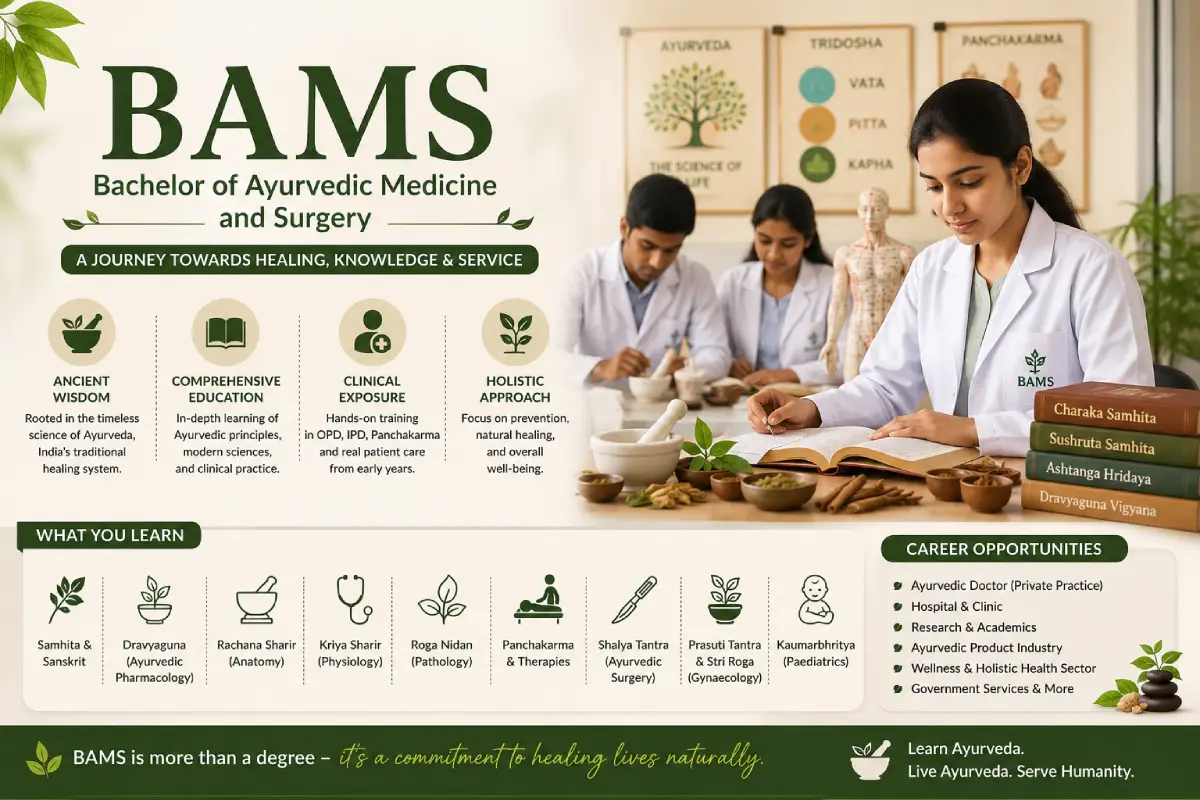
Agni is one of the earliest and most enduring topics in Ayurvedic courses in India. In the BAMS programme, the Bachelor of Ayurvedic Medicine and Surgery, students first meet the concept while learning the fundamentals of Ayurveda, alongside the doshas, the Panchamahabhuta (five great elements), and the Saptadhatu (seven tissues).
From there, Agni threads through the whole curriculum. It is studied in depth within Ayurvedic physiology, applied in the diagnosis of digestive and metabolic disorders, and put into practice in internal medicine and in cleansing therapies such as Panchakarma. Anyone comparing Ayurveda courses in India will find Agni treated not as a minor definition but as a working clinical principle that graduates use every day.
This is why the subject matters far beyond the examination hall. A practitioner who understands Agni understands where health begins, and where many diseases quietly take root.
How does DJ Ayurveda College teach the science of Agni?
At Divya Jyoti Ayurvedic Medical College and Hospital in Modinagar, Ghaziabad, Agni is taught as a living clinical principle rather than an abstract idea. The 5.5 year BAMS programme, recognised by the National Commission for Indian System of Medicine and affiliated to Mahayogi Gorakhnath University, introduces Agni within its foundational and physiology teaching and then carries it into the wards.
Students observe how disturbed digestion presents in real patients across the college’s teaching hospital of more than one hundred beds, in departments spanning internal medicine, Panchakarma, and preventive medicine. The college’s own research into gastrointestinal conditions, including work on irritable bowel syndrome and on diet in digestive disorders, reflects this clinical focus on Agni. For a prospective student, it is a practical illustration of how classical theory becomes daily practice.
Conclusion
Agni is where Ayurveda begins its account of health. A steady digestive fire builds strong tissues, sustains immunity, and supports a clear mind, while a weakened fire allows Ama and, in time, disease to take hold. Understanding this single principle changes how a person thinks about food, routine, and wellbeing. For those drawn to study it seriously, the BAMS programme at DJ Ayurveda College offers a place to explore Agni from first principles to bedside practice.
Disclaimer. This article is intended for educational purposes only. It describes classical Ayurvedic concepts and does not constitute medical advice, diagnosis, or a prescription. Ayurvedic treatment, herbs, and dietary changes should be undertaken only under the supervision of a qualified and registered Ayurvedic practitioner. It is not a substitute for professional medical care.
Frequently Asked Questions
Agni is the body's digestive and metabolic fire in Ayurveda. It is the capacity to break down food, convert it into usable nourishment, and power every process from tissue repair to clear thinking. Ayurveda considers a steady Agni the foundation of good health and stable energy.
Ayurveda considers Agni important because nothing a person eats nourishes the body until Agni transforms it. Classical texts describe lifespan, strength, complexion, and immunity as dependent on this fire. When Agni works well, tissues are nourished and Ojas is strong; when it weakens, disease is said to begin.
Ayurveda recognises thirteen types of Agni. There is one central digestive fire called Jatharagni, five elemental fires called Bhutagni, and seven tissue fires called Dhatvagni. Jatharagni is regarded as the chief fire, because its strength influences how well all the other fires function.
The four states are Samagni, or balanced digestion; Vishamagni, or irregular digestion linked to Vata; Tikshnagni, or sharp and excessive digestion linked to Pitta; and Mandagni, or weak and slow digestion linked to Kapha. Samagni is the balanced ideal that Ayurvedic diet and lifestyle aim to restore.
Ama is the toxic, undigested residue produced when Agni fails to process food completely. The word means uncooked. Classical texts describe it as heavy and sticky, capable of clogging the body's channels. Ayurveda links accumulated Ama to a coated tongue, heaviness, dullness, and the beginnings of many disorders.
Common traditional signs of weak Agni include low or unpredictable appetite, heaviness and drowsiness after meals, a coated tongue in the morning, irregular elimination, and persistent fatigue. These signals are indicative rather than diagnostic, so a qualified Ayurvedic practitioner should assess any ongoing digestive complaint.
Ayurveda holds that they can. Warm, freshly cooked meals, digestive spices such as ginger and cumin, taking the main meal at midday, and a steady daily routine are traditionally used to support the fire. These are general principles and are best applied with professional guidance rather than self prescribed.
Modern science does not recognise Agni as a single organ, but it studies the same processes: digestion, enzyme activity, metabolism, and gut health. Researchers have drawn parallels between these and Agni, and preliminary studies continue. These remain thoughtful comparisons rather than proof of identical mechanisms.
Agni is a core topic in Ayurvedic courses in India, especially the BAMS programme. Students first learn it among the fundamentals of Ayurveda, then study it within Ayurvedic physiology and apply it in diagnosis, internal medicine, and Panchakarma therapies throughout their clinical training and internship.
A BAMS graduate can practise as an Ayurvedic physician and work across hospitals, wellness and Panchakarma centres, the pharmaceutical sector, research, teaching, and the government AYUSH system. A firm grasp of foundational principles such as Agni supports clinical work across all of these paths.
Related Blogs

Is BAMS Better Than Other AYUSH Courses?
Is BAMS better than other AYUSH courses? For most NEET students, yes. BAMS (Bachelor of…

Government Jobs After BAMS: Roles, Recruitment Routes and Eligibility for Students of Private BAMS Colleges in Noida
Students from private BAMS colleges in Noida and Delhi NCR can apply for government jobs…

Ayurveda in the Age of AI – How Technology is Changing BAMS Careers
When you think of courses after BAMS, what comes to mind, traditional specializations, or something…
The Three Doshas Explained for Beginners: A Foundation at the Top BAMS Colleges in India
The three doshas, Vata, Pitta and Kapha, are the three functional energies that Ayurveda uses…

NEET UG 2026 and Your Path to a Bachelor Degree in Ayurvedic Medicine: Everything You Need to Know
So, you’ve decided to heal people the way your ancestors did — using nature, science,…

Ayurvedic Doctor Course: Major Specialisations, Courses and Career Scope
An ayurvedic doctor course in India means the BAMS degree. It runs for 5.5 years,…