
Ashwagandha in Ayurveda: Benefits, Classical Use, and How Private BAMS Colleges in UP Teach It
Home / BAMS / Ashwagandha in Ayurveda: Benefits, Classical Use, and How Private BAMS Colleges in UP Teach It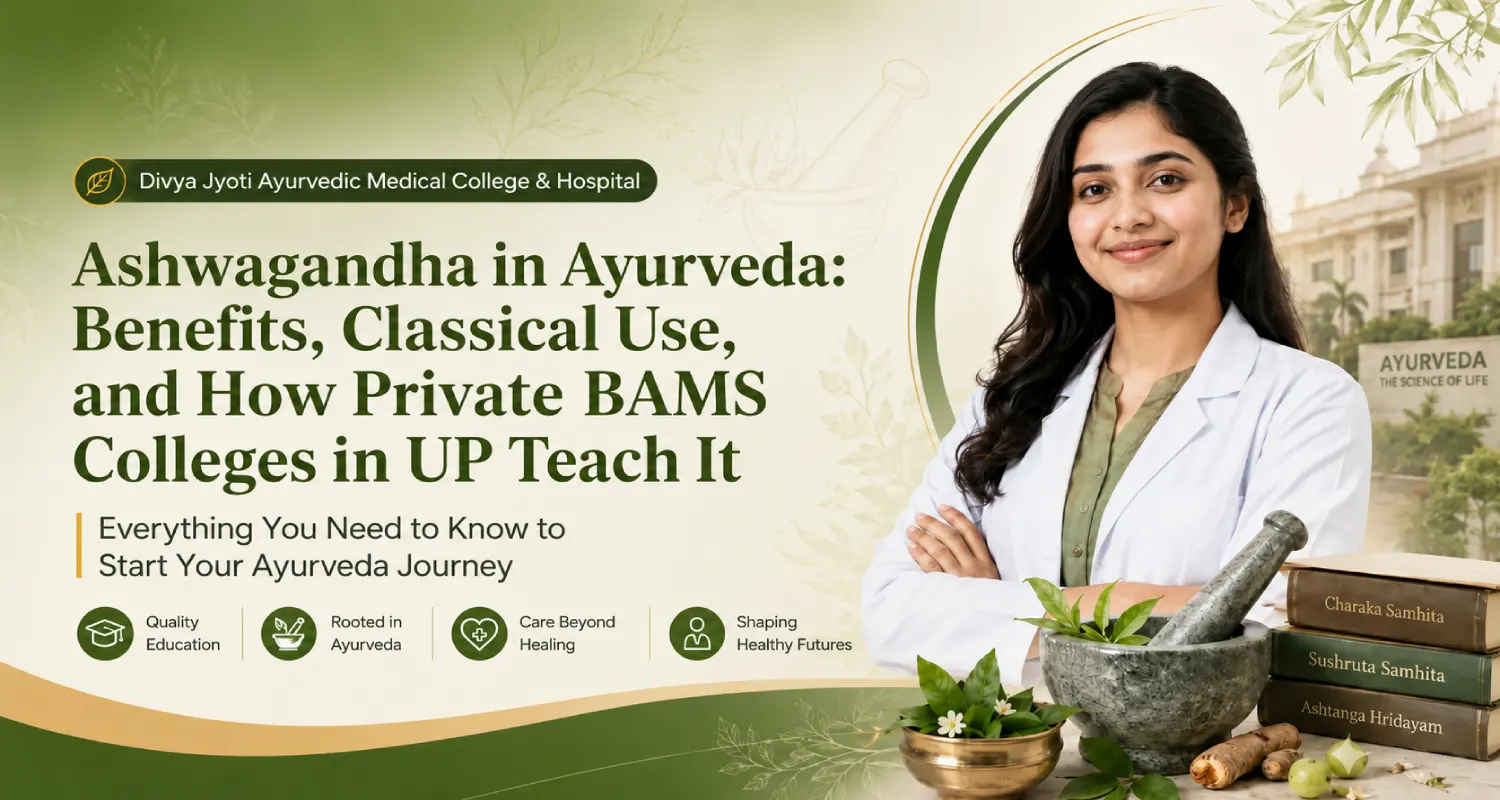
Ashwagandha is one of the most important rejuvenating herbs in Ayurveda. Classical texts classify it as a Rasayana (a substance that promotes strength, vitality, and longevity), and its root has been used for more than three thousand years to support resilience to stress, restful sleep, and physical stamina.
This guide explains the classical properties of Ashwagandha, its documented benefits, its place in the Samhitas, and what modern research suggests. It also shows how the herb is studied within the Dravyaguna syllabus at DJ Ayurveda College, one of the renowned private BAMS colleges in UP.
Ashwagandha- Key facts at a glance
- Botanical name: Withania somnifera (L.) Dunal, family Solanaceae.
- Sanskrit name: Ashwagandha, from ashwa (horse) and gandha (smell), a reference to the odour of the fresh root and the horse-like strength it is said to confer.
- Classical category: Rasayana (rejuvenative), Balya (strength promoting), and Vajikarana (reproductive tonic).
- Part used: mainly the root, prepared as churna (powder), kvatha (decoction), or taken with milk and ghee.
- Doshas: traditionally pacifies Vata and Kapha.
- Texts: described in the Charaka Samhita, Sushruta Samhita, Ashtanga Hridaya, and later nighantus such as the Bhavaprakasha.
What is Ashwagandha in Ayurveda?
Ashwagandha is a small woody shrub whose root has been used in Ayurvedic medicine for over three thousand years as a Rasayana, meaning a rejuvenative tonic. In Ayurveda it is valued chiefly for building bala (physical and immune strength), steadying the nervous system, and restoring the body during convalescence and old age.
The plant is known to botanists as Withania somnifera and belongs to the nightshade family, Solanaceae. It grows in the drier parts of India and across parts of the Mediterranean, Africa, and the Middle East. The species name somnifera is Latin for sleep bearing, a hint at the calming reputation the root carries in traditional use. Early European writers nicknamed it Indian ginseng because of its tonic action, although it is botanically unrelated to true ginseng.
The name itself is instructive. Ashwa means horse and gandha means smell. The fresh root carries a distinct horse like odour, and classical authors also read the name as a promise of the strength and vigour of a horse. This dual meaning captures how Ayurveda thinks about a medicine, by its sensory identity and by its effect on the body together.
| Attribute | Detail |
|---|---|
| Common name | Ashwagandha, also written Ashvagandha or Asgandh |
| Botanical name | Withania somnifera (L.) Dunal |
| Family | Solanaceae (the nightshade family) |
| Other names | Indian ginseng, winter cherry, Asgandh (Hindi and Urdu) |
| Sanskrit synonyms | Varahakarni, Balada, Vajini, Hayagandha, names that point to strength and the horse like quality |
| Primary part used | Root, used dried and powdered; leaves are used in some external preparations |
| Native range | Drier regions of India, Sri Lanka, Pakistan, Afghanistan, and parts of Africa and the Mediterranean |
What are the classical Ayurvedic properties of Ashwagandha?
In classical Ayurveda, every medicinal substance is described through its Rasa Panchaka, a set of five pharmacological attributes that together predict how a drug will behave in the body. For Ashwagandha these are a bitter and astringent taste, light and unctuous qualities, a hot potency, a sweet post digestive effect, and a deeply nourishing rejuvenative action.
These attributes are not abstract. A BAMS student learns to reason from them. The hot potency and unctuous quality explain why the root suits dryness, coldness, and depletion. The sweet post digestive transformation, called vipaka, explains its building, tissue nourishing effect. Reading the Rasa Panchaka of a herb is the first analytical skill taught in Dravyaguna, the study of medicinal substances.
| Property | Classical value | What it means in practice |
|---|---|---|
| Rasa (taste) | Tikta (bitter), Kashaya (astringent), with a touch of Katu (pungent) | Cleansing and toning; the bitterness supports metabolism rather than adding heaviness |
| Guna (qualities) | Laghu (light), Snigdha (unctuous, slightly oily) | Easy to digest yet moistening, which is why it nourishes without clogging the channels |
| Virya (potency) | Ushna (hot) | A warming action that counters cold and stiffness and supports circulation |
| Vipaka (post digestive effect) | Madhura (sweet) | The building, strengthening effect that makes it a tissue tonic |
| Prabhava and karma (special action) | Rasayana, Balya, Vajikarana, Medhya | Rejuvenation, strength, reproductive support, and benefit to the mind and nervous system |
How does Ashwagandha act on the doshas?
Ashwagandha primarily pacifies Vata and Kapha. Its warm potency and nourishing nature settle the cold, dry, and mobile qualities of aggravated Vata, while its lightness keeps it from increasing Kapha to excess. This is why it is so often chosen for conditions of nervousness, fatigue, and wasting, which Ayurveda reads largely as disturbances of Vata.
| Dosha | Effect | Why |
|---|---|---|
| Vata (governs movement and the nervous system) | Pacifies | Warmth, unctuousness, and nourishment oppose the cold, dry, restless nature of disturbed Vata |
| Pitta (governs metabolism and heat) | Broadly neutral, mild caution in heat | The hot potency means it is used thoughtfully where there is significant internal heat |
| Kapha (governs structure and stability) | Pacifies or is neutral | The light quality prevents the build up of heaviness despite its nourishing action |
Why do classical texts describe Ashwagandha as a Rasayana?
Classical texts describe Ashwagandha as a Rasayana because it is said to nourish all seven dhatus (the body tissues, from plasma to reproductive tissue), strengthen ojas (the vital essence underlying immunity and steadiness), and slow the effects of ageing. A Rasayana is not a cure for a single disease. It is a class of therapy aimed at the quality of the tissues and the resilience of the whole person.
The Charaka Samhita, the foundational text of internal medicine, places Ashwagandha among substances that promote longevity, resistance to disease, and reproductive strength, grouping it within both the Rasayana and Vajikarana traditions. The Sushruta Samhita, the great surgical text, applies it to debility and to recovery after illness and injury, where rebuilding strength is the goal.
Later authorities continue the theme. The Bhavaprakasha, a widely used materia medica, describes the root as kshayapaha, meaning that it relieves the depletion of tissues, and as balya, strength promoting. Because Ashwagandha also calms the mind and supports memory, it is discussed in the context of Medhya Rasayana, the group of herbs that act as tonics for the intellect and nervous system. In a busy Ayurvedic OPD it is one of the most frequently considered roots for general weakness and nervous exhaustion.
What are the traditional benefits and classical uses of Ashwagandha?
Traditionally, Ashwagandha is used to support physical strength, healthy sleep, resilience to stress, reproductive health, and recovery from weakness. Classical formulations apply it across general debility, nervous exhaustion, joint discomfort linked to Vata, and the period of convalescence after illness. The following table maps the most documented traditional uses to their classical rationale.
| Traditional use | Classical rationale | Plain explanation |
|---|---|---|
| Strength and stamina (Balya) | Sweet vipaka and nourishing action build the dhatus, especially muscle and reproductive tissue | Used as a daily tonic to rebuild a depleted, tired body |
| Calm and restful sleep | Pacifies Vata and steadies the mind; the species name somnifera reflects this reputation | Traditionally chosen to settle a restless, overactive mind at night |
| Resilience to stress | A Rasayana that strengthens ojas, the basis of steadiness and immunity | Thought to help the body cope with strain rather than sedate it |
| Reproductive health (Vajikarana) | Classed among vajikarana dravyas that support reproductive vitality | A long standing use for both men and women under guidance |
| Recovery and old age | Kshayapaha, relieves tissue depletion; supports convalescence | Given during recovery from illness and in later life to maintain vigour |
| Mind and memory (Medhya) | Discussed within Medhya Rasayana for the intellect and nerves | Used to support concentration and mental clarity |
Classical and traditional formulations that feature Ashwagandha include:
- Ashwagandha churna, the simple powdered root, often taken with warm milk.
- Ashwagandharishta, a traditional fermented liquid preparation used as a tonic.
- Ashwagandha ghrita and avaleha, medicated ghee and herbal jam forms used in rejuvenative therapy.
- Chyawanprash, the well known rejuvenative jam, which lists Ashwagandha among its supportive ingredients.
Educational note. This section describes traditional and classical uses for educational purposes only. It is not medical advice, and it does not recommend self treatment. Ayurvedic medicines should be taken only under a qualified, registered Ayurvedic practitioner who can assess your constitution and condition.
What does modern research say about Ashwagandha?
Modern research identifies a group of steroidal compounds called withanolides as the main active constituents of Ashwagandha, and preliminary clinical studies have examined its effects on stress, sleep quality, and physical performance. The evidence base is growing but remains early in many areas. Ashwagandha is best understood as a supportive tonic studied for general wellbeing rather than a proven treatment for any specific disease.
Phytochemical analysis of the root has reported withanolides such as withaferin A and withanolide D, alkaloids including withanine, and a group of compounds called sitoindosides, alongside flavonoids and saponins. In contemporary terms, the herb is often described as an adaptogen, a substance thought to help the body adapt to physical and mental stress. Published reviews in peer reviewed journals have surveyed its traditional use together with laboratory and clinical findings.
It is important to read this evidence carefully. Many studies are small, vary in the extract and dose used, and call for larger and longer trials before firm clinical conclusions can be drawn. The table below separates what classical Ayurveda claims from what modern research has examined so far.
| Area | Classical Ayurvedic view | Modern research status |
|---|---|---|
| Stress and resilience | Rasayana that strengthens ojas and steadies the mind | Investigated as an adaptogen; some preliminary trials report effects on perceived stress, with calls for larger studies |
| Sleep quality | Pacifies Vata; reputation reflected in the name somnifera | Early studies have explored sleep outcomes; evidence is limited and ongoing |
| Physical performance | Balya, builds muscle and stamina | Some small trials have examined strength and endurance in adults; results are preliminary |
| Immunity | Supports ojas, the basis of resistance | Laboratory and review work describe immunomodulatory activity that requires further clinical confirmation |
| Nervous system | Medhya, benefits the intellect and nerves | Reviews describe neuroprotective activity in experimental models; human evidence is still developing |
Educational note. Modern findings are summarised here for education. Preliminary research does not establish that Ashwagandha treats, cures, or prevents any disease. Always consult a qualified healthcare professional or registered Ayurvedic practitioner before using any herbal preparation, especially alongside prescription medicines.
Know More: Sinusitis Cure in Ayurveda: Shalakya Tantra Guide
How is Ashwagandha prepared and used in classical Ayurveda?
In classical Ayurveda, Ashwagandha is most often prepared from the dried root as a fine powder, a decoction, a fermented liquid, or a medicated ghee or jam. It is traditionally taken with an anupana (a carrier substance) such as warm milk, ghee, or honey, which Ayurveda believes helps carry the medicine to the tissues and direct its action. The choice of form and carrier is matched to the person and the goal of treatment.
| Form | Sanskrit name | Traditional purpose |
|---|---|---|
| Powder | Churna | The most common form, usually combined with a suitable carrier for a rejuvenative effect |
| Decoction | Kvatha or Kwatha | A water based extract used where a stronger, more rapidly acting preparation is wanted |
| Fermented liquid | Arishta | A self generated alcohol preparation valued as a long keeping tonic |
| Medicated ghee | Ghrita | Ghee processed with the herb, used in nourishing and Medhya contexts |
| Herbal jam | Avaleha or Lehya | A sweet semi solid form that makes long term tonic use palatable |
Quality matters as much as form. The identity of the root, how it is dried and processed, and the appropriateness of the dose all influence safety and effect. For this reason, classical Ayurveda treats herbal medicine as a clinical discipline rather than a casual home remedy, and dosing is individualised by a practitioner.
Educational note. No dose or self treatment protocol is given here by design. Appropriate preparation, dose, and duration depend on the individual and must be decided by a registered Ayurvedic practitioner.
Is Ashwagandha safe, and who should be cautious?
Ashwagandha is generally regarded as well tolerated when used appropriately under qualified guidance, and classical texts describe it as a nourishing, non-stimulating tonic that does not cause dependence. However, it is not suitable for everyone, and several groups should seek professional advice before use.
- People who are pregnant or breastfeeding should use it only on professional advice, as guidance varies and caution is appropriate.
- People with thyroid disorders or autoimmune conditions should consult a clinician, since the herb may interact with these conditions.
- Anyone taking sedatives, immunosuppressants, thyroid medication, or other prescription drugs should check for interactions with a qualified professional.
- Anyone scheduled for surgery should disclose its use, as with any supplement, to their treating team.
These cautions are general and not exhaustive. They are exactly the kind of clinical judgement that a trained Ayurvedic physician applies, which is why supervision is recommended rather than self prescription.
Educational note. This article is educational and is not a substitute for professional medical advice, diagnosis, or treatment. Ayurvedic treatment should be taken under a qualified, registered Ayurvedic practitioner. Seek the advice of your physician with any questions about a medical condition.
How do private BAMS colleges in UP teach Ashwagandha and Dravyaguna?
At private BAMS colleges in UP, a herb like Ashwagandha is studied formally within Dravyaguna Vigyana, the branch of the syllabus devoted to medicinal plants and their properties, usually in the second year of the five and a half year programme. Students learn its botanical identity, its Rasa Panchaka, its classical references, and its therapeutic applications, and then they observe how it is used in the attached teaching hospital.
The Bachelor of Ayurvedic Medicine and Surgery, or BAMS, is a five and a half year programme that includes four and a half years of study and a one year clinical internship. Admission is through NEET, and candidates must have passed Class 12 with physics, chemistry, and biology. A single herb such as Ashwagandha is a good example of how the course connects classical theory to clinical practice, year by year.
| Year | Relevant subject | Where Ashwagandha fits |
|---|---|---|
| First year | Padartha Vigyan and Ayurveda fundamentals (Tridosha, Panchamahabhuta) | Students learn the dosha framework that explains why Ashwagandha pacifies Vata and Kapha |
| Second year | Dravyaguna Vigyan (medicinal plants) and Rasashastra (formulation) | The herb is studied in detail: identity, Rasa Panchaka, actions, and its place in formulations such as arishta and ghrita |
| Third year | Kayachikitsa (internal medicine) and Panchakarma | Its use in debility, nervous conditions, and rejuvenative therapy is studied clinically |
| Final year and internship | Clinical practice in OPD and IPD | Students observe and assist in the real use of Rasayana herbs under supervision in the teaching hospital |
Good teaching does not stop at the textbook. A well equipped Ayurvedic college supports this learning with a herbal garden where students can identify living plants, pharmacognosy and Rasashastra laboratories where they study and prepare formulations, and a teaching hospital where they see herbs applied to real patients. This blend of classical study, laboratory work, and supervised clinical exposure is what distinguishes a serious BAMS education at the top private BAMS colleges in UP.
Know More: Difference Between Ayurveda and Modern Allopathic Medicine: A Guide for Students
The DJ Ayurveda College – Your Gateway to Ayurveda
At Divya Jyoti Ayurvedic Medical College and Hospital, the study of a Rasayana such as Ashwagandha runs through the whole programme. The Department of Dravyaguna introduces the herb through its classical properties and living identification, the Department of Rasashastra and Bhaishajya Kalpana covers its formulation, and the Department of Kayachikitsa connects it to patient care in the hospital.
The college runs a five and a half year BAMS programme across fourteen departments, supported by a teaching hospital of more than one hundred beds with OPD and IPD facilities. It is recognised by the National Commission for Indian System of Medicine and affiliated to Mahayogi Gorakhnath University, Gorakhpur. For a student weighing the private BAMS colleges in UP, this combination of classical depth, laboratory training, and clinical exposure is what turns a single herb on a syllabus into practical clinical understanding.
Know More: What Is Panchakarma and How Does It Work
Conclusion
Ashwagandha is a clear window into how Ayurveda thinks. It is named for a horse, classed as a Rasayana, described precisely through its Rasa Panchaka, and applied with care to strengthen a depleted body and a restless mind. Classical wisdom and modern research are now in conversation about it. If reading about this herb has sparked your curiosity, you may enjoy exploring how the BAMS programme and the Dravyaguna syllabus at DJ Ayurveda College bring such plants to life.
Frequently Asked Questions
Ashwagandha is used in Ayurveda as a Rasayana, a rejuvenative tonic. Classical texts describe it for building strength, supporting restful sleep, improving resilience to stress, aiding reproductive health, and helping recovery from weakness and old age. It should be used under a qualified Ayurvedic practitioner.
Yes. Ashwagandha is one of the most important Rasayana herbs in Ayurveda, meaning a rejuvenative that nourishes the body tissues, strengthens ojas, and supports longevity. The Charaka Samhita groups it among substances that promote vitality and resistance to disease rather than treating a single illness.
The name combines two Sanskrit words, ashwa meaning horse and gandha meaning smell. It refers to the distinct odour of the fresh root, and classical authors also read it as a promise of the strength and vigour of a horse, capturing both the herb's sensory identity and its tonic effect.
Ashwagandha primarily pacifies Vata and Kapha. Its warm potency and nourishing, slightly unctuous nature settle the cold, dry, and restless qualities of disturbed Vata, while its lightness prevents excess Kapha. It is used thoughtfully where there is significant internal Pitta or heat.
The botanical name of Ashwagandha is Withania somnifera (L.) Dunal, in the family Solanaceae, the nightshade family. The species name somnifera is Latin for sleep bearing. It is sometimes called Indian ginseng for its tonic action, although it is not botanically related to true ginseng.
Modern research has identified withanolides as the main active compounds and has studied Ashwagandha as an adaptogen for stress, sleep, and physical performance. Findings are preliminary, with many small studies and a need for larger trials. It is studied for general wellbeing, not as a proven cure.
The root is the main part used in Ayurveda, prepared as a powder, decoction, fermented liquid, medicated ghee, or herbal jam. The leaves are used in some external preparations. The root is traditionally taken with a carrier such as warm milk or ghee to aid its action.
Ashwagandha is generally regarded as well tolerated under qualified guidance, and classical texts treat it as a nourishing, non stimulating tonic. However, people who are pregnant, have thyroid or autoimmune conditions, or take prescription medicines should consult a practitioner before use. Self prescription is not advised.
In the BAMS programme, herbs such as Ashwagandha are studied mainly in the second year within Dravyaguna Vigyan, the science of medicinal plants, and Rasashastra, which covers formulation. Their clinical use is then studied in the third year and observed during the hospital internship.
BAMS is offered at recognised institutions across the state, including private BAMS colleges in UP such as DJ Ayurveda College in Modinagar, Ghaziabad. A strong choice combines a detailed Dravyaguna syllabus, formulation laboratories, a herbal garden, and a teaching hospital for supervised clinical exposure.
Related Blogs

Ayurveda in the Age of Biohacking
You know what’s funny? We live in a world where our watches know more about…

BAMS to Hospital Management: Can Ayurveda Graduates Enter Healthcare Administration?
Yes. A BAMS graduate can move into healthcare administration. Most MBA and MHA programmes in…
What Is the Starting Salary From Private BAMS Colleges in India?
The starting salary from private BAMS colleges in India usually falls between ₹2.5 lakh and…
Why Is Ayurveda Becoming Popular in Modern Healthcare? A Student’s Guide to Choosing an Ayurveda College in Noida
Ayurveda is becoming popular in modern healthcare because people now want care that prevents illness,…
Agni, the Digestive Fire: Why Ayurvedic Courses in India Call It the Root of Health
Agni is the digestive and metabolic fire that Ayurveda places at the very centre of…

Ranking the Best Private BAMS Colleges: What Students Should Know
With the current era of holistic healing and alternative medicine, Ayurveda is taking center stage…