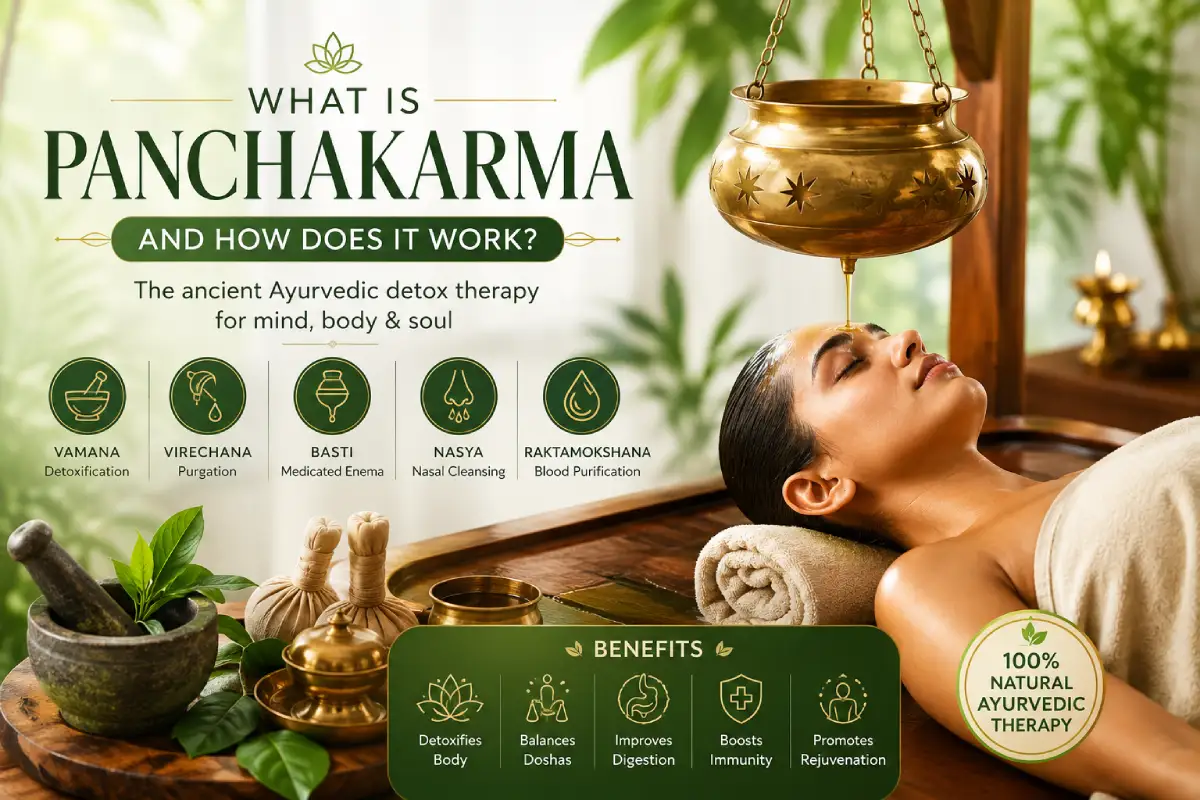
Panchakarma is a structured system of five Ayurvedic cleansing procedures designed to remove accumulated toxins, rebalance the three doshas, and restore the body’s natural functioning. The Sanskrit term joins pancha, meaning five, and karma, meaning action, so it describes five therapeutic actions performed in sequence. Classical texts present Panchakarma as the principal method of deep purification, used both to treat illness and to preserve health. Because it requires real clinical skill, it forms a core practical subject at private BAMS colleges in Uttar Pradesh and across India.
What are the key facts about Panchakarma?
- The word Panchakarma means “five actions” and refers to five classical procedures: Vamana, Virechana, Basti, Nasya, and Raktamokshana.
- The central purpose is shodhana, a deep cleansing that clears ama (metabolic waste) and corrects dosha imbalance at its root, rather than only easing symptoms.
- Every Panchakarma programme follows three phases: Purvakarma (preparation), Pradhanakarma (the main procedure), and Paschatkarma (recovery and rejuvenation).
- The therapy is documented in the foundational Ayurvedic texts Charaka Samhita, Sushruta Samhita, and Ashtanga Hridaya.
- Panchakarma must be assessed and performed by a qualified registered Ayurvedic practitioner. It is not a do-it-yourself routine.
- At DJ Ayurveda College, Panchakarma is one of fourteen departments and is taught within the 5.5-year BAMS programme.
What is Panchakarma in Ayurveda?
Panchakarma is the classical Ayurvedic method of bio-purification that uses five therapeutic procedures to draw toxins out of the body and return the doshas to balance.
Ayurveda holds that most disease begins when the three doshas move out of their normal state and combine with ama, the sticky residue left behind when digestion is weak. Treatments fall into two broad groups. Shamana therapies pacify and manage an imbalance, while shodhana therapies remove the disturbed material from the body altogether. Panchakarma belongs to the shodhana group, which is why it is so often described as the deepest form of cleansing in Ayurveda.
The Charaka Samhita, one of the oldest surviving Ayurvedic compendia, devotes detailed chapters to these eliminatory procedures, and the Sushruta Samhita and Ashtanga Hridaya describe them as well. A practitioner does not simply suppress a symptom. The aim is to clear the underlying accumulation so that the body can find its own balance again.
What does the word Panchakarma mean?
Panchakarma is a compound of two Sanskrit words. Pancha means five and karma means action or procedure, so together they name the five principal cleansing actions used in classical practice. Different classical schools count these five slightly differently. The Charaka tradition includes two forms of medicated enema among the five, while the Sushruta tradition lists therapeutic bloodletting in their place. Both views are taught in a BAMS course.
How does Panchakarma work according to Ayurvedic principles?
Panchakarma works by first loosening toxins that are lodged deep in the tissues, moving them back towards the digestive tract, and then expelling them through the most suitable natural route.
To follow the logic, it helps to know a few core ideas. The three doshas are Vata (the bioenergy that governs movement), Pitta (the bioenergy that governs transformation and metabolism), and Kapha (the bioenergy that governs structure and cohesion). Agni is the digestive fire that processes food and experience. When agni is weak, food is not fully processed, and ama, a toxic residue, forms. Over time this ama and the aggravated doshas settle in the dhatu, the body tissues, and block the srotas, the channels that carry nutrients and waste.
Panchakarma reverses this in stages. Oleation and fomentation soften the tissues and bring the lodged toxins back towards the gut. The main procedure then removes them through the nearest opening, whether upward through the mouth, downward through the bowel, or out through the nose. Removing the material, rather than only calming the symptom, is what the classical texts mean by treating the root of a disease.
| Dosha | Bioenergy It Governs | Common Signs When Aggravated |
|---|---|---|
| Vata | Movement, breathing, circulation, and nerve impulses. | Dryness, stiffness, bloating, restlessness, anxiety, and disturbed sleep. |
| Pitta | Digestion, metabolism, body temperature, and transformation. | Acidity, inflammation, skin irritation, excessive heat, and irritability. |
| Kapha | Structure, lubrication, immunity, stability, and strength. | Heaviness, congestion, sluggishness, fluid retention, and weight gain. |
The descriptions above are for general understanding only and are not a method of self-diagnosis.
What are the five procedures of Panchakarma?
The five procedures of Panchakarma are Vamana (therapeutic emesis), Virechana (purgation), Basti (medicated enema), Nasya (nasal medication), and Raktamokshana (controlled bloodletting).
Vamana is a supervised, medicine-induced vomiting used mainly to clear excess Kapha from the chest and stomach region.
Virechana is a controlled purgation that clears excess Pitta through the bowel. The Department of Panchakarma at DJ Ayurveda College has contributed published research touching Virechanakarma, which reflects how actively the procedure is studied in clinical settings.
Basti is the administration of medicated decoctions or oils through the rectal route. Classical texts regard it as especially important for Vata disorders, and many teachers describe it as close to half of all treatment.
Nasya is the delivery of medicated oils or powders through the nostrils, used for conditions affecting the head, neck, and sinuses.
Raktamokshana is the careful removal of a small quantity of blood, sometimes using leeches, for certain blood-related and skin conditions.
| Procedure | What It Involves | Dosha Focus | Traditionally Used For |
|---|---|---|---|
| Vamana (Therapeutic Emesis) | Supervised medicated vomiting performed under Ayurvedic guidance. | Kapha | Respiratory congestion and selected skin and metabolic conditions. |
| Virechana (Purgation) | Controlled medicated purgation to support detoxification. | Pitta | Acidity and certain liver, skin, and inflammatory conditions. |
| Basti (Medicated Enema) | Herbal decoction or medicated oil administered rectally. | Vata | Joint, nerve, and lower digestive tract conditions. |
| Nasya (Nasal Medication) | Medicated oils or herbal powders administered through the nose. | Kapha and Vata of the head | Sinus issues, headaches, and certain neurological conditions. |
| Raktamokshana (Bloodletting) | Removal of a small quantity of blood, sometimes using leech therapy. | Pitta and Blood | Selected skin disorders and localized inflammation. |
What are the three stages of a Panchakarma programme?
A complete Panchakarma programme always moves through three stages: Purvakarma, the preparation; Pradhanakarma, the main cleansing procedure; and Paschatkarma, the careful recovery.
Purvakarma prepares the body so that the main procedure is both safe and effective. It has two key steps. Snehana is internal and external oleation, in which medicated ghee or oil is taken and applied so that toxins begin to dissolve and move. Swedana is fomentation, or sweating therapy, which opens the channels and carries the loosened toxins towards the gut.
Pradhanakarma is the main elimination procedure itself, chosen from the five karmas according to the person’s constitution, the dosha involved, and the condition being addressed.
Paschatkarma is the recovery phase, and it is treated with as much care as the cleansing. Samsarjana krama is a graded return to a normal diet, starting with light, easily digested food and slowly building back up so that the freshly cleaned digestive fire is not overwhelmed. Rasayana, or rejuvenation, along with lifestyle guidance, then follows to consolidate the benefit.
| Stage | What Happens | Why It Matters |
|---|---|---|
| Purvakarma (Preparation) | Oleation (Snehana) and fomentation (Swedana) help loosen and mobilize toxins before treatment. | Prepares the body’s tissues, making the main Panchakarma procedure safer and more effective. |
| Pradhanakarma (Main Procedure) | One of the five Panchakarma therapies is performed to eliminate mobilized toxins from the body. | Removes aggravated doshas and ama (toxins) from their root cause. |
| Paschatkarma (Recovery) | Includes a gradual diet (Samsarjana Krama) and rejuvenation (Rasayana) therapies. | Restores digestive strength, supports healing, and helps maintain long-term treatment benefits. |
Which conditions is Panchakarma traditionally used for?
Classical Ayurvedic texts describe Panchakarma as a treatment for a wide range of chronic and constitutional conditions, and also as a seasonal cleanse and a rejuvenation programme for healthy people.
Traditionally, the procedures have been used in the management of certain joint and musculoskeletal complaints, skin conditions, digestive and metabolic disorders, respiratory problems, and stress-related presentations. Ayurveda also frames Panchakarma within Ritucharya, the seasonal routine, where a gentle cleanse at the turn of a season is thought to prevent the build-up of imbalance. It is important to read these as traditional indications rather than guaranteed outcomes. The right procedure, its intensity, and its suitability are decided case by case after a proper examination.
Disclaimer: This article is educational. It does not diagnose any condition or recommend treatment. Panchakarma should be undertaken only under a qualified registered Ayurvedic practitioner, and it is not a substitute for professional medical advice.
Is Panchakarma safe, and what does modern research show?
Panchakarma is generally considered safe when it is properly assessed and performed by a trained practitioner, but it is a clinical procedure with real contraindications, not a casual wellness trend.
Suitability depends on the individual. Factors such as age, strength, the season, pregnancy, and certain medical conditions can make a particular procedure unsuitable, which is exactly why qualified supervision matters. On the modern evidence side, interest in Ayurveda has grown, and bodies such as the Ministry of AYUSH and national research councils support the study of these therapies. Some preliminary studies suggest benefits for specific conditions, yet large, high-quality clinical trials remain limited, and researchers continue to call for more rigorous work. The honest position is that classical practice and emerging science both have something to say, and the two should not be confused with one another.
How is Panchakarma taught within a BAMS programme?
In a BAMS programme, Panchakarma is taught as a clinical subject, usually from the third year onward, and is practised on real patients during the compulsory internship.
The Bachelor of Ayurvedic Medicine and Surgery is a 5.5-year course, made up of four and a half years of study and a one-year internship. The early years build the foundations, including Tridosha theory, the five great elements, and the body tissues. By the third year, students move into clinical subjects, where Panchakarma is studied as the science of detoxification and rejuvenation alongside internal medicine and surgery. During the internship, students assist with and then perform procedures under supervision, which is how classroom theory becomes practical skill. This combination of text-based learning and hands-on hospital training is what allows a graduate to practise the therapy responsibly.
| Feature | Details |
|---|---|
| Course | Bachelor of Ayurvedic Medicine and Surgery (BAMS) |
| Duration | 5.5 years, including a one-year compulsory internship. |
| Eligibility | Class 12 with Physics, Chemistry, and Biology (PCB) and a minimum of 50% marks (varies by institution). |
| Entrance Exam | NEET qualification is required for admission. |
| Where Panchakarma Fits | Introduced as a clinical subject from the third year, followed by practical training and hands-on internship experience. |
How does DJ Ayurveda College approach Panchakarma education?
Divya Jyoti Ayurvedic Medical College and Hospital, located at Modinagar in Ghaziabad, Uttar Pradesh, treats Panchakarma as a full clinical discipline rather than an add-on. It is one of fourteen departments and is led by MD-qualified faculty, so students learn the subject from teachers who also treat patients. The college runs a teaching hospital of more than one hundred beds with outpatient and inpatient facilities, including a dedicated Panchakarma section, where students observe and assist with procedures. This exposure is reinforced through clinical workshops on allied purification and para-surgical therapies, such as leech therapy and cupping, and through departmental research that has examined procedures including Virechanakarma. Recognised by the NCISM and affiliated to Mahayogi Gorakhnath University, Gorakhpur, the college sits among the private BAMS colleges in Uttar Pradesh that pair classical training with genuine hospital practice.
What is the career scope after studying Panchakarma and BAMS?
A BAMS graduate with strong Panchakarma skills can work as an Ayurvedic physician, a Panchakarma consultant, or a therapist in wellness and rehabilitation settings, and can also move into research, teaching, or postgraduate study. The demand for trained Ayurvedic professionals has widened well beyond the traditional clinic, with roles in AYUSH hospitals, integrative health centres, and the Ayurvedic products industry, and many graduates specialise further through an MD in Panchakarma. According to the BAMS course page at DJ Ayurveda College, fresher salaries are placed in the region of six to eight and a half lakh rupees per annum (approx.), though actual figures depend on role, location, and experience. Panchakarma expertise can be a useful point of difference for students comparing private BAMS colleges in Uttar Pradesh, because hospital-based practice builds a confidence that theory alone cannot.
Why does learning Panchakarma matter?
Panchakarma is one of the most complete ideas in Ayurveda, a structured way of removing what the body no longer needs so that it can heal and renew itself. Understanding it is one thing, and learning to practise it safely is another, which is exactly where a strong BAMS programme makes the difference. If a career in Ayurvedic medicine interests you, it is worth exploring how the BAMS programme at DJ Ayurveda College teaches Panchakarma across both the classroom and the hospital ward.
Disclaimer: This article is intended for general education and awareness. It does not provide medical diagnosis, dosage, or treatment recommendations. Ayurvedic therapies, including Panchakarma, should be undertaken only under the guidance of a qualified and registered Ayurvedic practitioner, and they are not a substitute for professional medical advice.
Frequently Asked Questions
Panchakarma is a set of five Ayurvedic cleansing procedures that remove built-up toxins from the body and restore the balance of the three doshas. The name means five actions. It is used both to treat certain conditions and to refresh and rejuvenate a healthy body, always under expert supervision.
The five karmas are Vamana, which is therapeutic vomiting, Virechana, which is medicated purgation, Basti, which is a medicated enema, Nasya, which is nasal medication, and Raktamokshana, which is controlled bloodletting. Each one removes a specific dosha through the most suitable natural route, chosen after individual assessment.
The length varies with the person and the goal. A focused programme may run for about a week, while a fuller course with preparation and recovery can extend to several weeks. The practitioner decides the duration after examining the individual, because the preparation and recovery phases matter as much as the main procedure.
Some preliminary studies suggest benefits for particular conditions, and national bodies such as the Ministry of AYUSH support ongoing research. However, large and rigorous clinical trials remain limited. The responsible view is that classical evidence and modern science both contribute, and Panchakarma should not be presented as a proven cure for any disease.
Panchakarma is generally safe when performed by a trained practitioner, but it is not suitable for everyone. Pregnancy, very young or frail individuals, and certain medical conditions can make specific procedures unsuitable. This is why a proper assessment is essential, and why the therapy should never be attempted as a self-treatment at home.
A spa detox usually focuses on relaxation and surface cleansing. Panchakarma is a clinical Ayurvedic process based on individual constitution, with structured preparation, a targeted elimination procedure, and a guided recovery. It is designed to remove deep-seated toxins under medical supervision, which makes it a treatment rather than a comfort routine.
Yes. Panchakarma is a core clinical subject in the BAMS curriculum, usually introduced from the third year. Students learn the theory of the five procedures and then practise them on patients under supervision during the compulsory one-year internship, supported by a dedicated department and a teaching hospital.
Ayurvedic texts describe Panchakarma as a treatment for many chronic and constitutional conditions, but it should not be promised as a cure. Outcomes depend on the individual, the condition, and proper clinical care. It is best understood as a therapy that supports the body's own healing under qualified guidance, not a guaranteed remedy.
Purvakarma is the preparation phase that comes before the main procedure. It has two main steps, oleation with medicated ghee or oil, called snehana, and fomentation or sweating therapy, called swedana. Together they loosen toxins from the tissues and move them towards the digestive tract so the main cleansing can work safely.
Panchakarma is taught within the BAMS programme at recognised Ayurvedic institutions. DJ Ayurveda College in Modinagar, Ghaziabad, is one of the private BAMS colleges in Uttar Pradesh that runs a dedicated Department of Panchakarma alongside a teaching hospital, allowing students to learn the procedures in both classroom and clinical settings.
Related Blogs
Is BAMS Better Than Other AYUSH Courses?
Is BAMS better than other AYUSH courses? For most NEET students, yes. BAMS (Bachelor of…
Sinusitis Cure in Ayurveda: Shalakya Tantra Guide
INTRODUCTION Current healthcare data suggests that chronic sinusitis impacts over 30 million individuals annually, creating…
BAMS Course After 12th: Eligibility, Fees, Duration, Admission and Career Scope in Private BAMS Colleges
BAMS (Bachelor of Ayurvedic Medicine and Surgery) is a 5.5-year medical degree. It has 4.5…
Ayurvedic Doctor Course: Major Specialisations, Courses and Career Scope
An ayurvedic doctor course in India means the BAMS degree. It runs for 5.5 years,…
Kaumarbhritya: Career Scope in Ayurvedic Paediatrics After BAMS at an Ayurvedic Medical College
What is Kaumarbhritya, and what career does it offer? Kaumarbhritya is the paediatrics branch of…

Student Diaries: Life and Learning at Leading BAMS Private Colleges in UP
Opening a new chapter in your studies is similar to starting a diary with blank…