BAMS vs MBBS: Which Medical Career Is Better for You?
Home / BAMS / BAMS vs MBBS: Which Medical Career Is Better for You?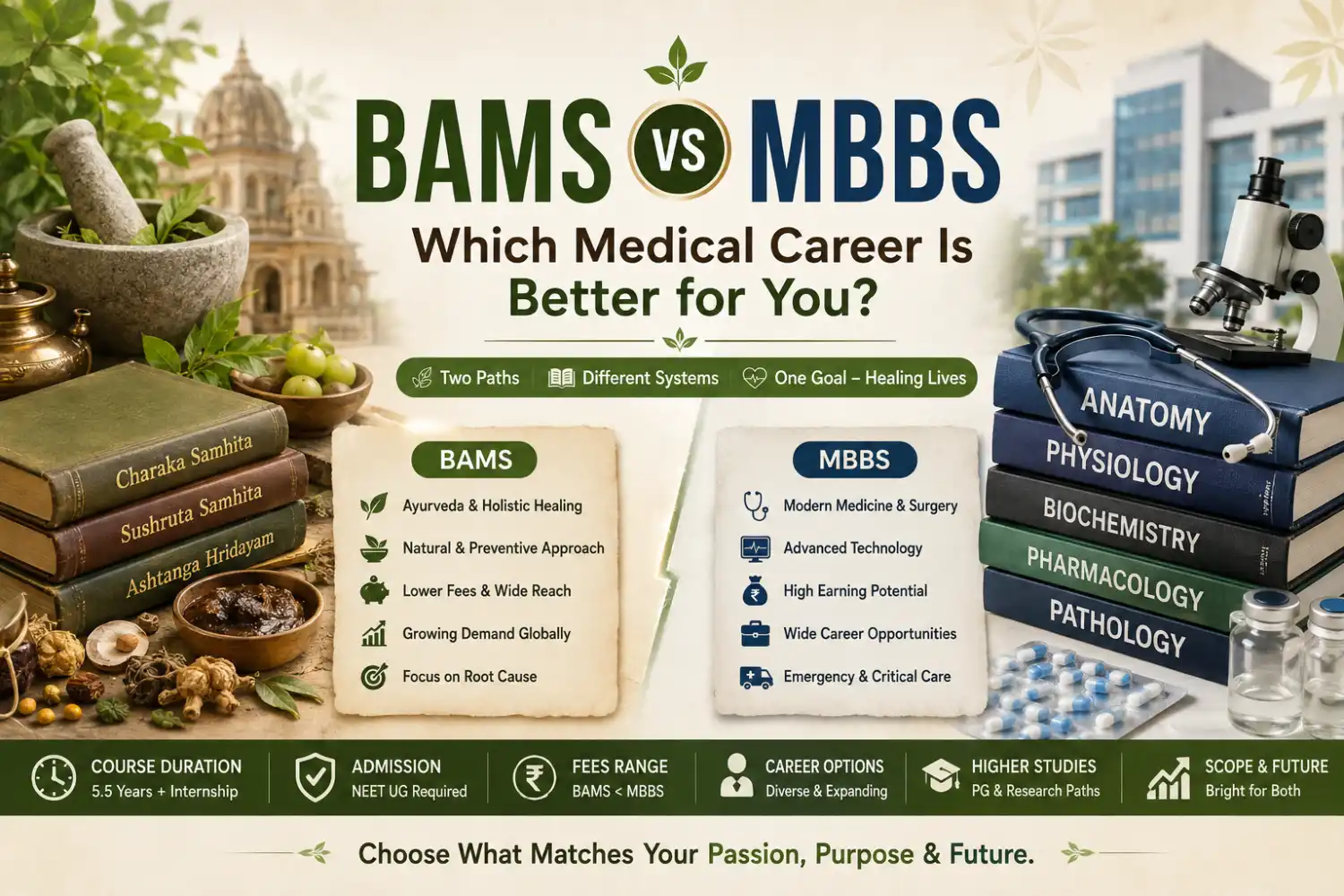
Neither degree is better in the abstract. MBBS trains a doctor in modern medicine and BAMS trains a doctor in Ayurveda. The two work in different systems, under different regulators. MBBS suits a student with a high NEET score, or the money for a private seat. BAMS suits a student who wants a medical licence at a lower score and a much lower fee, and the best private BAMS colleges in India now run teaching hospitals of their own.
Why Do Students Ask This Question Every Single Year?
At some point, most students wonder whether they picked the wrong dream. The NEET result arrives. The score is respectable but not brilliant. Somebody in the family says Ayurveda. Somebody else says take a drop year and try again for MBBS.
That argument plays out in lakhs of homes every summer, and it is rarely settled with facts. It is usually settled by whoever speaks loudest at the dinner table.
The two degrees are not rivals in the way people assume. They train doctors in two different systems of medicine, with different rules, different fees and different working lives afterwards. One is not a consolation prize for the other.
This article puts them side by side using 2026 numbers: seats, competition, fees, postgraduate routes and what a graduate can legally do. It also covers how to shortlist the best private BAMS colleges in India if Ayurveda turns out to be the better fit. No opinions dressed up as advice, just the position as it stands.
What Is the Real Difference Between BAMS and MBBS?
MBBS is a degree in modern medicine, regulated by the National Medical Commission. BAMS is a degree in Ayurveda, regulated by the National Commission for Indian System of Medicine under the Ministry of Ayush. Both are full medical degrees. Both run five and a half years. Both need NEET.
What differs is the science taught, the register a graduate joins, and the work that follows. It is quite common to hear that BAMS is a shorter or easier version of MBBS. That is wrong on both counts.
Table 1: BAMS and MBBS Side by Side
| Point of comparison | BAMS | MBBS |
|---|---|---|
| Full form | Bachelor of Ayurvedic Medicine and Surgery | Bachelor of Medicine and Bachelor of Surgery |
| System of medicine | Ayurveda | Modern medicine |
| Regulator | NCISM, under the Ministry of Ayush | National Medical Commission |
| Course length | 5.5 years, being 4.5 years plus a one-year internship | 5.5 years, being 4.5 years plus a one-year internship |
| Entrance test | NEET UG | NEET UG |
| Counselling bodies | AACCC for All India Quota, state AYUSH authorities for the rest | MCC for All India Quota, state medical authorities for the rest |
| Title on graduation | Ayurvedacharya, registered as an Ayurveda practitioner | Registered medical practitioner |
| Postgraduate entrance | AIAPGET | NEET PG, and INI-CET for institutes of national importance |
Source: NCISM and NMC regulations, and the NTA NEET UG 2026 Information Bulletin.
How Do the Seats and the Competition Compare in 2026?
Both courses draw from the same pool. NEET UG 2026 was re-conducted on 21 June 2026 and the result came on 16 July. Close to 20 lakh students appeared and 11,21,185 qualified. Every one of them is eligible for both MBBS and BAMS counselling.
What separates the two is how far down the merit list each one reaches.
Table 2: Seats and Competition, 2026-27 Session
| Measure | Ayurveda and AYUSH | MBBS |
|---|---|---|
| Candidates qualified in NEET UG 2026 | 11,21,185, the same pool for both courses | 11,21,185, the same pool for both courses |
| Number of colleges | 541 Ayurveda colleges, of which 79 are government and 462 private | 823 medical colleges, excluding AIIMS and JIPMER |
| Undergraduate seats | About 66,288 across BAMS, BHMS, BUMS and BSMS | 1,36,939 |
| Government share of seats | 79 government colleges out of 541 | 63,296 government seats out of 1,36,939 |
| Private share of seats | 462 private colleges out of 541 | 73,643 private seats out of 1,36,939 |
| How far the merit list is reached | Private Ayurveda seats stay open well into the 200s in later rounds | Government seats usually close above 600 for General candidates |
Source: NMC MBBS seat matrix 2026-27 released on 14 July 2026, Ministry of Ayush college data, and the NTA NEET UG 2026 result statement.
Read More: What Is Panchakarma and How Does It Work
What Does This Mean for a Student With an Average Score?
In practical terms, this is where the decision is actually made, whatever anyone says at the dinner table.
A score in the 250 to 400 band rarely reaches a government MBBS seat anywhere in the country. A private MBBS seat at that score is usually available, but at a fee most families cannot carry for five and a half years. The same score opens a wide choice of BAMS private colleges in India through state AYUSH counselling, at a fraction of that cost.
What Does Each Course Actually Cost?
Money decides this question more often than interest does. Families should look at the full five and a half years, not the first-year figure printed in a brochure.
Table 3: Indicative Tuition Fees per Year
| Type of college | BAMS | MBBS |
|---|---|---|
| Government college | About Rs 20,000 to Rs 75,000 a year in most states | Nominal in most states, usually the cheapest medical education available in India |
| Private college, general merit seat | About Rs 1.5 lakh to Rs 3 lakh a year | Several lakhs a year, running much higher at deemed universities |
| Management or NRI quota seat | About Rs 2 lakh to Rs 8 lakh a year | Considerably higher, and often quoted in US dollars for NRI seats |
| Counselling charges | Registration plus a refundable security deposit, set by each state | Registration plus a refundable security deposit, set by MCC or the state |
Source: State AYUSH counselling notifications, Collegedunia fee listings and AYUSH admission portals. The BAMS figures are sourced bands; the MBBS column is described in general terms because private medical fees vary far too widely by state and college to quote a single range. Private fees in both streams are re-approved every year by state fee authorities, so always check the current approved notification.
What Can a Graduate Actually Do After Each Degree?
There is little doubt that this is the part students understand least, and it is the part that matters most.
An MBBS graduate registers with the state medical council and practises modern medicine. A BAMS graduate registers with the state board of Indian medicine and practises Ayurveda. A BAMS graduate is not an MBBS doctor. The clinical scope, including any use of modern medicine, is set by NCISM regulations and by state rules, and those rules differ from state to state.
It is worth noting what this does not mean. It does not mean a BAMS graduate cannot treat patients, admit them, or run a clinic. It means the treatment given is Ayurvedic.
Table 4: Career Routes After Each Degree
| Route | After BAMS | After MBBS |
|---|---|---|
| Independent practice | Ayurveda clinic, Panchakarma centre or wellness practice | General practice in modern medicine |
| Hospital work | AYUSH hospitals and Ayurveda departments | Government and private hospitals across specialties |
| Government service | Medical officer in AYUSH dispensaries and Health and Wellness Centres | Medical officer posts under state and central health services |
| Postgraduate study | MD or MS in Ayurveda through AIAPGET, about 2,274 seats across roughly 250 colleges in the central counselling pool for 2026-27 | MD, MS or DNB through NEET PG, with INI-CET for AIIMS and similar institutes |
| Industry | Ayurvedic pharmaceutical companies, product development and quality control | Pharmaceutical and device industry, clinical research |
| Teaching and research | Ayurveda colleges and central research councils | Medical colleges and research institutes |
Source: NCISM and NMC practice regulations, AACCC postgraduate counselling notices and AIAPGET 2026 seat data. State rules on clinical scope vary, so students should check the position in the state where they intend to practise.
So Which One Is Better for You in 2026?
The honest answer is that it depends on the score, the money and the kind of medicine a student actually wants to practise. Looking at the broader picture, the table below covers most real cases.
Table 5: Which Course Usually Fits Which Student
| If this describes the student | The better fit is usually |
|---|---|
| NEET score above 600 and aiming at a government medical college | MBBS |
| Family able to fund a private MBBS seat for five and a half years | MBBS |
| Set on surgery or a hospital speciality in modern medicine | MBBS, even if that means another attempt |
| Score between 200 and 400, and unwilling to lose a year | BAMS |
| Wants a medical licence without a very large education loan | BAMS |
| Drawn to herbal pharmacology, Panchakarma and preventive care | BAMS |
| Planning a career in wellness, Ayurvedic products or AYUSH public health | BAMS |
| Undecided, and willing to take a drop year on the chance of MBBS | Weigh the cost of a lost year against a confirmed Ayurveda seat |
Source: Based on NCISM and NMC eligibility rules, the 2026-27 seat and fee data above, and published closing-score trends from earlier counselling cycles.
Read More: Understanding Dosha Balance in Kayachikitsa
How Should a Student Shortlist the Best Private BAMS Colleges in India?
Once Ayurveda is the decision, the college becomes the bigger question, not the course. No government body publishes an official ranked list of the best private BAMS colleges in India. NCISM permits and regulates colleges but does not rank them, and NIRF has no Ayurveda category. Every ranking a student reads online is somebody’s opinion.
What can be checked is far more useful. Ask any experienced practitioner and they will tell you the same thing: the difference between a strong Ayurveda college and a weak one is the hospital attached to it.
- Current NCISM permission for the running session, which can be checked on ncismindia.org in a few minutes.
- The affiliating university, because the degree is awarded by the university and not by the college.
- The size of the attached teaching hospital and the number of beds in actual use.
- Daily OPD numbers, which decide how many real cases a student sees before the internship year.
- Fourteen working departments, the number needed to cover the full BAMS syllabus.
- Full-time teaching faculty strength against the sanctioned intake.
- A functioning Panchakarma unit, since Panchakarma is a core clinical skill and a major earner later.
- The approved fee notification for the current session, rather than a figure quoted verbally.
Why Choose DJ Ayurvedic Medical College and Hospital?
Divya Jyoti Ayurvedic Medical College and Hospital sits on the DJ Group campus at Niwari Road, Modinagar, in Ghaziabad district, inside the Delhi NCR belt. It is approved by NCISM and affiliated to Mahayogi Guru Gorakhnath AYUSH University, and its published intake disclosure lists 100 sanctioned BAMS seats.
The order in which it was built is the point. The hospital opened in 2012 and the college followed in 2017, so teaching was arranged around a hospital that was already treating patients.
- Ranked first in UP AYUSH counselling for two consecutive years, in 2023 and 2024, as stated by the college.
- One hundred sanctioned BAMS seats, as listed in the intake capacity disclosure.
- A teaching hospital with over 100 beds, running full OPD and IPD services on the same campus.
- Around 200 patients in the OPD every day, so students see real cases from the early years.
- Fourteen specialised departments and over 10 specialised clinics covering skin, joint and paediatric care.
- A Panchakarma centre with over 10 therapy rooms and eight certified therapists.
- Over 110 teaching faculty members handling academic and clinical mentoring.
- Over 500 graduates working in hospitals, wellness centres and research bodies, including Yashoda Hospital, Felix Hospital, Patanjali, Sri Sri Tattva and IMS BHU.
- Research published in peer-reviewed journals such as Annals of Ayurvedic Medicine and Aryavaidyan, backed by a dedicated research and entrepreneurship development cell.
- Study visits to the All India Institute of Ayurveda, New Delhi and to PCIM and H.
- A herbal garden, working laboratories, a digital library and a learning management system.
- Over 10 free medical camps a year, serving above 5,000 people in nearby communities.
Judged on the checklist above rather than on a brochure, this is the kind of college that belongs on a serious shortlist of the best private BAMS colleges in India.
Conclusion
BAMS against MBBS is the wrong way to frame the question. The better question is which system of medicine a student wants to practise, and what their score and their family budget will actually reach in 2026.
A student with a strong score and the means for a good seat should take MBBS. A student holding a qualified but modest score has a real medical career waiting in Ayurveda, at a cost a normal family can manage, and without losing a year to another attempt.
It would not be wrong to say that the students who regret their choice are rarely the ones who chose Ayurveda. They are the ones who chose a college without a hospital. Pick the system first, then judge the best private BAMS colleges in India on the things that can be verified, and the decision stops being a gamble.
Frequently Asked Questions
Neither is better in general terms. MBBS trains a doctor in modern medicine and BAMS trains a doctor in Ayurveda. They are separate systems with separate regulators and registers. The right choice depends on the student's NEET score, family budget and the kind of medicine they want to practise.
Yes. BAMS is a full undergraduate medical degree regulated by the National Commission for Indian System of Medicine under the Ministry of Ayush. It runs 5.5 years, needs NEET UG, and a graduate registers with the state board of Indian medicine and practises as an Ayurveda doctor.
A BAMS graduate is an Ayurveda practitioner, not an MBBS doctor. The clinical scope, including any use of modern medicine, is governed by NCISM regulations and by state rules, and those rules differ from state to state. Students should check the position in the state where they plan to practise.
MBBS has more seats. The NMC seat matrix for 2026-27 lists 1,36,939 MBBS seats across 823 colleges, excluding AIIMS and JIPMER. AYUSH undergraduate courses together offer about 66,288 seats, and Ayurveda accounts for the largest share of those.
Usually, yes, and by a wide margin at the private end. Private Ayurveda colleges commonly charge about Rs 1.5 lakh to Rs 3 lakh a year in tuition, while private medical college fees run several times higher. Government seats in both streams are inexpensive but very hard to obtain.
Both need the same qualifying percentile, which was 715 to 213 marks for General and EWS candidates in NEET UG 2026. The difference is at the admission stage. Government MBBS seats usually close above 600 marks, while private Ayurveda seats have stayed open well into the 200s in later counselling rounds.
Yes. BAMS graduates sit for AIAPGET, the All India AYUSH Post Graduate Entrance Test conducted by NTA, and can take an MD or MS in Ayurveda. About 2,274 seats across roughly 250 colleges sit in the central counselling pool for 2026-27, with further seats under state quotas.
The demand side has grown considerably. India has over 7,55,780 registered AYUSH practitioners, 3,859 AYUSH hospitals and 8,168 AYUSH Health and Wellness Centres, and the AYUSH market grew from USD 2.85 billion in 2014 to USD 43.4 billion in 2023. The career is real, provided the training is.
There is no official ranking, so judge on verifiable facts: current NCISM permission, the affiliating university, the size of the attached teaching hospital, daily OPD numbers, whether all fourteen departments are running, faculty strength, a working Panchakarma unit and the approved fee notification.
There is no transfer route between the two courses. A student who wants MBBS after starting BAMS has to appear for NEET UG again and enter through counselling as a fresh candidate. This is why the decision is worth making carefully in the first year rather than the third.
Related Blogs
Sinusitis Cure in Ayurveda: Shalakya Tantra Guide
INTRODUCTION Current healthcare data suggests that chronic sinusitis impacts over 30 million individuals annually, creating…
Can You Put ‘Dr’ After Studying at an Ayurveda Institute in Delhi?
Yes, but only if the course is a full BAMS degree. A graduate of an…
What Is Panchakarma and How Does It Work
Panchakarma is a structured system of five Ayurvedic cleansing procedures designed to remove accumulated toxins,…
Does a Gap Year Affect Your Ayurvedic Course Eligibility? Full BAMS Guide
A gap year does not lower ayurvedic course eligibility for BAMS admission in India. NCISM…
Re-NEET UG Result 2026 Out: Know Toppers, Cut-Offs and Your BAMS Admission Roadmap
The Re-NEET UG Result 2026 is out. The National Testing Agency declared it on 16…
Is BAMS Better Than Other AYUSH Courses?
Is BAMS better than other AYUSH courses? For most NEET students, yes. BAMS (Bachelor of…