
Scope and Career After a BAMS Degree in India: What the Top Ayurvedic Courses in Delhi Lead To
Home / BAMS / Scope and Career After a BAMS Degree in India: What the Top Ayurvedic Courses in Delhi Lead To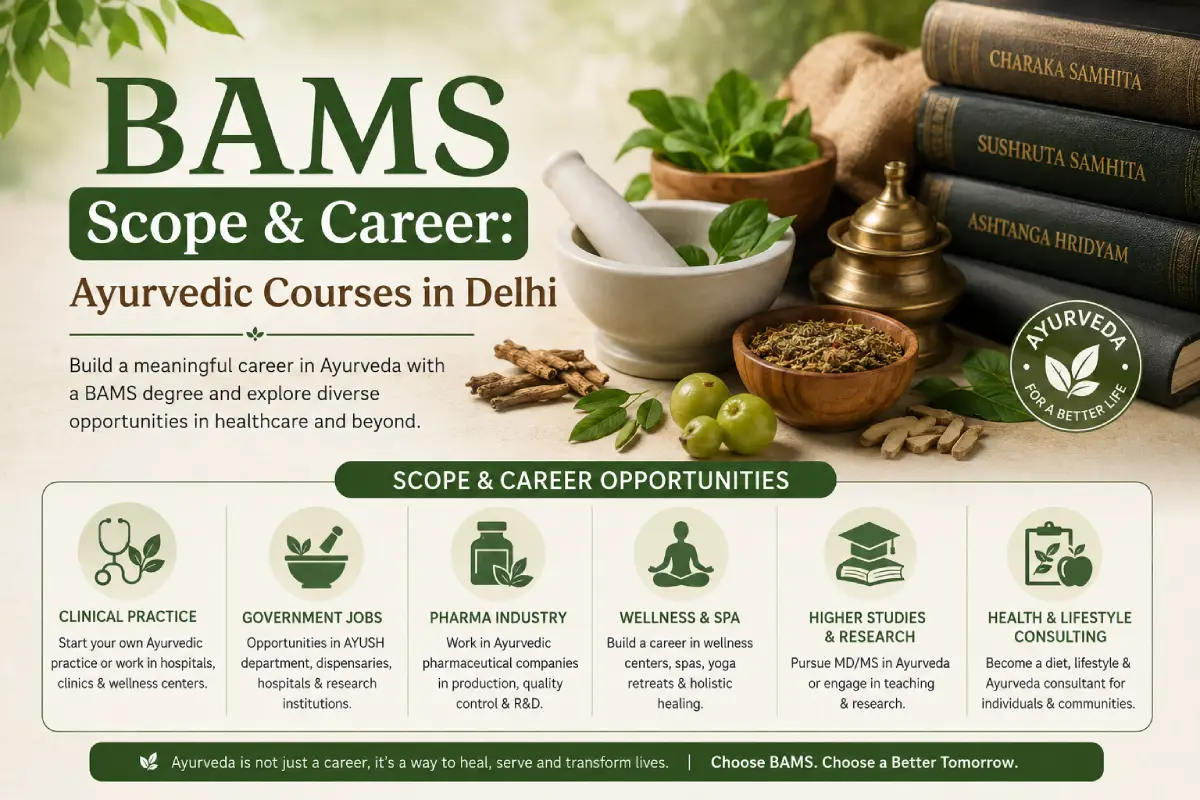
A BAMS degree, the Bachelor of Ayurvedic Medicine and Surgery, qualifies a graduate to practise as a registered Ayurvedic physician in India and opens a wide field of work across clinics, hospitals, government health services, the pharmaceutical industry, wellness, research, and academics.
This guide explains the full scope of Ayurveda as a career, the higher study options that follow the degree, indicative earnings, and the admission route through NEET and AYUSH counselling. It is an important insight for students comparing ayurvedic courses in Delhi and across the country.
BAMS Courses- Key facts at a glance
- BAMS is a 5.5 year professional degree, made up of 4.5 years of academic study and a compulsory one year rotating internship.
- Admission requires a pass in Class 12 with Physics, Chemistry, and Biology, a qualifying NEET-UG score, and a seat through AYUSH counselling.
- On registration, a BAMS graduate may practise as an Ayurvedic doctor, often addressed as a Vaidya, across India.
- The AYUSH sector, led by Ayurveda, was valued at about 18.1 billion US dollars in 2020 to 2021 according to a Ministry of AYUSH cited report, and continues to grow.
- Career routes include clinical practice, government AYUSH service, pharmaceuticals, wellness and medical tourism, research, and teaching.
- Higher study options include an MD or MS in Ayurveda through the AIAPGET, as well as public health, management, and research pathways.
What is a BAMS degree, and what does it qualify you to do?
BAMS, the Bachelor of Ayurvedic Medicine and Surgery, is the recognised undergraduate medical degree in Ayurveda in India. On completion and registration, the holder becomes a qualified Ayurvedic physician, often addressed as a Vaidya, and is entitled to practise Ayurvedic medicine, prescribe Ayurvedic formulations, and work within the wider AYUSH system of healthcare.
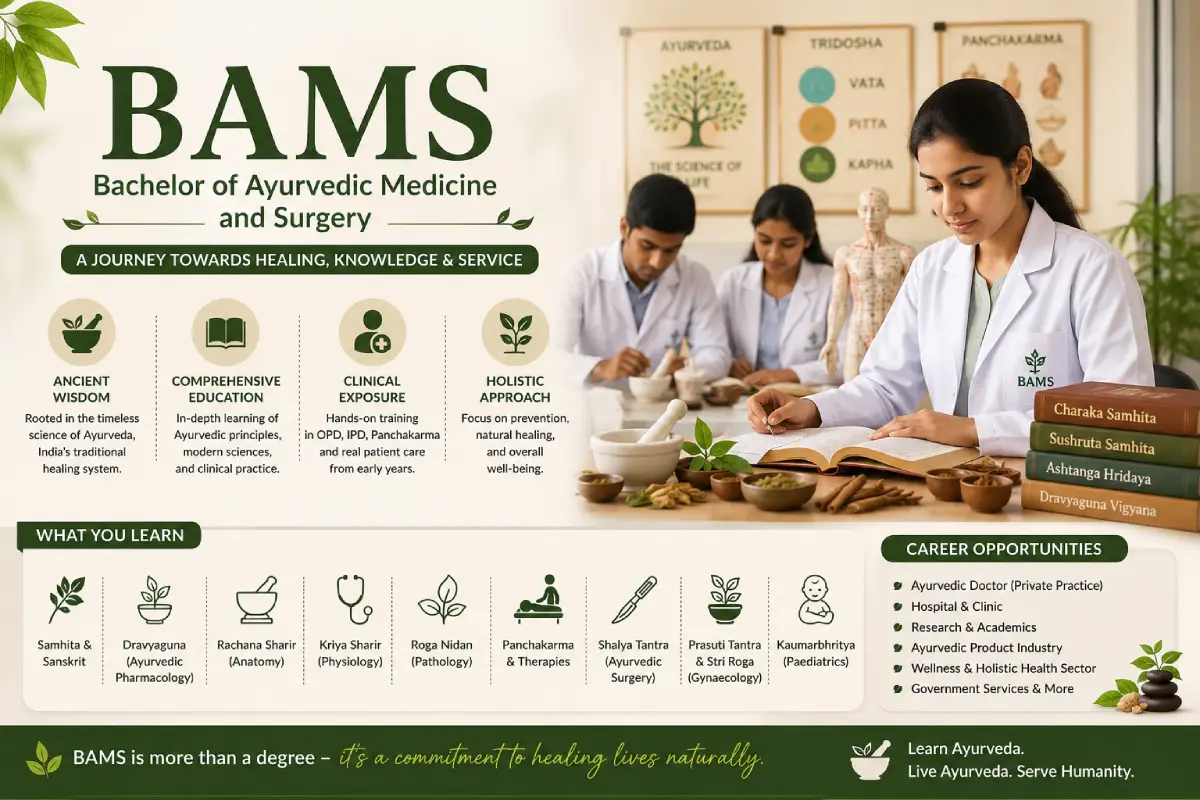
The course is built on the classical Ayurvedic canon, principally the Charaka Samhita, the Sushruta Samhita, and the Ashtanga Hridaya, taught alongside modern anatomy, physiology, pathology, and clinical methods. Students learn the theory of the three doshas, Vata (the bioenergy governing movement), Pitta (governing metabolism and transformation), and Kapha (governing structure and cohesion), together with concepts such as agni (the digestive and metabolic fire), dhatu (the body tissues), and srotas (the channels of circulation). The five and a half year structure includes a compulsory rotating internship in which students treat patients in outpatient and inpatient settings under supervision.
A point on practice rights. A BAMS graduate is a qualified practitioner of Ayurveda, not an MBBS doctor. The clinical scope, including any use of modern medicine, is governed by NCISM regulations and by state rules, which vary across the country.
What is the scope of Ayurveda as a profession in India today?
The scope of Ayurveda in India is broad and expanding, supported by a large public AYUSH infrastructure, rising demand for natural and preventive healthcare, and active government promotion.
- India has a sizeable AYUSH network of undergraduate and postgraduate colleges, thousands of AYUSH hospitals, tens of thousands of dispensaries, and a growing number of Health and Wellness Centres, according to Invest India.
- The AYUSH industry was valued at about 18.1 billion US dollars in 2020 to 2021 in a report cited by the Ministry of AYUSH, having grown at roughly 17 percent a year through the previous decade.
- Ayurveda is recognised as a system of medicine in more than thirty countries, and the World Health Organization has established its Global Centre for Traditional Medicine in Jamnagar, Gujarat.
- Government schemes such as the National AYUSH Mission, and the inclusion of AYUSH treatment packages within Ayushman Bharat, are widening the public role of Ayurveda.
For a graduate, this means entering a profession with several distinct demand pools at once: public sector employment, private practice, a maturing herbal and Ayurvedic products industry, and an export and wellness tourism market that continues to open up.
Disclaimer: this article is educational. Ayurvedic treatment should be taken under a qualified registered Ayurvedic practitioner and is not a substitute for professional medical advice.
What are the main career paths after a BAMS degree?
A BAMS degree leads to far more than private clinical practice. Graduates move into hospitals, government service, industry, wellness, research, and teaching, and many combine two or three of these over a career. The table below sets out the principal routes.
| Career path | What the role involves | Typical settings |
|---|---|---|
| Ayurvedic physician (Vaidya) | Diagnosing and treating patients with Ayurvedic medicine, diet, and lifestyle guidance | Own clinic, group practice |
| Hospital medical officer | Patient care, ward and outpatient duties, and supporting clinical teams | Ayurvedic and integrative hospitals |
| Government AYUSH service | Delivering public healthcare as an AYUSH medical officer | State health departments, National Health Mission, dispensaries, Health and Wellness Centres |
| Panchakarma specialist | Planning and supervising detoxification and therapeutic procedures | Panchakarma units, wellness hospitals |
| Pharmaceutical and product roles | Formulation, quality, medical affairs, and drug development | Ayurvedic and herbal manufacturers |
| Wellness and medical tourism | Consultation and therapy design for preventive care | Spas, resorts, wellness chains, medical tourism |
| Academics and teaching | Teaching BAMS subjects and guiding clinical training, a postgraduate degree is required | Ayurvedic colleges and universities |
| Research | Clinical and pharmacological research in Ayurveda | CCRAS, universities, research institutes |
| Entrepreneurship | Building a clinic, wellness brand, or Ayurvedic product line | Independent ventures |
| Medical writing and communication | Health content, documentation, and regulatory writing | Publishing, agencies, industry |
What government jobs can a BAMS graduate apply for?
BAMS graduates are eligible for a range of government roles within the AYUSH and public health system. These posts offer stability, fixed pay scales, and a clear path of seniority, and they are a common first choice for new graduates.
- AYUSH Medical Officer in state health services and under the National Health Mission, posted to district hospitals, dispensaries, and Health and Wellness Centres.
- Medical officer posts in organisations such as ESIC, the railways, and the defence services, and in central health schemes that include AYUSH provision.
- Teaching posts in government Ayurvedic colleges, which usually require a postgraduate qualification.
- Research positions under the Central Council for Research in Ayurvedic Sciences, the CCRAS, and allied bodies.
- Drug inspector and regulatory roles connected to Ayurvedic, Siddha, and Unani drugs, and posts in public sector undertakings and municipal health.
Recruitment is usually through a state Public Service Commission, National Health Mission notifications, or central examinations. Exact pay scales and eligibility differ by notification and state, so confirm the current details before applying.
What higher education options follow a BAMS degree?
The most direct route is an MD or MS in Ayurveda through the All India Ayush Post Graduate Entrance Test, the AIAPGET, but BAMS graduates also branch into public health, management, clinical research, and doctoral study. Postgraduate qualification raises both clinical authority and earning potential.
| Pathway | Route or entrance | Indicative duration | Where it leads |
|---|---|---|---|
| MD or MS in Ayurveda | AIAPGET, then AYUSH PG counselling | 3 years | Specialist practice, teaching, research |
| PG diploma in an Ayurveda speciality | Institution specific | 1 to 2 years | Focused clinical skills |
| Master of Public Health (MPH) | University admission | 2 years | Public health, programme management |
| MBA or hospital management | Entrance or merit | 2 years | Healthcare administration and operations |
| MSc in Yoga, nutrition, or clinical research | University admission | 2 years | Allied clinical and research roles |
| Fellowships and certifications, such as Panchakarma or Ksharasutra | Institution specific | Months to 1 year | Procedural specialisation |
| PhD in Ayurveda | After PG, university research | 3 years and above | Academics and senior research |
How much can a BAMS doctor earn in India?
Earnings vary widely by role, location, experience, and whether the graduate is in private practice, salaried employment, or government service. The figures below are indicative ranges to set expectations, not guarantees.
| Stage or setting | Indicative annual range (INR) | Notes |
|---|---|---|
| Fresh graduate in salaried roles, such as resident or duty medical officer | About 6 to 8.5 lakh, a figure published on the DJ Ayurveda College BAMS page | Early income for new private practice can be lower and grows with the patient base |
| Experienced practitioner or specialist | 10 lakh and above, per the same college source | Rises with postgraduate qualification, specialisation, and reputation |
| Government AYUSH Medical Officer | As per the applicable state or central pay scale | Fixed scale with allowances, confirm the current level |
| Ayurvedic pharmaceutical or wellness industry | Varies by role and employer | Medical affairs, research and development, quality, and product roles |
| Academic or research, after PG | As per the institutional or linked pay scale | Teaching and research positions |
Two honest caveats are worth stating. First, private practice income is modest in the early years and builds as a reputation forms, while government roles follow fixed scales from the start. Second, a postgraduate qualification, a clinical speciality, and a strong local reputation are the factors that move earnings upward over time.
What are the eligibility and admission steps for ayurvedic courses in Delhi and across India?
Admission to ayurvedic courses in Delhi and across India follows a single national route built around NEET and AYUSH counselling. The eligibility requirements are summarised below, followed by the step by step process.
| Requirement | Detail |
|---|---|
| Academic qualification | A pass in Class 12 with Physics, Chemistry, and Biology, with a minimum aggregate commonly around 50 percent and relaxation for reserved categories |
| Entrance examination | A qualifying score in NEET-UG is mandatory across India |
| Counselling | Seat allotment through AYUSH counselling, conducted by the AYUSH Admissions Central Counselling Committee for central and all India quota seats, and by states for state quota seats |
| Minimum age | Usually 17 years by the prescribed cut off date |
| Mode and duration | Full time, 5.5 years including the one year internship |
| Documents | NEET scorecard, Class 10 and 12 certificates, identity and category proof, and other documents as specified |
The admission process, step by step
- Pass Class 12 with Physics, Chemistry, and Biology.
- Appear for and qualify NEET-UG.
- Register for AYUSH counselling, either central or state, depending on the quota you are seeking.
- Complete choice filling and accept the seat allotted on the basis of rank, category, and preferences.
- Attend document verification and confirm admission at the allotted college.
- Begin the 5.5 year BAMS programme, including the final internship year.
What should you look for in the top ayurvedic courses in Delhi NCR?
The strongest ayurvedic courses combine NCISM recognition, university affiliation, an active teaching hospital, qualified faculty, and genuine clinical exposure. Use the checklist below to compare institutions rather than relying on prospectus claims alone.
| Factor to evaluate | Why it matters |
|---|---|
| NCISM recognition and university affiliation | Confirms the degree is valid and the graduate can register and practise |
| Teaching hospital with OPD and IPD | Real patient exposure is essential to clinical competence |
| Departments across fundamentals, clinical sciences, and therapeutics | A complete department structure supports thorough training |
| Faculty strength and student to faculty ratio | Closer supervision improves learning and clinical confidence |
| Panchakarma and laboratory facilities | Hands on therapeutic and diagnostic practice |
| Quality of the internship year | The internship shapes practical readiness for the first role |
| Placement support and alumni network | Helps with the first job and longer term opportunities |
| Research culture | Indicates academic depth and exposure to evidence based study |
One practical note on geography. The Delhi National Capital Region includes Delhi itself and the surrounding districts of Ghaziabad, Gautam Buddh Nagar, which covers Noida, Faridabad, and Gurugram. Many students who search for ayurvedic courses in Delhi are, in practice, willing to study at a well equipped college anywhere in this region.
Related Blogs
Is BAMS Better Than Other AYUSH Courses?
Is BAMS better than other AYUSH courses? For most NEET students, yes. BAMS (Bachelor of…
Panchamahabhuta: The Five Elements Behind Ayurvedic Medicine
Panchamahabhuta refers to the five great elements that Ayurveda regards as the building blocks of…
The Three Doshas Explained for Beginners: A Foundation at the Top BAMS Colleges in India
The three doshas, Vata, Pitta and Kapha, are the three functional energies that Ayurveda uses…
What Can You Do After BAMS? 10 Career Options for Ayurveda Graduates from the Best Private BAMS Colleges in UP
What can you do after BAMS? A BAMS graduate can work as an Ayurvedic physician,…
Can You Put ‘Dr’ After Studying at an Ayurveda Institute in Delhi?
Yes, but only if the course is a full BAMS degree. A graduate of an…
NEET UG 2026 and Your Path to a Bachelor Degree in Ayurvedic Medicine: Everything You Need to Know
So, you’ve decided to heal people the way your ancestors did — using nature, science,…