
Shalya Tantra and Shalakya Tantra: Understanding Two Important Ayurveda Specialisations
Home / BAMS / Shalya Tantra and Shalakya Tantra: Understanding Two Important Ayurveda Specialisations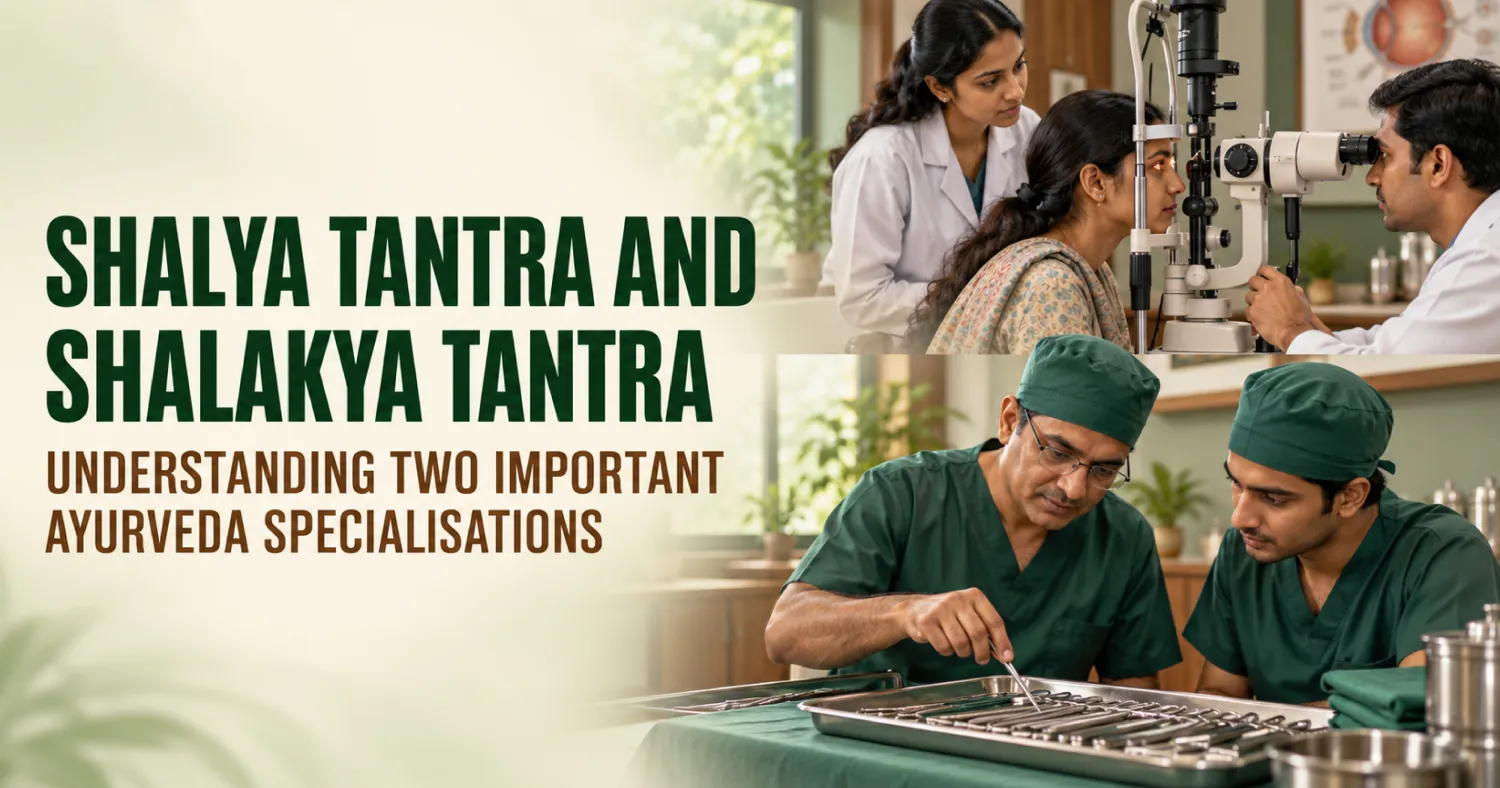
Shalya Tantra is the surgical branch of Ayurveda. Shalakya Tantra looks after the head and neck, including the eyes, ears, nose, throat, mouth and teeth. Both subjects are taught in the third professional year of the 5.5-year BAMS course. Students at BAMS private colleges in UP learn them through lectures, practicals and hospital work.
Introduction
One question that often comes up is how Shalya Tantra differs from Shalakya Tantra. The names sound alike, and both belong to Ayurveda. So many students feel confused at first.
This guide keeps things simple. It explains what each subject covers, how the teaching hours are split and what career paths they open.
Students who are choosing between BAMS private colleges in UP should understand both subjects early. DJ Ayurveda College in Modinagar, Ghaziabad, is one such college. It was established in 2017, and its hospital was founded in 2012. The college says it ranked No. 1 in UP AYUSH Counselling in both 2023 and 2024.
Shalya Tantra in BAMS private colleges in UP
Shalya Tantra is the surgical side of Ayurveda. The National Commission for Indian System of Medicine (NCISM) describes it as an ancient Indian science of surgery. It deals with surgical problems and with the care that patients need before and after surgery.
- Wounds, ulcers, swellings, fistulas and piles
- Wound dressing, bandaging and the use of surgical instruments
- Care before and after an operation
- Knowing when surgery is needed and when it is not
Shalya Tantra syllabus at BAMS private colleges in UP
The NCISM curriculum gives Shalya Tantra 375 teaching hours. Lectures make up 125 of those hours.
- Paper I covers the basics, such as the meaning of Shalya and the history of Shalya Tantra.
- Later units move to surgical conditions and their treatment.
- The remaining hours go to non-lecture and practical work.
Hospital training in BAMS private colleges in UP
Students learn best when they see real patients. At DJ Ayurveda College:
- The teaching hospital has over 100 beds, with full OPD and IPD services.
- More than 200 patients visit the OPD every day.
- Students observe these cases under faculty guidance.
Shalakya Tantra in BAMS private colleges in UP
Shalakya Tantra focuses on diseases of the head and neck. NCISM groups it under three areas: Ophthalmology, Oto-Rhino-Laryngology (ENT) and Oro-Dentistry. The curriculum gives it 300 teaching hours, with 100 of them as lectures.
Eyes, ears, nose, throat and teeth
- Eyes (Netra): common eye diseases and their treatment
- Ears (Karna): ear problems and hearing issues
- Nose (Nasa): nasal and sinus conditions
- Throat (Kantha): throat disorders and voice problems
- Mouth and teeth (Mukha and Danta): oral health and dental care
Shalya and Shalakya at a glance
The table below compares both subjects using NCISM figures. These hours come from the NCISM curriculum documents that apply from the 2021-22 batch.
| Point | Shalya Tantra | Shalakya Tantra |
|---|---|---|
| Main focus | Surgery and surgical care | Head and neck diseases |
| Areas covered | General surgery | Ophthalmology, ENT, Oro-dentistry |
| Total teaching hours | 375 | 300 |
| Lecture hours | 125 | 100 |
| Year of study | Third professional BAMS | Third professional BAMS |
Read More: Sinusitis Cure in Ayurveda: Shalakya Tantra Guide
How the BAMS course is built
The BAMS course runs for 5.5 years. Both subjects fit inside that time.
| Part of the course | Length |
|---|---|
| Academic study | 4.5 years |
| Compulsory rotatory internship | 1 year |
| Full course | 5.5 years (about 66 months) |
What to check when comparing colleges
Students can compare colleges with a short checklist. The figures below come from DJ Ayurveda College’s own website, so they are self-reported.
| What to check | Why it matters | DJ Ayurveda College reports |
|---|---|---|
| NCISM approval | Shows the course follows national rules | Approved by NCISM |
| Teaching hospital | Gives students real cases to learn from | 100+ beds with OPD and IPD |
| Daily OPD | Shows how many patients students see | 200+ patients a day |
| Faculty | Gives guidance and mentoring | 110+ faculty members |
| Departments | Shows how wide the training is | 14 specialised departments |
| Placement support | Helps graduates find jobs | 500+ graduates placed |
Conclusion
Shalya Tantra and Shalakya Tantra are two different branches of Ayurveda. One deals with surgery. The other looks after the head and neck. Students who choose BAMS private colleges in UP can study both through classroom teaching and daily hospital work. Before picking a college, students and parents should check NCISM approval, hospital size and placement support. A short checklist makes the decision easier.
Frequently Asked Questions
It is the surgical branch of Ayurveda. It deals with wounds, ulcers, fistulas, piles and other problems that may need surgical care.
It is the branch of Ayurveda that deals with diseases of the head and neck. That includes the eyes, ears, nose, throat, mouth and teeth.
Yes. The NCISM curriculum lists both as subjects in the third professional year.
The NCISM curriculum lists 375 teaching hours, with 125 of them as lectures.
The NCISM curriculum lists 300 teaching hours, with 100 of them as lectures.
It lasts 5.5 years. That includes 4.5 years of academic study and one year of compulsory internship.
Neither subject is easy. Shalya Tantra needs strong surgical understanding, while Shalakya Tantra needs careful study of small organs. Many students find the subject they enjoy more manageable.
Graduates can work in hospitals, clinics, wellness centres and research units. Some students go on to a postgraduate MS course in one of these branches.
The course teaches surgical principles. The legal scope of practice is set by government rules, so students should check the current rules before planning a surgical career.
Yes. The college lists Shalya Tantra among its 14 specialised departments and holds CME workshops on the subject. Students should check the latest department list on the college website.
Related Blogs
Ayurveda in the Age of AI – How Technology is Changing BAMS Careers
When you think of courses after BAMS, what comes to mind, traditional specializations, or something…
How NEP 2020 Is Transforming Ayurvedic Education in India
Education in India has been changing faster than we can keep track of. But for…
Why Ayurveda Courses Are Attracting Students from All Medical Backgrounds
In the rapidly changing world of healthcare today, there is one compelling trend that cannot…
Ancient Roots, Modern Careers: Exploring Opportunities at BAMS Colleges in Uttar Pradesh
When you hear about Ayurveda and career, what do you think of? Maybe century-old treatments,…
Kayachikitsa in Ayurveda: Career Scope and Opportunities from an Ayurvedic Medical College in Delhi NCR
What is Kayachikitsa, and what career follows after BAMS? Kayachikitsa is the general medicine branch…
How WHO’s Push for Traditional Medicine is Influencing Ayurveda Courses in India
If you have ever thought about studying Ayurveda, you might have noticed that the conversation…